

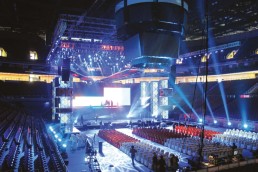
Star Live: Retrofitting Mothergrids In Legacy Venues
When the roof is the limiting factor: Retrofitting Mothergrids in Legacy venues
Today’s multi-use venues are under increasing pressure to maximise event density. Calendar gaps are lost revenue. Rapid changeover is no longer a bonus – it is expected.
But for many established venues, the constraint is not the pitch, the bowl, or the hospitality offer. It’s what’s above the stage area.
In the current touring landscape, roof capacity and ease of rigging are often the first criteria assessed during venue selection. If a venue cannot confidently demonstrate sufficient rigging capability in terms of capacity and feasibility, it may struggle to remain in contention for major touring productions.
Legacy assumptions vs modern demand
Many venue roofs were never designed with today’s touring demands in mind. In many cases, they were conceived purely for sport, with little consideration for concert rigging; in others, they were engineered for live events, but at a time when production loads were far lighter and less complex. Contemporary tours now bring together large-format LED walls, extensive dynamic lighting arrangements, powerful line array audio systems and broadcast infrastructure, creating loads that are not only heavier but far more concentrated.
In practical terms, this demands rigging systems that can transfer significant forces efficiently back to the primary structure. In many large sports venues, available strong points can be up to 12 metres (40 ft) apart and, in some cases, difficult to access. The challenge is no longer simply one of weight, but of how that load is safely and effectively transferred.
Read the full article from ISSUE 47 below: