

Why interoperability is the real MVP of sports and entertainment venues
By Ian Godfrey, CTO, TSL
For major stadia and arena venues, the audience experience is defined as much by spectacle as by sport. And meeting those ever-increasing levels of expectation depends on complex technology stacks working seamlessly in the background.
Modern venues are no longer just event spaces; they are now complex, multi-layered production environments. In many ways they resemble full-scale broadcast facilities that need to be capable of supporting everything from live sports and concerts to global live media distribution, often within the same operational window.
As a result, the challenge facing venue operators is no longer simply deploying more technology, but instead, how to make increasingly diverse and distributed systems work together as a coherent whole.
Managing increasing in-venue complexity
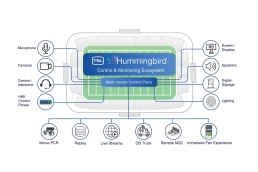
Venue AV and technical teams are now managing a vast ecosystem of technologies: broadcast infrastructure (in-venue, connecting to OB providers and specific feeds for tenants/franchises/artists’ live streams etc), AV systems, lighting, graphics engines, replay platforms, digital signage networks are only the start. Systems are sourced from different vendors, each with its own control protocols, interfaces, and operational logic.
Historically, audio and video domains were tightly coupled, often delivered as part of vertically integrated systems where signal transport and control logic were closely linked. That model worked when venues supported a narrower range of use cases and technologies evolved at a slower, more linear pace.
Read the full article from ISSUE 47 below: