

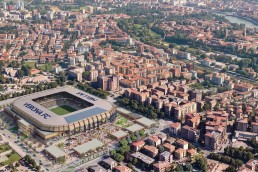
Hellas Verona Submit Stadium Plans to City of Verona
Hellas Verona FC has submitted the Feasibility Document for Project Alternatives (DOCFAP) to the Municipality of Verona, formally initiating the process provided for under Italy’s Stadium Law and setting out the Club’s plan for Verona’s new 30,000-seat stadium. The new venue will create a world-class atmosphere by bringing fans closer to the pitch, ensuring full accessibility, and providing top-tier stadium hospitality and facilities.
In line with the Urban Planning Document issued by the Municipality of Verona, Hellas Verona FC has developed a comprehensive proposal to demolish the existing Bentegodi Stadium and construct a new venue on the same site. If approved, the new stadium will meet the requirements to host matches during UEFA Euro 2032. The plan also includes a temporary stadium in the immediate vicinity, allowing the Club to continue playing its home matches in Verona throughout the construction period.
Several alternatives to the proposed project were thoroughly assessed, including retaining the existing stadium, redeveloping it, and relocating the entire project to another area of the city. Following this analysis, the demolition of the Bentegodi and construction of a new stadium on the same site was identified as offering the strongest overall balance of community benefit, feasibility, and timing, while also aligning with the Municipality’s urban planning objectives.
Supporter feedback has also played an important role in the development of the proposal. Through the Club’s recent fan survey, Hellas Verona has sought to understand the priorities of its supporters and reflect those views in the development of the new stadium project.
The analysis also covered technical, functional, economic and financial, environmental, and urban-planning considerations and was carried out with the support of a specialist advisory team comprising Gensler, Sportium, iDEAS, Arup, GAD, KPMG, Linklaters, and Studio Inzaghi, under the coordination of Colliers as project manager.
The proposal, now under assessment by the Municipality of Verona, represents a gross investment of nearly €300 million. The project is expected to be financed primarily through private investment by the Club’s ownership, together with public participation in certain elements of the project at a level broadly consistent with comparable stadium developments. The objective is to transform the existing stadium into a modern, accessible, and multifunctional venue capable of operating well beyond matchdays and generating long-term economic and social benefits for Verona. Independent analysis submitted as part of the proposal indicates that the project would support thousands of job-years during construction and generate substantial recurring economic activity, added value, and employment once operational.
The project is designed to make the stadium an integral part of the life of the city, rather than a venue used primarily on matchdays. Restaurants, retail, corporate events, concerts, and other activities would create a year-round destination, bringing people to the area throughout the week and extending the stadium’s economic and social impact well beyond the football calendar. The development would also provide an opportunity to enhance the surrounding area, creating a more active, connected, and attractive destination for supporters, residents, and visitors alike.
At the same time, the new stadium represents an investment in the long-term future of Hellas Verona FC. Beyond traditional matchday revenues, the venue would enable the Club to develop new and diversified revenue streams through hospitality, sponsorship, non-football events, the Club museum, and stadium tours. This broader and more resilient revenue base would strengthen the Club’s financial sustainability and support its long-term sporting competitiveness.
A further key element of the project is ensuring continuity of the Club’s sporting activities throughout the approximately three-year construction period. Based on the current project timeline, completion of the new stadium is targeted for the 2031/32 season, subject to the necessary approvals and subsequent phases of the development process. To allow Hellas Verona to continue playing in the city during this time, the plan provides for the temporary expansion of the existing Olivieri facility in Via Sogare and improvements to the surrounding areas.
The investment would ultimately create a network of four football pitches, transforming a temporary requirement of the stadium project into a lasting opportunity to renew and improve the sporting infrastructure for Hellas Verona’s youth and women’s teams and, more broadly, for the city of Verona.
Hellas Verona looks forward to the next stages of the process and to working closely with the Municipality, supporters, local stakeholders, and the wider community to further develop the proposal and deliver a new stadium that creates lasting value for Verona.