

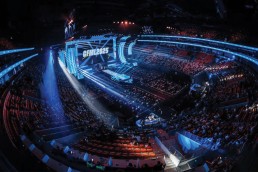
From Static Space to Living System – When Venues Wake Up
A sports arena was once a simple proposition: seats, a scoreboard, and a field of play. A convention center was exhibition halls, meeting rooms, and a catering kitchen. A theater was a stage, curtains, and rows of chairs.
These spaces were built for one thing, and one thing only.
That era is ending. Display, audio, control, and cloud computing came in and converge into a digital system that turns a fixed space into a responsive environment — one that can reconfigure from a basketball game to a concert in hours, from a product launch to a gala dinner overnight.
Come to ISLE vantage point. The exhibiting companies are more than hardware suppliers, but as full-stack solution architects. Across Asia, Europe, and Oceania, ISLE display and AV integration leaders are not just shipping panels and controllers — they are designing, deploying, and sustaining the unified systems that make modern venues work. They have learned the hard way: from hundreds of large-scale projects, across every venue type, in every climate and condition. Besides full-range products, ISLE exhibitors bring to the world proven model of how to make a venue intelligent, adaptable, and built to last and adjust.
Sports Venues: From Scoreboards to Experience Operating Systems
Arena displays once served a single, narrow function: showing scores and instant replays.
Today, they act as the central hub of the entire venue experience—a change that mirrors a deeper evolution in how venue operators structure their business models.
Ledman Optoelectronic, a leading global provider of professional sports display solutions, has installed its Micro LED center-hung systems and perimeter display networks in top-tier stadiums and arenas across Asia, Europe, and Oceania. On the surface, the technology delivers broadcast-grade 4K resolution, seamless panel stitching, and ultra-high refresh rates for flicker-free viewing for both in-person audiences and broadcast crews.
But its true strategic value runs far deeper. The platform unifies real-time game data, interactive fan engagement tools, dynamic sponsorship content, and venue operations into a single visual layer. For multi-purpose arenas that host everything from professional sports, to concerts, conferences, and brand activations, this means: the same display infrastructure can be reconfigured in a matter of hours to support entirely different scenarios.
Display technology is no longer a passive capital expenditure—it is an experience operating system that drives higher per-capita spending, longer visitor dwelling times, and more flexible venue utilization. For the display industry, this rewrites value proposition: instead of negotiating price per panel, vendors now partner with venue operators to design solutions that directly grow revenue and improve operational efficiency.
Venue Audio-Visual Integration: Unified Information Distribution and Scenario-Based Coordination
Beyond the flagship display screens in a venue’s core spaces, a parallel transformation is underway across the distributed audio-visual network that reaches every corner of a facility.
For years, venue displays and public address systems operated in isolated silos. Scoreboards ran independently, lobby signage required manual updates, and emergency broadcasts had to be activated through separate systems. Today, integrated audio-visual (AV) platforms tie every terminal into a single, coordinated framework, turning fragmented devices into a venue-wide information nerve system.
Magnimage, a specialist in venue-grade video processing and information distribution systems, delivers end-to-end AV integration solutions for large-scale indoor venues. Its platform unifies center-hung screens, concourse digital signage, suite displays, public address systems, and emergency command terminals under a single management architecture.
During sporting events, it pushes synchronized score updates, wayfinding guidance, and safety announcements across all displays and audio channels simultaneously. During live performances, it aligns stage visuals with lobby promotional content and pre-show audience reminders. For conferences and exhibitions, it enables one-click switching of event agendas, floor maps, and brand messaging across the entire venue. The system also supports integrated emergency response, triggering visual alerts and audio broadcasts across all terminals in seconds to support safe, orderly crowd management.
This approach redefines the role of display technology in venue operations. Rather than functioning as isolated decorative or standalone functional devices, displays and audio systems become a unified infrastructure for information delivery, experience orchestration, and safety management.
The Invisible Backbone: Control Systems & Cloud Management as the Foundation of Long-Term Value
If front-end displays and AV terminals are the most visible face of this evolution, back-end control systems are the invisible foundation that makes it all possible. For casual observers, screen size and brightness are the primary markers of quality. For industry professionals, however, the reliability, scalability, and adaptability of control systems are what distinguish a short-term, one-off installation from a long-term value asset.
Colorlight, a global leader in LED display control and cloud management technology, powers thousands of venue and live event projects worldwide. Its hardware controllers and cloud-based management platforms enable seamless multi-screen synchronization, real-time content updates, and remote system monitoring.
For high-stakes sporting events and live productions that demand zero downtime, its built-in redundant architecture ensures uninterrupted performance even if a single component fails. For venue operators managing multi-scene events across multiple spaces, its centralized management system drastically reduces on-site labor costs and cuts maintenance response times.
This is where much of the industry’s future competitive advantage will be forged. Front-end display hardware is increasingly standardized and commoditized—nearly any manufacturer can produce panels with comparable brightness and pixel pitch.
What cannot be easily replicated is a control ecosystem that performs reliably across thousands of installations, supports continuous software updates, and adapts to new use cases years after initial installation. This platform-based approach also enables the industry’s broader shift from one-time project sales to recurring service revenue. When a vendor can remotely monitor, update, and optimize a system over its entire lifecycle, it evolves from a product supplier into a long-term operational partner.
Diversified Indoor Venues: How Creative Displays Are Redefining Spatial Experience
While sports venues drive the most high-profile technical upgrades, a broader wave of display innovation is transforming a wide range of other indoor venue types—from convention centers and performing arts theaters to corporate experience centers and cultural pavilions.
In these spaces, display technology is no longer constrained by the traditional rectangular screen format. Instead, it is evolving into an integral structural element of architectural design, enabling immersive, scenario-specific visual experiences.
Infield, a specialist in custom creative LED displays, delivers tailored solutions for non-sports indoor venues, including irregular-shaped screens, transparent displays, curved immersive walls, and interactive LED flooring.
In convention and exhibition centers, its modular creative screens can be flexibly configured to match booth designs and event themes, turning standard exhibition spaces into immersive brand experience zones. In performing arts theaters, its ultra-thin, high-contrast displays integrate seamlessly with stage set design, extending the performance space and deepening narrative immersion without compromising artistic vision. For corporate showrooms and cultural pavilions, its interactive display systems combine visual storytelling with audience engagement, transforming static exhibition spaces into dynamic, participatory experiences.
For venue operators, this expands the functional boundaries of display technology. Screens are no longer mere tools for information delivery—they are core assets that define a venue’s visual identity, expand its range of use cases, and unlock new revenue streams from themed events, immersive exhibitions, and commercial activations.
The System, Not the Screen
The global venue technology industry is at an inflection point. The companies that will lead the next decade are not those with the brightest panels, but those that can integrate display, audio, control, and cloud into systems that perform reliably, adapt seamlessly, and deliver value long after the ribbon is cut.
ISLE display and system integration companies are uniquely positioned for this transition. They have moved far beyond low-cost manufacturing, bringing to the world insights forged across hundreds of large-scale venues — from Olympic stadiums to concert arenas, from convention centers to cultural pavilions.
What they are exporting today is not just screens and controllers. It is a mature, end-to-end model for venue digitization — one that unifies hardware, AV integration, and cloud management into a single, coherent framework.
The screen was never the point. The system is. And the system is already being built — venue by venue, city by city, across the world.
Thank you for reading this article. Welcome to visit us at Stadia Expo (Business Design Centre, London) booth No.59. And if you are interested in the ISLE, please visit the website to learn more information: www.isle.org.cn/?lang=en