

First Live Production with S12: brutal güet Deploys Lawo AoIP and Flexible Broadcast Workflows at the Winter Classics
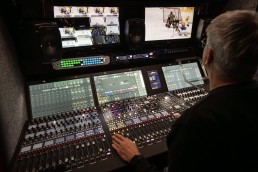
The Women’s Winter Classics in Gstaad marked the first live outing for OB truck S12, the new mobile production unit operated by Swiss broadcast service provider brutal güet. Produced for RED+, the open-air event — a flagship fixture of Switzerland’s top-tier women’s ice hockey league — also served as the inaugural live deployment of the vehicle’s fully IP-based Lawo audio infrastructure. At the core of the audio control room is a Lawo mc²56 MkIII console with 48 faders, paired with a redundant A__UHD Core and an AoIP environment based on SMPTE ST 2110, AES67 and RAVENNA. The production demonstrated how flexible system configurations, efficient workflows and high audio quality can be reliably implemented in a demanding live environment.
The Winter Classics in Gstaad rank among the premier events in Swiss women’s hockey. Staged in the center of the village, and framed by an alpine backdrop, the matchup saw reigning champions SC Bern face league leaders EV Zug. The production was realized in a demanding setup given the lack of conventional stadium infrastructure on site. For brutal güet, the event provided an ideal opportunity to put the production concept of the new OB van into operation for the first time under live broadcast conditions.
For Christian Maier, Senior Broadcast Audio Engineer at brutal güet, the first production with the new system marked a technological step forward: “Overall, it initially felt quite unspectacular because I was already familiar with the system. At the same time, working with AES and RAVENNA streams introduces new capabilities and advantages that still require a certain degree of adaptation.”
Multilingual operation is a central requirement in Swiss broadcast productions. Although only one language feed was actively used in Gstaad, the audio setup was designed for trilingual operation from the outset. “Productions in Switzerland are inherently more complex. We always have to be able to deliver three language versions,” explains Maier. “That’s why I structured the setup so that all three languages are prepared — not only for this production, but for all future ones as well.”
The latest mc² generation provides advanced DSP capabilities that streamline daily workflows. “Being able to store and recall EQs, compressors and presets, as well as using dynamic EQ processing, makes multilingual productions much easier. I don’t have to build the same signal chains multiple times.” DSP resources can also be allocated selectively. “Not every output requires full processing. If a signal path is mainly used for information delivery, I can reduce processing there and allocate resources where they deliver the greatest sonic benefit.”
Speed is another critical factor in live broadcast operation — both in day-to-day use and when troubleshooting. “I can customize the console to suit my workflow in every detail, but I don’t have to. I can also pragmatically route a signal from A to B quickly and easily — and it still works. At the same time, I can create an interface that lets me work extremely efficiently”, says Maier. The system’s visual clarity proves particularly valuable when problems arise: “If a camera operator reports they can’t hear anything, I can immediately check a second or third meter to see whether the signal is leaving my system. That tells me right away where to look — or where not to look.”
The open-air setting introduced additional acoustic challenges for the audio design. With no plexiglass walls behind the goals, the typical ice hockey reflections were absent; also the number of spectators was unpredictable. “It makes a significant difference whether 500 or 5,000 people are standing around the rink. In some cases, spectators may even be just a meter behind my ambience microphones,” notes Maier. To address this, the team implemented a customized microphone setup using directional shotgun microphones, ensuring precise capture of the on-ice action while minimizing unwanted noise.
Maier’s mixing approach focuses on balancing atmosphere and speech intelligibility. “I like to use a strong ambience mix to create an immersive experience, but the commentator always needs a clearly defined space.” This was implemented using dynamic EQ processing, sidechain filtering and automix functions. “The ambience is dynamically shaped in the relevant frequency ranges to leave room for speech without reducing overall level. This is an area where the latest Lawo console generation offers significantly more creative and technical flexibility.”
Precise timing and latency management is another critical aspect of modern broadcast production. Wireless cameras, remote feeds and distributed IP signal paths require flexible delay strategies. “Different signal paths operate in different time domains, and these have to be aligned again at the output stage. With Lawo, delays can be applied exactly where they make sense — at the input stage, within groups or on direct outputs. This level of clarity and flexibility remains a key advantage, especially in hybrid IP and remote production environments.”
For brutal güet, the S12 premiere represents both a technical milestone and a strategic foundation. The vehicle was built by Broadcast Solutions based on the Streamline concept and designed for a wide range of production scenarios, including sports, cultural events, festivals and live entertainment. “From the outset, our goal was not to focus exclusively on traditional sports productions,” says Maier. “If we produce an opera, we need this surface structure and channel capacity as well. The concept is to use the OB van as a fully equipped mobile control room and minimize on-site setups.”
The successful Winter Classics production validated this approach, showing how Lawo AoIP technology, flexible DSP architectures, and carefully designed workflows enable modern live broadcasts to be executed efficiently with consistently high quality, even under challenging conditions. For brutal güet, the first production with the S12 OB van marks the beginning of a new generation of mobile broadcast operations — scalable, versatile, and fully IP-based.