

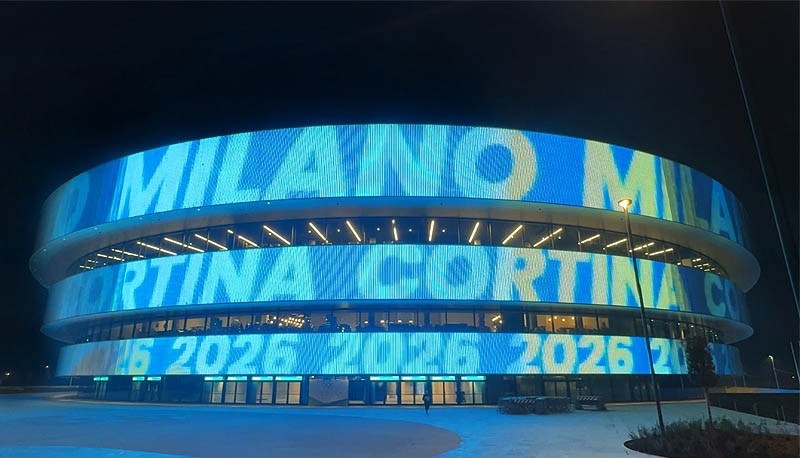
Located within a redeveloped urban district of Milan, Arena Milano — also known as Arena di Santa Giulia and recently renamed “UNIPOL Dome” following its new title sponsor — has rapidly emerged as a symbol of the area’s architectural and cultural revitalisation.
Commissioned by CTS Eventim and designed by David Chipperfield Architects in collaboration with ARUP, the largest venue of this kind in Europe combines the classical language of the Roman amphitheatre with a contemporary architectural expression defined by bold geometries and refined proportions.
Lighting Design Concept and Installation
The façade lighting scheme, conceived by Arup and DCA, is based on Griven’s custom linear LED modules with independently controllable pixels, mounted along the arena’s three external rings using bespoke panels tailored to the varying heights of the façade elements. Each LED bar has been manufactured in custom lengths to ensure uninterrupted visual continuity along the building’s curved geometry.
In total, the installation comprises 54,560 LED bars extending nearly 50 km in length, featuring around 400,000 pixels with an extraodinary pixel pitch of 125mm x 165mm, managed via 3785 DMX universes controlled via Artnet protocol in unicast and it is supported by 340 km of DMX cabling and 3,785 power supply units.
This complex system transforms the arena envelope into a large-scale dynamic communication surface, a unique interactive façade, while maintaining architectural coherence with the building’s clean, linear composition.
Multimedia Façade Functionality
The multimedia façade of Arena Milano is capable of displaying dynamic imagery, text, colour gradients, animated effects and video content optimised to its native resolution. A centralised control platform manages the entire perimeter, allowing the synchronisation of visual content with precision and consistency. Dedicated façade management software enables the upload of multimedia files, live camera feeds and moving text, as well as the automated scheduling of programmed scenarios based on predefined dates and times.
The configured server operates all LED modules as a unified system, allowing real-time adjustments to brightness and illumination levels through a single command interface. Automated dimming functions enable the luminous flux to be modulated according to environmental conditions and specific operational requirements, contributing to reduced light pollution and improved energy efficiency.
Product Performance and Technical Features
Specifically developed by Griven for this installation, the GRAPH-i-PIX Opaline RGBW custom LED modules incorporate precision optics and an opaline diffusing front screen: Gri-dex. This diffuser—made of fire-resistant, UV-stable, and anti-yellowing polycarbonate—was engineered exclusively for Griven to ensure exceptionally smooth colour transitions and uniform visual output. Bespoke beam angles and finishing enhance light reflection across the anodised aluminium vertical elements separating each LED bar, reinforcing the façade’s architectural rhythm.
With an IP66 protection rating and integrated thermal protection, these modules are fully resin-encapsulated to ensure maximum resistance to weathering while providing effective heat dissipation. They deliver stable output in terms of both colour consistency and saturation, enabling the luminous intensity of the multimedia façade to be modulated in response to natural light conditions throughout the day and night.
In line with the essential and rational design principles defined by the project’s architectural studio, all power and control cabling is fully concealed, and each LED bar is equipped with a quick-connect system to ensure maximum protection and ease of replacement. The ultra-slim black (RAL 9005 textured) profile integrates discreetly within the façade, delivering a versatile direct-view lighting solution capable of producing complex pixel-mapped content and high-impact abstract visual compositions.
Available in configurations with either seven or eight individually addressable pixels, the RGB+W 4000K version ensures high-quality white light output and flicker-free operation at any dimming level. The bespoke engineering of the modules enables clear daytime legibility while maintaining a refined visual presence at night, meeting both aesthetic and energy-performance requirements without compromising colour richness or operational flexibility.
We are extremely proud to have contributed to this challenging project through the development of a groundbreaking illumination system. We would like to express our sincere gratitude to all the people, organisations, and companies whose expertise, commitment, and collaboration made the successful completion of this extraordinary architectural achievement possible. Particular thanks go to our commercial and technical teams, whose skills, dedication, and professional excellence were instrumental in bringing this ambitious vision to life.