

Daktronics Install New Video Board for Purdue’s Ross-Ade Stadium
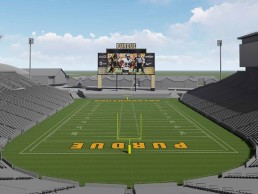
When Purdue Boilermakers fans return to Ross-Ade Stadium in 2020, they’ll be greeted by a new end zone video display designed, manufactured and installed by Daktronics (NASDAQ-DAKT) of Brookings, South Dakota. Installation of the new display on campus in West Lafayette, Indiana, will be one of the first HDR-capable displays in college football and four times larger than the current display.
“We believe our fans will find the live in-stadium experience at Ross-Ade is enhanced by the addition of this prominent, state-of-the-art video board,” said Mike Bobinski, Purdue Vice President and Director of Intercollegiate Athletics. “The unique combination of the board's size, clarity of image and proximity to the field and seating bowl will be second to none in college football.”
The new LED video display in the south end zone will measure nearly 57ft high by 150ft wide and will feature 10mm line spacing. The total of 7.6 million pixels and HDR capability will bring sharp, pristine imagery and colour to Boilermakers fans at every event at the stadium.
“Purdue fans will receive one of the best in-game experiences in all of college football with their new LED video display system,” said Trent Poelker, Daktronics Sales Representative. “Our history with Purdue is deep and we’re honoured to be selected to provide this solution for the university and their athletics department. Our team of Daktronics 2,500 employees is proud to be able to support this project.”
The display is capable of variable content zoning allowing it to show one large image or multiple zoned images. It can show live video, instant replays, game-day statistics, graphics, animations and sponsorship messages.

Visitors Smart Cars to Supply Energy to Johan Cruijff ArenA
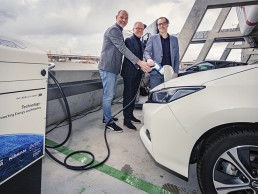
Visitors’ electric cars can start supplying energy to the Johan Cruijff ArenA. The first bidirectional charging station making this possible was connected by Laurens Ivens, alderman of Amsterdam City Council, today. Dozens of similar charging stations are to be installed in the car park under the stadium in future. The ArenA is looking into how it can reward visitors for the ‘borrowed’ electricity.
Smart vehicle2grid technology connected up to the ArenA battery sees to it that the correct amount of energy is supplied from car to stadium, though only when this is required and with the consent of the vehicle’s owner. The system ensures that the battery is charged on time so that visitors can return home safely. The energy derived from the cars serves as additional storage and backup for the ArenA, thus reducing the stadium’s electricity bill and contributing to a more stable national grid.
“It’s a great initiative which—in a fast-paced world of Smart Cities, electric vehicles, digital systems and algorithms—sees us now moving towards an innovative means of achieving sustainable, socially responsible mobility. Enabling visitors to give back clean energy to the stadium ensures they have a smart way of doing their bit towards the ecosystem. This is a fantastic milestone for public and private cooperation and one to be proud of,” says Ger Baron, chief technology officer, Amsterdam City Council.
The initiative will start with 14 regular charging stations and one bidirectional charger in the ArenA dek car park. Subsidised by the European Union, this system will entail electric vehicles being used as an innovative source of energy for the stadium. The project dovetails with Amsterdam’s future mobility plans, such as mobility hubs. Electric vehicles’ batteries can play a significant role in efforts to render the energy transition in the Netherlands increasingly sustainable.
The project is the result of a collaboration between BAM, The Mobility House and the Johan Cruijff ArenA and is supported by ‘SEEV4City’, an initiative of Interreg North Sea Region, the Amsterdam Climate & Energy Fund and Nissan.
Pierattelli Architetture Presents Project for the Fiorentina Football Club Stadium
The stadium of Fiorentina Football Club based in Florence (Italy) is a building
of historical and artistic interest, built between 1930 and 1932. The Club belongs now to a
new chairman, Rocco Commisso, an American-Italian businessman, which has put the
need of a modern sport infrastructure as one of the strategic pillars of the club.
In the public debate of the future of the old stadium, comes the proposal of the Florentine
Studio Pierattelli Architetture, which has designed a project for the new Fiorentina
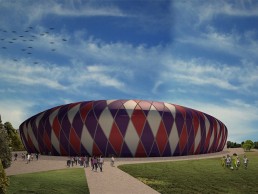
football ground with a hallmark organic form and a metal mesh cover in the club’s colours
– purple, white and red.
The project takes the form of a Masterplan covering the redevelopment of an expansion
area in the north-west of the city, Novoli’s district, and it would become a sign of renewal,
growth and urban expansion. The project for the new stadium thus becomes an opportunity to upgrade the urban scenario of one of the most vital areas of the city. It redefines the relationship between architecture and context, resolving other critical issues weighing on the area through the arrival of the stadium.
In fact, this also provides the opportunity to renovate the road network which is noteworthy today for its major infrastructural failings, redressing the balance and creating a new one with the Mercafir (the Florence fruit and vegetable market).
The construction of artificial hills completes the project of creating a living, usable architecture with services always open to citizens. With its hallmark organic form, the particular conformation of the stadium, higher on one side than on the other, brings to mind a "Stone".
A metal mesh in the club’s colours, purple, white and red, covers the outer structure. 16
entrances, 4 of them with turnstiles, with lifts and panoramic stairways, give access to 3
rings of grandstands, as well as to the shopping mall and catering area which are always
open to the public.
“The new stadium project certainly provides a unique opportunity for Florence”, said
architect Massimo Pierattelli, “for rethinking the relationship between the building, its
functions and the city, adding new meaning to the structure and creating added value for
citizens, as well as for fans”.
The new stadium designed by Pierattelli Architetture is therefore not only grafted on to the
existing urban fabric, but becomes part of a new vision of the city, able to combine different functions and leaving areas that are active all year round as a legacy. A holistic vision of the relationship between architecture, urban planning and social life, able to optimise the relationship between city life and sport.
The stadium project proposed by Pierattelli Architetture stands out for its special, almost
organic silhouette, and its curved steel surface with rhomboidal metal mesh design. The
colours of the surfaces are those of the team: purple, white and red, with a slight
transparency that allows a glimpse of the distinctive elements of the stadium even from the
outside. The coloured mosaic is initially characterised by a strong predominance of purple,
up to the roof where white prevails: viewed from overhead, the entire structure brings to
mind an enormous flower.
With its perimeter of about 600 metres, a maximum width of over 200 metres and a
maximum length of over 150 metres, the stadium has a capacity of 40,000 seats.
The height of the structure varies from 30 to 40 metres: the highest part, overlooking the
grandstands, is located in front of the new entrance and is designed to accommodate the
journalists’ grandstand.
The facility has 16 different entrances with panoramic stairways and lifts: 4 are equipped
with turnstiles for sports events and are therefore usable exclusively during such events.
The main entrances, located on the main axes, allow access to a double-volume ring at
ground floor level that runs along the entire length of the floor and channels the flow of
people into the different areas. The project includes facilities that are always open to the
public, such as the double volume shopping mall and the restaurant with panoramic terrace.
An area at the centre of the second ring is dedicated to VIP grandstands, 10 skyboxes of 16
square metres each and four equipped meeting rooms for market or executive summits.
This area is accessed exclusively from the panoramic stairways to the north. The last ring
dominates the entire stadium and, to point up the gap between the stands and the roof, does not house services, but only the dividers and columns that support the internal structure. The underground part of the stadium is given over to facilities: changing rooms for stewards including swimming pool, warm-up area and wellness center, as well as a large hospitality area from which the press room, skybox areas, VIP grandstands and toilets can be accessed.
The surface area of about 60 hectares in the Novoli neighbourhood, in the north-west of
the city, is home to a very active, dynamic urban network, where however a significant
lack of infrastructure seriously limits its role and potential. Starting precisely from the assessment of the limits and criticalities of the neighbourhood, Pierattelli Architetture has based its project on the upgrade of the road network that develops around the Mercafir area.
Viale Guidoni – along which most of the traffic in and out of the city currently flows - is
directed underground through a tunnel with an entrance close to the railway and exit in
front of the Palace of Justice, changing to a one-way direction of travel and maintaining a
pedestrian and cycle path at ground level for the inhabitants of the neighbourhood.
A road has been added to the north of the area that connects today’s Piazza Artom with Via
dell'Olmatello, cutting the Mercafir area in half. The latter is retained, but scaled down with
a view to optimising spaces and resources: the area becomes entirely pedestrian, an island
of peace within an area of inter-municipal traffic.
Down the long sides of the project area, it was decided to create 4 artificial hills, to mark
the boundaries of the area, while at the same time providing a new green lung for the city.
The hills have a maximum height of 6 metres. Live architecture enjoyable on an everyday
basis, they are positioned in such a way as not to represent a visual obstacle.
www.pierattelliarchitetture.it
VITEC Kicks Off the Ultimate Game-Day Experience at Allianz Field
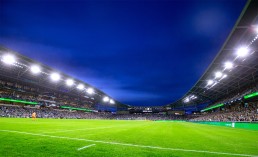
VITEC, a worldwide leader in advanced video encoding and streaming solutions, today announced that Minnesota United selected its award-winning EZ TV IPTV and Digital Signage Solution to control video feeds and signage to hundreds of screens installed throughout the new Allianz Field soccer stadium. As part of the new $250-million venue, EZ TV delivers a high-quality, low-latency live feed of the game and eye-catching digital signage, allowing fans to never miss a minute of action.
“We wanted to deliver the very best experience to our fans as well as our operators and advertising staff. The system can quickly, easily, and reliably distribute not only the game-day feed to every screen but also ensure that we are successfully deploying attention-grabbing and strategic campaigns with the signage content,” said Cole Mayer, production engineer, Minnesota United. “It’s a complex job, but VITEC’s solution integrates all these capabilities into one platform that exceeded our operational and technological vision. With the power of VITEC, Allianz Field is one of the best, most technologically advanced soccer stadiums in the world.”
Leveraging the power of EZ TV, Allianz Field’s staff can quickly and efficiently distribute, control, and maintain the more than 200 displays within the stadium. The cost-effective solution resolved the challenge of delivering a high-quality, broadcast-grade game-day feed to every screen with low-latency distribution and flawless synchronization between displays over its IP infrastructure. EZ TV’s built-in digital signage creation tools also enabled the organization to achieve a dynamic digital signage strategy where operators can easily distribute targeted content to specific displays throughout the venue. Integrated with Daktronics Show Control System, Minnesota United is able to trigger updates to signage for each screen during the games from the same Show Control System. The combined solution makes it effortless and simple for a single operator to change campaigns from pregame, to in-game, halftime, and post-show sponsorships during events.
Com Tech Upgrades Union College Hockey Rink With EM Acoustics
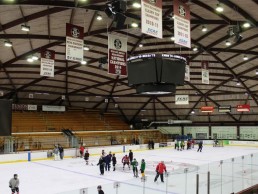
Schenectady, New York-based Union College recently upgraded the sound reinforcement system at the Frank L. Messa Rink, home of the school’s men’s and women’s hockey teams. The school athletic department worked with Charles Zarriello, owner of Com Tech, and Rich Trombitas of Cardone, Solomon & Associates, to determine the proper sound reinforcement solution for their needs. Com Tech – located in nearby Voorheesville – was tapped for the installation.
“The existing system had been failing for years,” explained Charles. “The technology was old, coverage was poor and intelligibility issues were worse. The new, distributed EM Acoustics system sounds terrific and provides the coverage the college was looking for and that the fans deserve.”
Rich recommended a total of six loudspeaker clusters, with three distributed evenly on each side of the rink. Each cluster consists of an EM Acoustics MSE-159, EMS-121X and a HALO C subwoofer.
“The ice rink is located in a geodesic dome on campus, which can make installation a challenge,” added Rich. “Weight distribution as well as a clean, integrated appearance were important. We ultimately designed a custom frame with EM’s assistance that seamlessly integrates all speaker elements as a compact cluster and hangs from the domed ceiling without causing unnecessary stress on the structure.”
The combined coverage of the clusters easily covers the seating area and the ice. Each EM Acoustics MSE-159, a two-way passive, reflex loaded full range loudspeaker, blankets the seating area. The EMS-121X loudspeakers – ideal for applications that require full range performance with low weight – ensure the players on the ice are also covered. The HALO-CS is a reflex subwoofer that provides the low-end impact a sporting venue requires, in a very compact footprint.
A portion of the loudspeakers from the old system were re-purposed to cover standing room only areas on the ends of the rink that were not covered previously, another win for the college.
“This project had an extremely tight build schedule,” related Charles. “There was no spare time; we were offloading loudspeakers from the airline transport company as they were preparing the ice for practice the next morning. When all was said and done the college and fans were very happy. Not only was the system intelligible, but the clarity was exceptional, and the rink is filled with sound.”
Daktronics Brings TD Garden Centerhung Video Screens
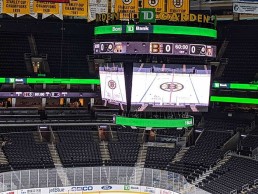
TD Garden continues to improve the game-day experience for its fans by partnering with Daktronics to install the first 2.5-millimeter centerhung video screens this year. The installation marks the tightest pixel pitch on a centerhung in sports.
“Our game presentation enhancements are some of the most exciting parts of TD Garden’s significant ‘Legendary Transformation’ this year,” said Lorraine Spadaro, vice president of technology at TD Garden. “The complete overhaul of the HDX screens significantly enhances the clarity and quality of game presentation and brings 4K quality video to our guests.”
The centerhung’s upgrade includes four new main video screens retrofitted into the existing structure to bring an overhauled viewing experience. Each display features 4.5 million pixels and measures 13 feet high by 23 feet wide.
“The tight 2.5-millimeter pixel pitch of their centerhung screens position TD Garden as innovators in the use of LED technology in sports venues,” said Daktronics President and CEO Reece Kurtenbach. “We’re proud to work with TD Garden on their venue upgrade efforts.”
The centerhung improvements come on the heels of 30 LED displays being installed in 2018 in vomitory locations along the seating fascia. These displays also featured the tight 2.5-millimeter line spacing for high-resolution imagery.
The new technology adds to the existing LED displays Daktronics had previously installed at the venue including two LED digital billboards and two 360-degree ribbon boards along the seating fascia.
Daktronics’ powerful Show Control System integrates the LED displays together for TD Garden. This industry-leading system provides a combination of display control software, world-class video processing, data integration and playback hardware that forms a user-friendly production solution.
FIFA Awards EVS' Xeebra with Certification for its Virtual Offside Line
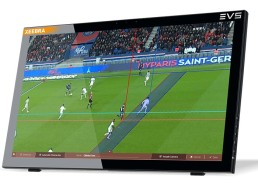
EVS has announced that its AI-driven offside line technology has successfully completed FIFA’s Quality Programme for Virtual Offside Lines (VOL). The FIFA Quality Standard certification for VOL, highlights the accuracy and consistency of the EVS solution.
EVS took part in two independently run testing events in September 2019, hosted by LaLiga clubs Getafe CF and CD Leganés, that examined both the 2D positioning of the offside line and the 3D body positioning of the players. Over the two days, 40 different match situations were tested with two cameras for each situation to determine the accuracy of the offside line.
This VOL certification provides validation that EVS’ offside line technology meets a certain set of standards and can deal with the complexities that come with precisely determining the offside line. And since this technology is fully integrated with EVS’ multi-camera review system Xeebra, it also means EVS can apply for future tenders from FIFA – as well as from other leagues and federations – that include the offside line with VAR.
“Offside decisions can be decisive in determining the outcome of football matches, making it vitally important that the virtual line drawn by our Xeebra system is as accurate as possible,” said Stéphanie Dessart, Senior Product Manager at EVS. “From camera angle limitations, to the height of the body part deemed to be offside and the curvature of the pitch, several factors have to be considered. This certification from FIFA proves that Xeebra is able to deal with these challenges, consistently meeting high accuracy and repeatability requirements.”
Xeebra uses machine learning technology, enabled by EVS’ software engine VIA Mind, to automatically calibrate the field of play, while a multi-camera review feature allows users to overlay an offside line for VAR operations during matches. The AI-driven calibration doesn’t require any pre-game setup or the deployment of additional equipment, using images from the live broadcast camera feeds to save time and ensure the highest level of precision.
Adlib Supplies Full Technical Production for 2019 Netball World Cup
Adlib was proud to supply full technical production to the 2019 Vitality Netball World Cup staged at the 11,000 capacity M&S Bank Arena in Liverpool.
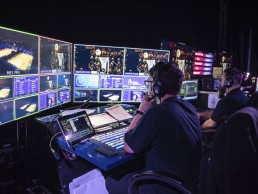
Adlib’s rental departments implemented a fully integrated video, lighting and audio package linking in with broadcast elements for BBC and Sky. The spectacle took place over 10 glorious days of top sporting action which delivered world class netball to an international TV audience and many thousands packing into the court-side seats which were sold out for the duration.
This quadrennial event featured two distinctive criteria. Firstly, a spectacular Opening Ceremony which wowed the crowds and got everyone in the mood for the great sports to follow.
Adlib’s technical team worked closely with curators of the ceremony ‘Culture Liverpool’ and ‘Iluminos’. Adlib provided six Panasonic RZ21K 20,000 lumen laser projectors mounted vertically to project the visuals created by Iluminos onto the courts below. Lighting and video effects combined to produce the spectacle enjoyed by the live audience and TV viewers alike. On-court drama followed, produced by Sport Presentation specialists Red Sky at Night Events Ltd, this saw 16 nations compete for the coveted Vitality Netball World Cup 2019 trophy.
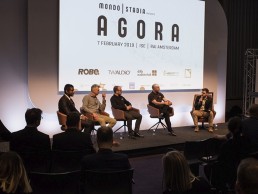
AGORA Early Bird Offer Ends Jan 8
The early bird ticket offer for MONDO STADIA Presents AGORA will end on Jan 8.
The international conference for technology in sporting venues, the latest developments in the industry and future projects will return to ISE in 2020. Through panel discussions, case studies and expert keynote speakers, AGORA will explore the benefits of the latest technology, trends and techniques - analysing the impact it has and will have at modern stadiums and sporting venues around the globe. From enhancing the fan experience and modernising stadium infrastructure, through to the planning of ceremonies and events, AGORA will provide valuable insight that will help to increase knowledge and performance for stadium and sporting venue projects in the future.
AGORA will offer sporting venue managers and event organisers the chance to network with technology innovators and industry experts.
Shure Axient Digital Provides Flawless Coordination at the NRL Grand Final
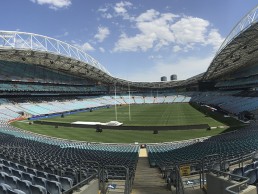
The Canberra Raiders squared off against the Sydney Roosters at the NRL Grand Final in front of 82,922 spectators at Sydney’s ANZ Stadium, with millions more watching the broadcast. Impressive numbers – as was the 229 radio microphones active at the ground that Peter Twartz, Radio Frequency Manager for the Stadium and the NRL, had to coordinate to work flawlessly with one another.
Wayne Mulder, Engineering Coordinator for production provider JPJ, made Twartz’s job that bit easier by using Shure Axient Digital and PSM1000 IEMs across pre-show entertainers
OneRepublic, the choir, MCs, hosts, and national anthem performers. All up, 52 channels of
Shure’s premium wireless mic and monitor products, Axient’s unparalleled frequency
management backbone, and Shure’s Wireless Workbench software kept the show running
flawlessly in an extremely hostile RF environment.
“At JPJ, we wouldn’t use anything else but Shure Axient for this kind of application,” declared Mulder. “The mics have to work when millions are watching, and Axient Digital’s performance is flawless. I trust Shure Axient completely – it turns on, does what it says it’s going to do, and even in the crazy, hostile RF environment of the NRL Grand Final, it’s bulletproof.”
Mulder and the JPJ team chose four handheld ADX2 transmitters for the main vocal channels, running in dual-frequency diversity mode. This mode sees a redundant signal transmitted from the ADX2 to the receivers, which automatically select the best signal from the two independent frequencies. Both are automatically managed, and change undetectably if RF problems occur.
Another huge advantage of using the ADX2 is Shure’s ShowLink control system, which enables parameters like gain and channel to be changed remotely without having to physically touch the transmitter. “ShowLink is fantastic,” agreed Twartz. “You have total control over what is usually only available from the panel on the transmitter. If a singer belts it out louder than you bargained for, you can take the gain down while they’re on stage. I like to think of ShowLink as insurance in case there’s anything you end up wishing you’d done before you gave the performer the mic!”
JPJ deployed a site-wide fibre optic network carrying both Dante and MADI for
interconnectivity, making integrating Dante audio from the Shure Axient receivers a simple
matter of connecting to the network. Settings in the transmitters themselves allow JPJ to
keep control data streams and Dante separate. Three AXT600 Axient Spectrum Managers
were used to monitor and control the top, middle, and lower tiers of the stadium respectively.
Amazingly, the whole system needed only two antennas to cover the entire ground. “The MCs could go up to level seven on the far side of the stadium and do an interview with their
ADX2s,” related Mulder. “Nothing else could have given us that kind of coverage. We didn’t
have to run in Quadversity mode and use four channels for one transmitter, but the option
was there. Just running in dual-frequency diversity mode gave us peace of mind, because you never know when a random reporter is going to turn their RF device on. We didn’t have to turn the power up on the receivers either, which kept our noise floor low.”
New zone management features in Shure’s Wireless Workbench software made the almost
mathematically impossible task of coordinating nearly 400 fundamental frequencies and their intermodulation distortion products (IMDs) achievable for Twartz.
“Wireless Workbench is exceptionally good with its Zones,” explained Twartz, “either geographical Zones or time-based Zones, which you can individually select. Between zones you can choose to care about fundamental frequencies being unique, but not IMDs, which is an important distinction as IMDs aren’t as critical. The latest version of Wireless Workbench has also added the capability to distinguish when Zones are physically far enough apart to not care about fundamental frequency overlap, and determine which frequencies need to be clean and IMDfree, with whom, and when.”
“If we’d tried to create a frequency and channel structure that was IMD-free, it would have
been impossible,” concurred Mulder. “The ability for the new version of Wireless Workbench to create six or seven Zones and then adjust the IMD and frequency settings where they overlap is fantastic.”
“At the NRL Grand Final, we had Channel 9 and NEP working on the TV broadcast, and ABC
radio, Triple M, the Continuous Call Team from Macquarie, and NRL Nation, all using radio
frequencies,” outlined Twartz. “In the stadium, we had Encore Event Technology and AVE
running 36 channels in function rooms between them, all just a sheet of glass away from the field. Add to this multiple news crews and others using wireless mics. While we try hard to document and manage them all, some make it past us on the day. This is where Shure Axient Digital and all of its spectrum management tools is a lifesaver.”