

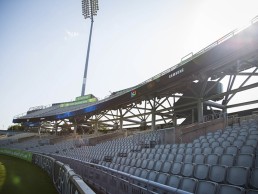
Pioneer Group Integrates First LED Mid-Tier at Emirates Old Trafford
Lancashire Cricket, one of the leading 18 First-Class counties within the domestic structure of England and Wales, was formed in 1864 and is based at the award-winning 23,500 capacity Emirates Old Trafford, England’s second oldest Test venue.
The club has made significant investment to redevelop the stadium and become industry leaders, since losing Test status in 2009. Over the last decade, the club has undergone a £60 million transformation, making it one of the most desirable international and domestic cricket, conference and events venues in the north west.
There’s little denying that cricket has been the sport of the summer this year. Despite a reputation of being slow pace and attracting a generally older audience, this ceases to be the case. Whilst the play of new, faster T20 and 100 ball games, have drawn in a younger crowd, the excitement of both the recent Cricket World Cup win and Ashes Test Match have had an undoubted influence on the sport’s renewed popularity. As hosts of the ICC Cricket World Cup, Lancashire Cricket needed to maximise the viewing experience for fans, and with information and stats vital to the game, their displays had to be second to none in time for the match. The club’s existing screens and technology were out of date, so new LED infrastructure was the latest stage in the redevelopment.
As part of the redevelopment, Lancashire Cricket partnered with Samsung to provide the club with a new, integrated video display system, which pioneered the digital experience for fans and set the benchmark for other UK cricket stadia.
Justin Hopwood, Sales and Marketing Director at Lancashire Cricket said: “Over the past ten years we’ve invested £60m in re-developing the stadium. We already had some large screens in place, but they were old and technology wise out of date.”
Integration, information and revenue were key for the new solution, as it needed be fully integrated with connectivity, capability and scalability. Clear display of information related to the game was of integral importance, to enhance match-day experience and engage fans around the ground.
Justin continued: “When we looked at the longer term, we knew the giant screen and LED ribbon was going to benefit to a match day experience. The challenge with live sport is to make sure that the experience is matched with what people expect from watching it at home.”
In addition to enhanced experience, the club also wanted to look at ways technology could increase revenue and the role it would play in sustaining the stadium’s long term business plan, not only by attracting more visitors, but also through sponsorship, advertising and implementation of the club’s own marketing strategies.
The system needed to have total connectivity, so as to develop fan engagement through web applications and mobile phones and as part of this, the club also invested in a £750,000 stadium wide wi-fi project.
The project needed to fit within budget and the screens installed ahead of the first ICC Cricket World Cup fixture, the biggest in global sport, India vs Pakistan, on 16 June. This level of digitalisation was also new to the club, so they needed to understand how best to make it work for them have it easy and manageable to use.
As experts in stadium LED, Pioneer Group were chosen for best understanding the needs of the project and, therefore, developing the most appropriate solution. Software was key to the infrastructure of the mid-tier and two jumbo screens - the system needed to be fully integrated and have the ability to support all assets.
Justin explained the importance of effective digital signage within a stadium environment: “The challenge with live sport is to make sure that the experience is commensurate with what people expect from being at home.”
Clear display of relevant information is therefore key. This is especially true for cricket, where facts and figures are integral to the understanding of the game.
On the previous display solution, Justin added: “We already had some large screens in place, but they were old, tired and out of date technology-wise.”
After reviewing options, investment in new jumbo and mid-tier LED was decided as the most effective solution to enhance viewing experience for fans. Justin continued: “When we looked at the longer term, we knew that the giant screens and LED ribbon were going to bring value and benefit to match day experience.”
To increase fan engagement, Pioneer integrated the latest ultra-high bright LED technology from Samsung for high definition visibility, even in direct sunlight. The latest ultra-high bright LED technology from Samsung was used to build the screens. This included 16 mm pixel pitch LED configured into 10x7 cabinet arrangements, to create two 60 sq metre jumbo displays located in the vicinity of the point and tram areas of the ground. Pioneer’s engineers utilised Samsung LED technology to design and manufacture a bespoke interface frame for the cabinets, working within the stadium’s existing infrastructure. For the mid-tier, Pioneer designed and manufactured custom brackets to interface each of the two Samsung Prysm View 16mm pitch LED screens to stands B and C. A universal rail system was also built, so as to aid speed of install of both 56 x 0.956m screens to the existing stands.
However, hardware was not the only instrumental factor contributing to the display, as Justin highlighted: “The other thing that is equally important to the infrastructure of the screens and the ribbon is software.”
Paul Childerhouse, Managing Director at Pioneer Group, explained further: “The message from Lancashire was that they wanted a fully integrated system.”
After taking inspiration from the US, ChyronHego’s Click Effects was specified for its ability to quickly and easily display content.
Content is generated via a HX Server (Blaze), which runs the underlying graphics to both Jumbos and mid-tier, as well as controlling and creating show content. To safeguard the system, and to avoid the risk of failure on match-day, Pioneer built an exact replica in mirror display for backup. An 8x8 Matrix Switcher is central to the system, transporting all the video images that are to be layered and making them available to view/preview, which are all routed to outputs independently. Outputs 1, 2, 3 4 and are responsible for delivering background graphics, score-boards and advertising to both Jumbos and Mid-Tier ribbons. Outputs 6 and 7 are interchangeable inputs to the jumbos, allowing for the screens to switch to video via any IPTV STB box, digital signage platform, pc or even DVD. Output 8 is routed to the control room and can be used as a confidence or preview monitor for any of the inputs available to the system. To combine the output from the Click Effects servers with the video content of choice, Analog way scalers prepare the graphics so they are joined.
Paul added: “At a press of a button, we can play a particular showreel, a particular competition, and it’s very fast and in real-time.”
Olivier Cohen, Head of Commercial Strategy at ChryonHego, explains why ClickEffects was the perfect choice for Emirates Old Trafford: “The brief was to provide a more immersive experience to the audience, while, at the same time, providing a cost-effective solution that could be up and running within minutes - combined with minimal operational experience, full redundancy and, thus, providing an incredibly intuitive solution incredibly intuitive by any user.
“The nature of Click Effects Prime itself allows a huge amount of flexibility and ease of use in terms of providing real time 3D graphics or clips to any number of outputs, in any resolution to any canvas size, while being able to data bind to the visual displays. It is extremely easy to create moments of exclusivity in the arena through creating visual events by the click of one button. In short, the investment allows Emirates Old Trafford to scale up the fan experience within the stadium as and when adoption becomes a reality.”
“One of the most significant factors that came out of the American model was that their investment in screen and ribbon infrastructure delivered not only a better fan experience with engaging graphics, but also supports the stats that are integral to understanding the sport,” Justin explained. “Pioneer have continued to support us as we start to learn how to best use the software.”
The Samsung LED is the perfect match to support the vast potentiality for content, offering the ultimate in high definition display, even in direct sunlight. Cricket fans can now enjoy the game in the most informative and engaging way, as well as audiences from other events hosted by the stadium – such as music concerts - benefitting from a better experience.
Justin concluded: “We’ve been extremely pleased with our choice of software and hardware that we have put in place, and this will only benefit the club further over the next few years, where we welcome back another exciting set of international fixtures.”
Emirates Old Trafford has been digitally transformed and now boasts one of the most advanced LED infrastructures within a UK stadium, as well as being the first cricket ground in the UK with a LED mid-tier. With Pioneer Engineers commencing work at the end of March, the whole project was delivered by the beginning of May in time for the ICC Cricket World Cup.
Paul is proud of all the contributing elements which made the project a success: “If people were to ask me what’s really special about the project, it’s that we had Lancashire Cricket on one side and Pioneer Group on the other and we’ve all joined in our common goal to provide the latest technology to a cricket ground. It’s resulted in the latest LED technology from Samsung, the first mid-tier LED to be installed in a UK cricket ground, a control system from America which has never been tried in the UK before and we’ve brought these three elements together to make it a massive success.”
www.displaysolutions.samsung.com

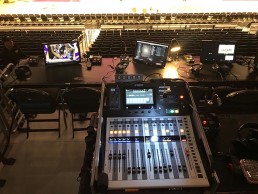
Studio Technologies Enhances LA Lakers Broadcasts
Freelance Engineer Michael Dooley has worked on hundreds of remote broadcasts for various radio stations over the last 30 years. In 2004, he began running broadcasts for LA Lakers games, which are aired on the team’s flagship station ESPN LA 710 as well as 16 stations in Fresno, San Diego, Las Vegas, and elsewhere. To ensure that he continues to produce high-quality broadcasts for one of the country’s most popular sports teams, Dooley relies on the Dante®-enabled Model 205 Announcer’s Console from Studio Technologies, manufacturer of professional audio, video and fibre-optic solutions.
Michael’s key challenge was finding a more permanent solution to his cough box setup. His previous analogue designs included several different cough box, mic switch, and headphone amp combinations that didn’t require a wall wart at each position. While he had tried several products over the years, there wasn’t a solution that suited his broadcast needs, as well as his space constraints.
“After I saw that Studio Technologies had created very compact, highly functional announcer boxes with Dante capability, I decided to convert my Lakers broadcast gear to digital,” said Michael. “Some sports allow the broadcast teams to spread out in their own broadcast booth, but not basketball. I have five broadcast positions squeezed into one-and-a-half eight-foot tables. Everyone has about two-feet of space at the broadcast table. With laptops, stats monitors, and paperwork, it gets crowded. Also, the recently added tally output function to the microphone control jack now allows me to not only turn the mics on and off with a remote switch, but it also enables me to see which microphones are on or off. This is very convenient when an announce position is on the other side of the broadcast table.”
The small footprint of the Model 205, along with all its advanced audio capabilities, made it the perfect console for Michael. The unit offers a unique combination of analogue and digital audio resources housed in a compact, rugged steel enclosure intended for table-top use. Along with excellent audio quality and a user-friendly design, the Model 205 supports Dante Audio-over-Ethernet connectivity and AES67 compatibility for integration into contemporary applications.
The Model 205 allowed Michael to send up to four feeds and receive three feeds, all via Dante to each announcer and producer position. The two talkback buttons on the Model 205 enabled him to establish multiple on-site talkback channels, including a private talkback loop for the on-site producer to talk to the station in the middle of play-by-play. In the past, the producer was only able to communicate to the station during commercial breaks and time-outs.
All of this is achievable in a way that wasn’t possible with an analogue setup. According to Michael, he previously had to use a 12-channel snake to connect analogue boxes with separate cables for each audio input and output. The Dante capabilities of the Model 205 only requires a single CAT5 cable for four input channels and three output channels, along with serving as a power source.
“Using the Dante connectivity, I’m able to set up a five-position broadcast area that doesn’t use any XLR cables,” said Michael. “The combination of built-in compressors and clean mic preamps give me superb audio from each announcer. It works flawlessly within my new broadcast workflow.”
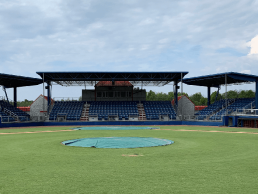
PreSonus WorxAudio Hits a Triple for Danville Braves
During the 2019 minor league baseball season, the Danville Braves fans and players enjoyed its new sound system, designed and installed by Piedmont Multimedia of Hillsborough, North Carolina, and featuring three PreSonus WorxAudio S-X2 Stadium-series loudspeakers.
“The Danville Braves contacted us back in March because with their old sound system, they had very uneven coverage in the seating areas and couldn’t hear anything whatsoever on the field of play,” related Piedmont Multimedia Director of Operations Paul Boone. “They had 12 older small weatherproof loudspeakers scattered through the seating areas, aimed at different locations along the grandstand and around the apron section of the bleachers. The more speakers you have, the harder it is to control them and not have a muddled, uneven sound. Time alignment is difficult, especially in a large outdoor space like that. They needed a solution that would do a better job with fewer loudspeakers.”
With years of experience designing and installing systems for outdoor venues, including high-school football stadiums, Paul knew that PreSonus WorxAudio’s weatherized S-X2 all-in-one weatherized compact line arrays would provide a superior solution for the 2,588-seat stadium. “I’ve been associated with PreSonus and WorxAudio from way back,” he noted. “I used to sell WorxAudio loudspeakers as a contractor, and we installed one of the first weatherized packages that WorxAudio built.”
To show stadium management what the arrays could do, Boone brought in a regular (non-weatherized) PreSonus WorxAudio X2 and set it up temporarily above the press box, in the center of the main grandstand. “We played music and talked on a wireless microphone through the X2,” he recalled. “The coverage is very wide, with 160° of horizontal dispersion, and even with just one box, the groundskeepers working on the field could hear everything clearly. The stadium management loved the WorxAudio loudspeakers. Compared to their old sound system, even one X2 was a night-and-day experience.”
Working with PreSonus’ Commercial Division team, Boone devised a design for the stadium system. “We decided to deploy three weatherized S-X2s, putting one in the main grandstand, one firing across the first base line, and one firing across the third base line,” he detailed. “It looked really good in the EASE report, and it worked out great in practice. The stadium people were so impressed with the demo and design that they signed the agreement in two or three days.”
To drive three full-range S-X2s, Boone chose six PreSonus WorxAudio PDA1000-R power amplifiers, two for each S-X2. “The PDA1000-R is a great amplifier,” Paul asserted. “It’s a really efficient Class D amplifier that puts out good power but doesn’t take a lot of energy or produce a lot of heat. It’s not real heavy or cumbersome, either.” The Piedmont team distributed analog audio from the amps to the loudspeakers. “Each S-X2 uses multicore cable for the high and low frequency elements, so we used an eight-conductor cable to each box,” Paul specified.
To keep things simple for the PA announcer, who is not a sound technician, the Piedmont Multimedia team provided a small analog mixer with four mic inputs and several line inputs, a wireless mic, and two handheld Shure mics with switches so the announcer could quickly and easily turn them on and off.
With the Braves’ Fan Fest looming, the Piedmont Multimedia team worked quickly. Installing the new system proved to be the easy part. “It took us longer to pull down the 12 older loudspeakers than to hang the new S-X2s and pull the wire,” revealed Paul. “We only spent three days on site, total, and we finished on Fan Fest day. We were leaving as the fans were lining up to come in; that’s how tight the project was. It was perfect timing all the way.”
Best of all was the system’s performance. “Three WorxAudio S-X2s tremendously outperformed 12 older boxes,” affirmed Paul. “The SPL on the field was beautiful. The comment from the customer was that the sound was very clear and distinct.”
The S-X2’s throw was impressive too. The centerfield fence is 400 feet from home plate, and way out past centerfield is a hill with trees that elevates rapidly. “You could hear the sound reflecting back from that hill as clean as it was coming out of the loudspeaker,” Paul recalled. “The reflection didn’t muddle the sound or affect intelligibility because the delay was so long, and you could clearly understand what was said.”
The Danville Braves’ stadium not only got a high-quality system concluded Paul: “it was very simple, inexpensive, and a great package. The customer spent a whole lot more on their old 12-box system that we replaced than they did on the new system with 3 WorxAudio S-X2s and got far better sound quality and coverage. They’re very impressed.”
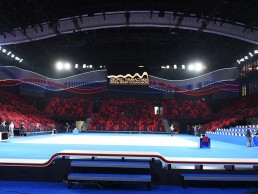
Elation flexibility on display at new Rhythmic Gymnastics Centre in Moscow
Gymnastics holds a special place in the hearts of Russians. As arguably the most successful gymnastics country of all time, the sport is followed closely and is conducted at the highest level with facilities dotting the country at all stages.
Dominated by Russian gymnasts, rhythmic gymnastics has been a particular success for Russia since gaining worldwide recognition as an Olympic sport in 1984. In Moscow, construction of a new, modern gymnastics venue was recently completed, the Irina A. Viner-Usmanova Rhythmic Gymnastics Centre, a world-class facility that houses a flexible Elation Professional lighting system.
Featuring a main performance arena and facade that resembles the wave of a gymnastic ribbon, the Irina A. Viner-Usmanova Rhythmic Gymnastics Centre, named after one of the most successful gymnastics coaches of all time, can host any type of gymnastics event from local competition to world championship.
As the sports facility was designed to be multifunctional in order to accommodate training and competition across a variety of events, as well as concerts, shows and special events, Elation distributor LPD Tech was contracted to provide a versatile lighting system. With flexibility essential in gymnastics, perhaps it was appropriate that the new venue’s lighting system was expected to possess that same resilient quality.
Faced with the challenge of finding a multi-faceted luminaire that could add flair to opening and closing ceremonies while doubling as a multi-purpose concert and show light, after consultations with several lighting designers, LPD chose the Elation Platinum FLX hybrid moving head to fulfil the many roles.
“The Platinum FLX is an award-winning, multifunctional spot, beam and wash fixture that is as bright as a 1,200-watt fixture so was perfect for this type of application,” commented Executive Director of LPD, Mikhail Morozov. “Together with different gobos, prisms, bi-directional animation effects, CMY colour mixing and highly saturated colours, it can be used to decorate any event and is enough to keep anyone happy and satisfied.”
LPD completed the general design of the venue’s multimedia systems, including supply and installation of the sound and lighting equipment. Located in the venue’s central arena, 26 of the Platinum FLX fixtures fulfil the main lighting role in a design completed by the LPD engineering team. Housing the Philips 470W Platinum 20R lamp and emitting up to 23,000 lumens, the FLX can adjust from a pencil-thin beam to a fat tree trunk shaft of light in a snap and can zoom in all modes.
The Elation lighting fixtures are controlled by a brand new Obsidian NX 2 lighting console in combination with Elation eNode4 Ethernet-DMX routers. “We chose the NX 2 because of its wide-ranging functions and features in a small size, which the venue requested as they require mobility in the control system. Perhaps most importantly though was the included Capture software which helps them to design different types of shows.” Running Obsidian Control Systems’ proprietary ONYX software, the Rhythmic Gymnastics Centre is the first installation in Russia of the compact yet fully integrated NX 2 lighting controller.
Located in Moscow's Luzhniki Olympic Complex, the 4,000-seat Rhythmic Gymnastics Centre was host to the Rhythmic Gymnastics Junior World Championships this past July, the first time that thousands of visitors were able to experience the new lighting system.
Voice-Acoustic's Installed in the Sparkassen-Arena Jena
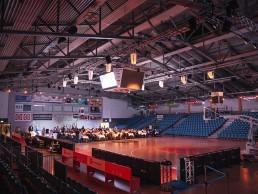
The Sparkassen-Arena Jena with 2300 sqm offers a capacity for up to 3000 guests.
The multifunctional hall is used for concerts, sports and corporate events.
The goal was to find a solution that would make it possible to uniformly sound the grandstands at sporting events and that would have a clear orientation to the stage at concerts.
The company CKV Ton- und Lichtanlagen from Thuringia developed a concept with loudspeakers of the German manufacturer Voice-Acoustic and was the winner of the contract for the project.
Altogether 12 Modular-15 with 90° by 60° horn (6 self-powered, 6 bi-amping slave) and 2 Paveosub-218sp were installed. The Modular-15sp have a very high internal amplifier power of 3200W and can bi-amplify power another Modular-15.
At the 40m long side ranks four Modular-15 are mounted and at the 20m long front sides two Modular-15. The hall was split into several sound zones. All self-powered loudspeakers are networked and grouped via Ethernet cable with the Voice-Acoustic Remotecontrol software.
The software enables the operator to choose between concert sound and sports sound. Only the 40m side ranks, which are separated into 4 delay zones, are used for concert sound. The auditorium is then sounded with a line-array of the production touring company. In sports mode, all 4 side ranks are active. As low-end support two Paveosub-218sp are placed in the auditorium.
The height of the rig is 9m. CKV installed the speakers above the truss on pipes using the Voice-Acoustic Easfly mechanism. This does not obstruct the viewing axis of the 163-inch LED video cube.
The hall operators are very satisfied with the new technical possibilities and excellent speech and sound quality. Even at noisy events such as basketball matches with enthusiastic fan groups, the system has more than enough headroom and has already performed very well.
New L-Acoustics System Installed at Allianz Arena
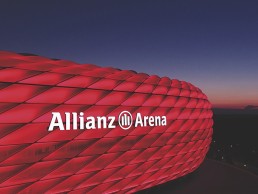
Inaugurated in 2005, Munich’s Allianz Arena, with its iconic façade of almost three thousand air-filled panels which made it the first stadium to display a full colour-changing exterior, is one of the best-known football stadiums in the world. Inside, too, the three-tiered stadium construction leaves an impression on the 75,000 plus spectators who come to see top national and international sport, and especially to support home football team Bayern Munich. For this season, the sound system in the Allianz Arena has stepped up its game. In cooperation with the engineering and planning office Müller-BBM, L-Acoustics Certified Provider System Integrator, Wilhelm & Willhalm event technology group, have installed an extensive Kara system from L-Acoustics.
Since the Arena opened, Wilhelm & Willhalm has been the infotainment technology service provider to the venue, and won the upgrade project when Müller-BBM launched a tender for the new sound system which would provide optimized, uniform sound level distribution across all three tiers, improve the transmission quality for music playback, as well as increase speech intelligibility for announcements. In addition, the new system needed to anticipate the upcoming EURO 2020 where, as part of the first pan-European European Football Championship, the only matches in Germany will be staged in there. Three preliminary round matches and a quarter-final are already scheduled and the venue’s sound system needed to respond to strong UEFA stadium standards.
Headquartered in Planegg, near Munich, Müller-BBM, previously worked with the Arena and the Wilhelm & Willhalm event technology group to optimize room and building acoustics at the venue. This experience helped when it came time to the design of the new sound reinforcement system. "The membrane roof of the Allianz Arena creates considerable reverberation in the spectator area. For this reason, care was taken to design a system that delivers sound to the spectators, minimizing reflections,” explained Thomas Dürrbeck, who was responsible for planning and construction at Wilhelm & Willhalm event technology group.
Weight restrictions also played a decisive role: "Due to the static restrictions in the roof area of the stadium, only an eight-inch array system was considered," adds Harald Frisch, sound engineer at Müller-BBM. "L-Acoustics’ Kara system offers an almost ideal ratio of weight, precision of coverage, achievable sound pressure level and sound quality."
In total, the L-Acoustics installation in the Arena comprises 266 Kara line source elements as well as 54 SB18 subwoofers for the main PA, with 48 ARCS WiFo as delay arrays in the curved areas and 70 5XT coaxial compact loudspeakers under the balconies. The system is driven by 110 LA4X amplified controllers with a system output of 440,000 watts, which are distributed over ten central amplifiers, each with two 40U system racks.
"The cooperation with Müller-BBM was excellent right from the start, extremely flexible and professional in every single phase of the installation," said a spokesperson at Wilhelm & Willham’s Dürrbeck. "From the very beginning it was clear that all parties involved were working together as a large team to implement the project optimally for the customer".
Jürgen Muth, Managing Director Allianz Arena München Stadion GmbH, agreed, stating: "the new Kara PA system is the result of trusted cooperation with our technology partner Wilhelm & Willhalm, and Müller-BBM as the executive planning office. With L-Acoustics, we chose one of the world's leading suppliers in the field of professional sound system technology, who offers a complete package of sound characteristics, flexibility and cost-effectiveness."
"We are delighted that the Allianz Arena Munich now has a Kara system that meets the stadium's leadership requirements, as well as the requirements of UEFA,” concluded L-Acoustics Director of Business Development, Jochen Frohn. “The great cooperation between Mueller BBM, Wilhelm & Willhalm and the Allianz Arena enabled planning, installation and commissioning of the system within a very short time. Hearing the system when it was fired up for the first matches filled us with great joy and pride."
Eleven Sports Media Celebrates Awards at World Football Summit
Blackpool’s sports technology business, Eleven Sports Media are celebrating after winning a major award at an international sports summit.
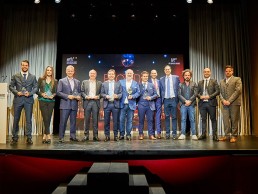
The Whitehills based company, who are back of shirt sponsors at Blackpool FC, were in Madrid this week to receive ‘Best Supplier’ at the prestigious World Football Summit.
Eleven’s work with more than 40 different football clubs across British football, including some of the Premier League’s biggest names, has seen their stadium specific TV networks StadiumTV and StatTV entertaining more than half a million football fans in stadiums every weekend.
These digital assets now form an integral role in a club’s commercial proposition and Eleven Sports Media are recognised in the sports industry as leaders in helping clubs and brands use the power of sport to engage hugely passionate sports audiences through innovative partner programmes.
It was this unique combination of products and services which helped Eleven claim the prestigious award.
Eleven were joined at the summit by some of football’s biggest names, including legendary Brazilian striker Ronaldo, as well as executives from some of the biggest clubs in the world including Real Madrid, Barcelona, Manchester City, Liverpool FC, Juventus and Inter Milan.
The judging panel for Eleven’s category included executives from the San Francisco 49ers, UEFA and some of the world’s leading sports technology companies.
One of those judges, Rohn Malhotra, Co-founder of SportsTechX, said: “To decide the winner we took into account three primary things, how innovative the product was, the impact that it was able to generate for its clients and of course the metrics by which the product would be evaluated. Given all those factors, the jury were in no doubt that Eleven Sports Media not only fulfilled all these categories in a significant way, but also were able to contribute to the end person, that as football executives we are all working for – the football fan.
“They created truly engaging content by driving conversations that keeps football audiences entertained.”
Matt Cairns, CEO of Eleven Sports Media said: “There has been a relentless drive demonstrated from a very talented and committed group of people in order to create, build and deliver the products we have been recognised for by winning the ‘Best Supplier’ award.
“Although Eleven’s products and services have evolved greatly over the last decade, particularly our work with partner programmes, at the core of everything we do is, and always has been, the content experience of sports fans and that is why platforms like StadiumTV and StatTV exist.
“We’re delighted to be announced as the winner by WFS, an event that carries significant weight in the industry.
“To be recognised by leading figures at some of the world’s biggest sporting institutions, as well as our peers in the sports technology space, is an indicator that as a company we are playing our part in positive change and innovation in a continually competitive industry.”

Marshall POV Cameras Take eSports Broadcasts to the Next Level
Over the last decade, eSports has become really big business. Spurred on by the phenomenal growth of live Web streaming, the craze is gaining momentum at a rapid, if not unfathomable pace. For Producer Tim Reis, improving the quality of his “player cams” with Marshall Electronics CV502 Miniature Camera, helped to bring a more immersive, all access experience to his broadcasts and live streams.
The first eSport broadcast Tim worked on using the Marshall CV502 Miniature Cameras was for a particularly popular five vs. five online multiplayer game that was both broadcast and streamed live. The championships were held in an arena format with all 10 players sharing a single stage. The production wanted individual “player cams,” in order to get a look at the intensity of the eSport athletes’ faces as they played. This was previously achieved using standard webcams, which inevitably resulted in a complicated network of wires and conversion boxes to make the player cams a functional asset to the program.
“As we prepared for the event, it was clear that our ‘player cam’ system needed an update,” said Tim. “I needed a 1080p SDI out native camera with a small footprint and action-cam-style field-of-view. I was led to Marshall’s CV502 POV Camera. With the CV502, we mounted them atop each computer monitor and they worked incredibly well.”
The Marshall CV502 camera offered a clear solution for Tim, especially due to its visual fidelity in an environment with constantly shifting stage lighting as well as its streamlined workflow that would have been unachievable with a standard webcam-based setup. “We bought 15 of the CV502 POV cameras for that show, and a lot of major eSports brands were paying attention to our production that year,” said Reis. “Now you’ll see the CV502 at pretty much every major eSports broadcast. It’s becoming the industry standard. The CV502 has an ultra-low, 0.2 lux rating, making it great for low-light settings, which is fairly standard for eSports competitions.”
The Marshall CV502 Full-HD Miniature Camera offers performance, flexibility and value in a tiny form factor. Built around a next generation 2.5-Megapixel, 1/2.86-inch sensor, the CV502 delivers progressive Full-HD video up to 1920 by 1080p at 60/59/50fps and interlaced 1920x1080i at 59.94/50fps.
The CV502 utilizes a full-sized BNC (3G/HDSDI) output and a threaded M12 lens mount for a wide range of prime and varifocal lens options. Remote adjustment and picture settings commands are delivered via common RS485 (Visca) or OSD menu joystick. A wide range of picture adjustment settings are available and adjustable from a distance including paint (red/blue), white balance, exposure, gain control, pedestal (blacks), white clip, gamma and more.
Tim has been involved in several eSports broadcasts domestically as well as on the international stage. In addition to Marshall’s POV camera, Reis has also rented its MD Series monitors and has used it as a client monitor. “Marshall’s monitors are rugged and have great color fidelity. It also has fantastic false color exposure tools for camera ops,” said Tim. “Both the player cams and monitors from Marshall are a great asset to have on any eSports production.”
Daktronics Installs First Collegiate Centerhung
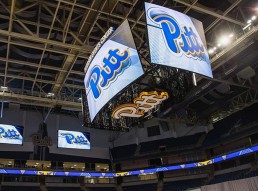
Daktronics has partnered with the University of Pittsburgh (Pitt) to deliver new LED video display technology to multiple athletic facilities on campus in Pittsburgh, Pennsylvania, including the first centerhung in collegiate sports featuring less than four-millimetre LED line spacing.
Fans of Pitt Panthers basketball, volleyball and soccer programs will be welcomed by a new visual experience on game day as Petersen Events Center, Fitzgerald Field House and Ambrose Urbanic Field have received new LED technology this fall.
“Thanks to a great partnership with Pitt Sports Marketing and our JMI Sports team, we have installed video boards that should help us create one of the best in-venue viewing experiences in all of college basketball,” said Pitt Director of Athletics Heather Lyke. “When you combine the Oakland Zoo, the court flip, the addition of public Wi-Fi and now this video component, our commitment to enhancing the game-day experience for our fans is absolutely being realised.”
Inside Petersen Events Center, the centerhung features four outward-curved LED video displays totaling eight million LEDs. Each display features 3.9-millimetre line spacing, the only collegiate display with line spacing closer than four millimetres. The sideline-facing displays each measure approximately 15ft high by 28ft wide and the end-line facing displays each measure 15ft high by 16.5ft wide. Two end-wall displays feature 10-millimetre line spacing and measure 16.5ft high by 31ft wide.
The Fitzgerald Field House, home of Ptt volleyball as well as wrestling and gymnastics, received two new end-wall LED video displays. Each features 5.9-millimetre line spacing and measures approximately 10ft high by 23ft wide.
The Pitt men’s and women’s soccer venue, Ambrose Urbanic Field, now has a new video display at the end of the field measuring 17ft high by 30ft wide and featuring 10-millimetre line spacing.
These displays are capable of variable content zoning allowing them each to show one large image or to show any combination of live video, instant replays, up-to-the-minute statistics, graphics and animations, and sponsorship messages.
“Daktronics is very proud to continue our long-standing partnership with the University of Pittsburgh,” said Scott Willson, Daktronics sales representative. These new displays will have a tremendous impact in informing, entertaining and engaging fans, sponsors and student-athletes across the campus.”
Petersen Events Center also received six LED scorer’s tables. Each measures approximately 2ft high by 8ft wide and features six-millimetre line spacing. These tables can be set up in any configuration to show additional statistics, graphics and sponsorship messages during events.
In addition to the equipment installation, Pitt will be receiving custom digital content created and delivered by Daktronics Creative Services.
Barça Studios Choose Riedel's MediorNet
Riedel's MediorNet real-time signal network has been recently installed in Barcelona, Spain, to enable the sharing of video resources between Barça Studios (FC Barcelona TV and Media Center) in Sant Just Desvern, just outside of Barcelona; FC Barcelona's Camp Nou Stadium in the center of Barcelona; and FC Barcelona Sport City, located in Sant Joan Despí. The MediorNet network not only connects Barça Studios with the Camp Nou Stadium and Sport City, but also facilitates decentralised signal acquisition, processing, and routing between different areas of the stadium using several Riedel MediorNet MicroN and MediorNet Compact PRO units. Barça Studios is the official broadcaster of FC Barcelona and is owned and operated by the football club.
The setup consists of a Compact PRO frame and nine MicroN app-driven devices equipped with the Standard and Processing Apps that handle connectivity between all three locations. CWDM optical multiplexing allows the connection between Barça Studios and Camp Nou to function redundantly on just two dark fibres. Five of the MicroN devices are used in the stadium: one on the pitch; one each in the TV compound, data processing room, and video scoreboard control room; and one as a mobile node that can be flexibly positioned anywhere in the stadium. The remaining four MicroN units, also equipped with the Standard and Processing Apps, are located in the Barça Studios and FC Barcelona Sports City.
"The built-in signal processing capabilities of MicroN allow us to take advantage of the device's onboard embedders/de-embedders, frame sync, frame store, and a timecode generator," said Xavier Fontoba, Audiovisual Operations Supervisor of Barça Studios. "The Processing App adds colour correction in the RGB and YCbCr colour spaces, up/down/cross-conversion, and two multiviewers - all of which streamline our workflows and eliminate single-purpose devices."
For control and operation, Barça Studios uses Riedel's MediorWorks software on its corporate network. For authorised users, 2300-Series SmartPanels loaded with the MediorNet Control App allow routing of signals directly from the panel.
"Ensuring total reliability and flexibility were the biggest challenges of this project," said Adrián Lorenzo, System Consultant for Southern Europe at Riedel. "With MediorNet we were able to deliver the perfect solution, providing the essential redundancies that the client required for their critical live TV and sports production environment."