

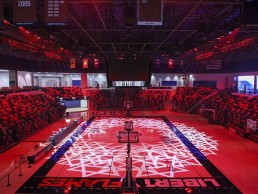
Liberty University adds Ayrton Khamsin-S fixtures to Sports Arena
Liberty University has invested in a complement of 20 Ayrton Khamsin-S LED profile luminaires for the new Liberty Arena on the Lynchburg, Virginia campus.
Liberty Arena seats 4,500 spectators and is the home of the university’s men’s and women’s basketball and volleyball teams whose games are broadcast on ESPN+. Liberty University previously purchased Ayrton Mistral fixtures for a multi-use event space, which hosts a wide array of entertainment programs and gatherings.
“We wanted bright LED fixtures that would really pop and enhance the fan experience in our new dedicated sports arena,” says Amy Caun, lighting director and Tier 2 production technician in Liberty’s Event Production department.
Designed for scenic applications, the Khamsin-S is equipped with a new LED module delivering powerful metallic white light with a record-breaking output of 40,000 lumens and a colour temperature of 6500 K.
“We like to stay with one product line, and ACT Lighting arranged a shoot-out with Khamsin and another Ayrton fixture,” she explains. “We were really impressed with Khamsin’s design, how sleek and compact it is for such a powerful fixture. Khamsin also had great saturated colours, and, being an LED fixture, we don’t have to worry about lamp life.”
In addition to the Khamsin-S fixtures, the new arena boasts a Daktronics center video board stanchion display, court table and 360 degree video ribbon display plus four 4K laser projectors for court projection, all of which play a role in creating an immersive fan experience.
“Before a game starts all of these elements work together to excite and engage fans and players alike,” says Caun. “We’ve designed each of these elements to complement each other and together create a thrilling environment.”
During the starting lineup the Khamsin-S units, which are mounted on truss on either side of the court, illuminate the players and court and build excitement. Custom gobos featuring the Liberty Flames logo and mascot project onto the court and seating. The Khamsin-S are also deployed going in and out of halftime and for celebratory effects after a win.
“Although the coronavirus pandemic means there are currently very few fans present during games, that actually has given us time to really dial in the production in the new Arena,” notes Caun. “Once more fans are able to attend again, we know they’ll enjoy a high-quality, in-person experience and the Khamsin fixtures play an important role in helping us create a thrilling game experience.”


ChyronHego Launches Three New Brands
ChyronHego has launched three new corporate brands — Chyron, Hego, and Tracab — that respectively provide industry-leading professional broadcast products, professional live broadcast services, and collegiate and professional coaching tools. The three new brands will operate under the ChyronHego senior leadership team, and the company’s existing customers will enjoy ongoing sales, support, and development for the current ChyronHego product portfolio.
“Our launch of Chyron, Hego, and Tracab is exciting not only because we are reclaiming the renowned ‘Chyron’ name, but also because these discrete brands allow us to be even more agile in addressing the requirements of specific markets,” said ChyronHego CEO Ariel Garcia.
About the Brands
Chyron: Professional Broadcast-Grade Products
The word “chyron” has been synonymous with on-air graphics since the company pioneered the broadcast character generator over a half-century ago. Reclaiming this legendary name, Chyron will continue to serve professional broadcast across multiple verticals, including news, sports, and other entities that require broadcast-grade graphics, data management, content management, MOS integration, and control.
Building on its tradition of innovation and excellence, Chyron has ramped up development and support to meet the needs of broadcasters today and in the future. Chyron’s flagship product, the PRIME Platform, is an industry-leading graphics tool that also serves as an agile, scalable solution for broadcast OTA and OTT workflows, whether deployed via traditional on-premises hardware, in the cloud, or in a hybrid configuration.
Hego: Professional Live Broadcast Services
Hego renews its commitment to providing excellence in broadcast services, including equipment and experienced personnel qualified to work with Chyron and other vendors’ equipment.
Tracab: Coaching Tools
Tracab serves professional and collegiate athletic coaches and leagues with a product portfolio that includes Tracab (player-tracking data) and Coach Paint (illustrated replay and virtual player lineups as a coaching tool).
Growth and Customer Focus
Though faced with a pandemic that took a toll on companies across the broadcast industry, ChyronHego continued to grow in 2020. January 2021 began with a successful corporate recapitalization, led by Apollo Investment Corporation. To leverage these achievements and continue to grow, each brand begins 2021 focusing on its market segment, with customer-centric support and customer-driven development.
“We have a lot of great things brewing and look forward to sharing these very soon!” added Garcia. “Following this rebrand announcement, our customers can look forward to new products and innovations throughout the coming year.”
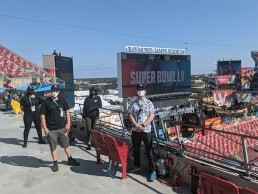
PixMob Lights Up the Crowd at the Super Bowl LV Halftime Show
PixMob provided an unforgettable spectacle despite a challenging year for North America’s biggest annual sporting event, the Super Bowl LV Halftime Show, held at Raymond James Stadium in Tampa, Florida – featuring a career-spanning headline performance by The Weeknd.
Employing over 22,500 LED wristbands for live audience members (and some 30,000 adapted LEDs for the cardboard cut-out ones), 500 “flares” (ultra-powerful LEDs) for the performers on the field, 75 LED masks, and 150 “light-up eyes” (on face shields) for the choir, PixMob demonstrated the ability to turn audiences into part of the show while creating a pulsating, colourful and entrancing canvas of light for viewers at home.
“We’re very happy and honoured to be doing the Super Bowl Halftime Show for a second year in a row, especially during these exceptional pandemic conditions," PixMob President, Jean-Olivier Dalphond commented. "We approached it as both a challenge and an opportunity, and we are very pleased to have been able to offer such an uplifting experience for everyone watching this extraordinary event during these unprecedented times.”
Renown from tours with Taylor Swift, Shawn Mendes and the Spice Girls to the opening ceremonies of the Olympics and NHL and NBA playoff games — PixMob have shifted and adapted to today’s reality with the creation of Safeteams, a bold new initiative tackling the pandemic in the events, commercial and industrial sectors.
Utilising PixMob’s proprietary wearable technologies, Safeteams assists organisations wishing to reopen or maintain safe operations during COVID-19. Safeteams provides social distancing and contact tracing solutions that create safe work environments through the use of connected devices designed to help stop the spread of the virus within workplaces.
Interest in, and adoption of, Safeteams has been extremely high with over 50 US, Canadian and Quebec-based companies now working with Safeteams – including CanSave, Metal Power Product, Courchesne-Larose, Moderco and All Weather Windows, with more to be announced soon.
Levi’s Stadium’s Prepares to Open as a COVID-19 Vaccination Site
The San Francisco 49ers and the County of Santa Clara have announced the creation of California’s largest COVID-19 vaccination site at Levi’s Stadium to facilitate the rapid rollout of vaccinations to the residents of Santa Clara County. The site will open next week with the initial capacity to vaccinate 5,000 people per day, with plans to increase capacity up to 15,000 people per day as vaccine supplies increase.
The site will run under the supervision of Santa Clara County Public Health officials to ensure compliance with all relevant safety and availability guidelines. Equitable distribution of vaccines is paramount, and the Levi’s Stadium site is taking all logistical steps to ensure maximum availability and accessibility.
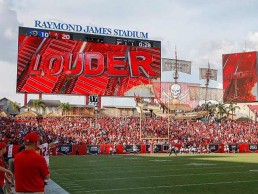
17 Consecutive Years of Daktronics Products Used at Football’s Big Game
For the 17th consecutive year, professional football’s championship game will be held at a venue featuring Daktronics products. As the lights shine at Raymond James Stadium in Tampa, Florida, on February 7, the biggest football game of the year will feature 14 LED displays totaling nearly 40,000 square feet of digital signage.
“Our technology being used at the big game is exactly why we’re in business, whether that game is professional football’s championship game or a child’s first little league game,” said Daktronics Vice President of Live Events Jay Parker. “This year, we’re fortunate enough to be trusted with LED technology at football’s big game for the 17th year in a row. It’s also exciting that the game is at Raymond James Stadium, a great, long-time Daktronics partner.”
While viewers see the main event, the Daktronics service team is on site long before the game kicks off. Leading up to the day of the event, event technicians and control room specialists are at the stadium to run pre-event checks and ensure the system is prepared for kickoff. Personnel will remain on site throughout game day to monitor the system and keep it operating as expected from an LED production standpoint.
“When our customers partner with Daktronics, they know they’ll be getting the best service available in the industry, and this service will be on display Sunday in Tampa,” said Daktronics Vice President of Services Sarah Rose. “We’re proud to provide peace-of-mind for sporting events at all levels of competition with our services above and beyond the purchase of equipment and technology.”
The home of the Tampa Bay Buccaneers has long been using Daktronics technology, dating back to Raymond James Stadium opening in 1998. The original system lasted 18 years until it was replaced in 2016 with 14 LED displays, all featuring 15HD pixel layouts. The stadium has used Daktronics technology to host two of professional football’s previous championship games in 2001 and 2009. This year will be their third time hosting the big game.
The stadium features Daktronics Show Control, an industry-leading control system that combines display control software, video processing, data integration and playback hardware into a user-friendly and easy-to-use production solution.
EMG Italy Chooses Riedel's Bolero
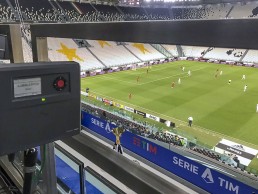
Riedel Communications has announced that Italian broadcast services provider Global Production - EMG Italy has added two Bolero wireless intercom systems to improve clarity, enable communication over more channels, increase efficiency in daily operations, and save money on RF applications in outside broadcast environments and TV studios.
"With the Bolero systems in place, we get easy multichannel communication, maximum clarity, and lots of applications over the venue — all qualities that our previous wireless intercom solutions lacked," said Renato Mancini, Chief Technology Officer at Global Production - EMG Italy. "In every application, whether in the OB van or in the studio, Bolero has never failed us. Plus, we couldn't ask for a better customer support experience."
Global Production - EMG Italy, part of Euro Media Group (EMG), who own Europe's largest range of studios and mobile facilities, is a production outsourcing partner that supports premier content producers of international sports events – including Super Bike World Championship (SBK), live events, entertainment, TV and fiction programs, music, and shows in Italy and throughout the continent. Global Production - EMG Italy has deployed Bolero in OB-6 and OB-8, two trucks in its fleet of outside broadcast vans known as The Float. Production teams use Bolero either as a stand-alone wireless intercom system or integrated with the trucks' existing Riedel Artist infrastructure.
Reliability and stability were the most important features for Global Production - EMG Italy, and Bolero delivers with an external power supply that can power up to five antennas, ensuring maximum power and data redundancies.
Bolero supports up to 250 beltpacks and 100 antennas in a single deployment. The Bolero high-clarity voice codec provides both higher speech intelligibility and more efficient use of RF spectrum, supporting twice the number of beltpacks per antenna for the same radio bandwidth as other DECT-based systems. And Riedel's exclusive ADR technology reduces sensitivity to multipath reflections, making Bolero useable in challenging RF environments where other systems struggle.
"Because Bolero is truly a plug-and-play solution with no IP configuration needed, Global Production - EMG Italy's teams can configure it quickly and easily via a web GUI internal to the antennas," said Giuseppe Angilello, Sales Manager Italy for Riedel. "This speeds up the workflow — an important factor in fast-paced live production environments — and Bolero's high level of durability and reasonable battery and RF license costs save money for the company too."
PSV Eindhoven Transforms Executive Suite
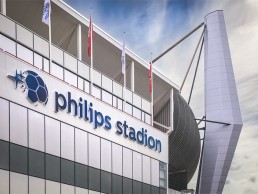
A luxury match-day executive suite inside Dutch footballing giant PSV Eindhoven’s 35,000 seat stadium has been transformed into one of the city’s most desirable and advanced out-of-office, flexible meeting room venues, following a major upgrade to its AV technology using Philips professional displays.
The ‘Jan Heintze Kick Box’, named after the club’s European cup-winning legend who is also a Danish national team star (86 caps), is one of sport’s most luxurious match-day hospitality venues. Capable of housing up to 34 people it is complete with its own private bar, kitchen, buffet and perfect views of the pitch.
The club wanted not only to provide a best-in-class visual solution for matchday entertainment services, but also to utilise the room for non-matchdays. Providing an elite-level professional communication system for meetings and events to local businesses was key, as demand for equipped flexible work offices and spaces continues to grow. According to figures, demand for flexible office workspaces has increased by 50% in the past five years. There are more than 31,000 flexible office now available for hire – with stadiums playing an increasing role.
Designed, operated and used by Panduit, a leading global provider of innovative networked solutions, in collaboration with PPDS eight advanced smart HD displays were installed. Supporting Philips, the club’s official sponsor, all of the Philips displays were installed to create a premium, inclusive and versatile meeting room and function room experience. Philips recently extended its sponsorship of the club – which was founded in 1913 as Philips Sport Vereniging – by a further ten years, expiring 2031. It is the longest known sporting sponsorship of any professional sports team, totalling 118 years.
The installation inside the Jan Heintze Kick Box, includes 3 Philips 32” Q-Line displays, 4 Philips 49” P-Line displays and, designed as the room’s centrepiece, a Philips 50” Q-Line display.
A custom AV over IP solution by partner, Atlona, enables easy wireless presentation, with content able to be cast and streamed from their Windows, Apple, Android or Linux devices instantly for increased efficiency. Using the PPDS CMND platform, TVs can be easily managed and updated by staff, either in the room or remotely, while custom branding and content on displays, as well as promotions and sponsored content can be created and deployed instantly.
A state-of-the-art sound system was also integrated to seamlessly work with the display system for a holistic premium audio-visual experience. The entire system was also future-proofed with Li-Fi integration by Signify for optimised reliability.
Roeland Scholten, Sales Director Benelux & IKAM EMEA at PPDS:, said: “The result of this custom solution transformed the box from an empty and unused space when no games were on into an in-demand and profitable space.”
“We achieved perfect versatility with our Philips displays,” added Peter Dillen, Strategic Account Manager EMEA, Panduit.
Levi's Stadium
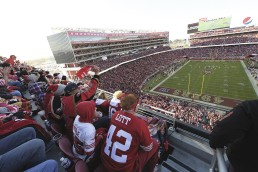
The San Francisco 49ers and Foxconn Industrial Internet (Fii) have completed a ground-breaking technological accomplishment with the installation of the world’s first-ever, full-field 8K video replay system. This achievement comes just over a year after the brands announced their multi-year partnership and plan to collaborate on 8K technologies that make Levi’s Stadium the first sports and entertainment venue with 8K video capabilities.
Since the aforementioned partnership announcement in September 2019, the 49ers and Fii have shared a congruent tech vision with 8K video capabilities that would keep Levi’s Stadium at the forefront of fan-centric innovation. That vision becomes a reality thanks to five 8K cameras, positioned inside the stadium to provide full-field coverage and clear views of all goal lines and side-lines, which utilise an incomparable digital zoom without pixilation.
https://issuu.com/mondiale/docs/mdst15_digitallr/54
Images: Levi’s Stadium, San Francisco 49ers
League of Legends World Championships Comes Alive with GLP
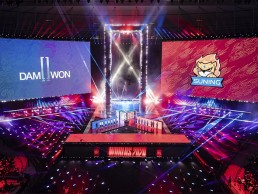
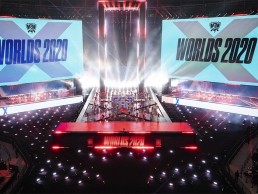
Hundreds of GLP JDC1 hybrid strobes were deployed by Lighting Designers, Mat Stovall and Trevor Stirlin Burk at the new Pudong Football Stadium in Shanghai for the League of Legends World Championship 2020 Finals.
Organised by Riot Games and ConCom Inc, the event took place on a massive scale. The Worlds was broadcast in 16 languages and across 21 platforms setting a new record; an indicator of eSports’ increasing appeal.
The live event saw 888 active JDC1 heads in use — corresponding to a lucky number in Chinese numerology. All pieces were sourced from Christie Lites, and were supplied via main contractors, CT Asia Pacific. Christie Lites’ account executive was Robert Roth, and senior project manager was Bobby Braccia; both worked closely with CT Shanghai’s Aaron Ross Durdin and the rest of the CT team to facilitate the visions of the designers.
Most notably the versatile JDC1’s were used during the spectacular Opening Ceremony to highlight a giant free-standing, 33m high, 65-tonne Paifang (traditional Chinese architectural central arch), fabricated by Star Live. They also back-lit two giant 18m x 32m LED screens, on which the gameplay was displayed. Finally, they formed the centrepiece of a rectilinear, so-called giant ‘poppy field’, interspersed with beam lights in the 33,765-capacity arena (socially distanced for a maximum of 6,000 people).
Stovall and Burk explained that, given the constraints placed on them by COVID-19, Riot strives to create a unique show every year and even with the obvious challenges, that goal remained the same. This was Stovall’s ninth year at the event, working alongside Opening Ceremony director Sam Wrench. He stated that massive safety precautions had been taken. “There were 24 competition teams from all over the world taking part, and like most productions we were all wearing masks. There was regular testing and a two-week quarantine before starting work, as mandated by the Chinese Government.”
The ceremony itself was split into different parts, opening with K-pop group K/DA performing via augmented reality, followed by a medley of anthems from past Worlds events. At the end, as the players were introduced, a virtual, towering version of League character Galio — known as the stone colossus — appeared on stage. The whole rig was used as the main story unfolded, running into a reveal of the players, and then going into the championship gameplay itself.
Although the design went through several iterations the large creative canvas of the JDC1 hybrid strobes had always been central to the creative dynamic, according to Stovall. “We fixed on the JDC1 before we could commit to the rest of the rig. I knew they would really define the show.”
To give an idea of the JDC1 versatility, each module contains a traditional single tube element with an incredible clear, bright white output and combines that with a surrounding full face of RGB LED power, utilising 1,320 high quality LEDs. These two elements have independent control and can be used as separate pieces or combined for stunning effects. Along with working as a powerful strobe light, both the tube and the full-face sections can be run continuously for high output blinder and wash light effects, while the RGB face can be divided into 12 separate ‘plate’ sections, and additionally the bright white tube also can be divided into 12 sections and then the whole array can be fully pixel mapped.
Of the 888 JDC1s used, 540 were distributed across the deck, with the remaining 348 lining the arch. “We had lots of Chinese variant products in the rig, but we insisted there should be no substitute for the JDC1,” confirmed Burk.
The two men admitted that the JDC1 had been their creative entry point. “It would have been easy just to throw gear at [the production] but we were tasked with making the event more of a visual vocabulary with linear sheets of light. The versatility of the JDC1 helped us restrict the number of different fixture types, as we could utilise either the strobe or the pixel elements.”
The show had already been a number of months in development by the time the lighting team came onboard. “We had to develop our design quickly,” said Stovall. “Trevor and I started immediately after 4th July weekend. We needed to set rules and stick to our core principles on a set this big.”
In the case of the poppy field the versatility of the JDC1, in conjunction with a high wide camera meant that any effect could be left for the audience or flipped for the camera reverse shot. “The JDC1 was bombastic but at the same time elegant in a way that only this scale could represent,” Stovall said.
The two men worked with a full cast of other directors and programmers. In addition to those mentioned, these included Tiffany Keys, Mike Appel, and Shaheem Lichtmore (programmers); Geoff Knight and Scott Beck (gaffers); Randy Quick (Concom coordinating director) and Justin Restaino, Nick Troop, Adam Mackasek, and Marc Hilko (executive producers, Riot Games). CT project manager was Sam Tibble.
Another key person was Zach Matusow, who had been lighting director for the lead-in tournament and called spots for the championship stadium show. “Because there were so many uncertainties, we chose someone who we knew would be able to take on multiple roles. He was assistant lighting director, but when my gaffer got his visa delayed Zach took over as gaffer for the playoffs as well as running the follow spots,” Stovall confirmed.
Both Stovall and Burk are no strangers to deploying GLP solutions. “The X4 Bars are a crowd favourite and I also do a lot with the FR1’s. As for the impression X4, they are workhorses,” Stovall said, and his colleague agreed. “The Bars and FR1’s are great, and like the JDC1 they are a blank canvas.”
The designers confirmed overwhelmingly that their faith in specifying so many JDC1s — and refusal to accept locally produced substitutes — had been fully justified. As for the event itself, there may only have been 6,000 people admitted to the arena but this year’s viewership stats for the finals revealed an Average Minute Audience of 23.04 million and 45.95 million Peak Concurrent Viewers. There were over 1 billion hours of competition watched over the course of the entire tournament.
League of Legends World Championship 2020 Relies on Brompton LED processing
The World Championship (Worlds) is the crowning event of Riot Games’ League of Legends. Last year, like many other productions, the world’s most watched esports event migrated to the virtual realm and was broadcast live for over 240 hours using the most advanced and pioneering XR (Extended Reality) and MR (Mixed Reality) technologies, relying heavily on Brompton’s Tessera 4K SX40 LED processors to ensure perfect image reproduction on its LED video set.
League of Legends tournaments have traditionally featured a host country, with teams touring different cities for each round of the games. However, with the challenges posed for both travel and live audiences, Possible Productions, a creative developer agency that has been working with Riot Games since 2016, looked for a solution that would give a sense of evolution to the tournament while broadcasting the entire production live from Shanghai.
“The key challenge that Riot presented us with was extending the feeling of campaign throughout the entire month of the tournament without physically bringing people to different locations,” says Michael Figge, Creative Director at Possible Productions. “It quickly became apparent that in order to bring different places to us, we needed to build a highly advanced extended reality stage that would sustain hundreds of hours of live broadcast of mixed reality content.”
With an incredibly tight schedule, Possible Productions put a crack team in place, including those that had worked on the Disney+ The Mandalorian TV series, and Riot’s engineering partner, Lux Machina, who supplied top-quality equipment including ROE Visual LED panels and Brompton Tessera processors.
“When choosing products to put into the stack for this year's Worlds, we did not have the luxury of time,” says Wyatt Bartel, Senior Technical Director at Lux Machina. “With a compressed schedule and COVID regulations in front of us, we had to choose known, high quality products, that would without doubt meet the needs of production.”
As pioneers in the Virtual Production space, Lux Machina has consistently turned to ROE's Black Pearl 2.8mm LED tile powered by Brompton processing. “From Disney's Mandalorian to Riot Games’ League of Legends Worlds, these products have not let us down,” adds Bartel.
A giant soundstage, wrapped in LED screens, not only allowed for adequate social distancing for the players, but also offered plenty of scope for the Possible team’s creative ideas. The final setup was a massive powerhouse of over 1,000 ROE tiles, displaying visuals at 32K resolution and 60 frames per second, made using a modified version of Unreal Engine.
“ROE Black Pearl 2.8mm panels were used for the walls and ROE Black Marble for the floor. The overall size of the volume was 16.5m wide by 17m deep and 4.4m tall, all running on Brompton Tessera 4K SX40 LED processors,” continues Michael. “Whenever you’re doing an event of this scale and using such a large number of LED tiles, it’s hard to ensure they’re all from one batch, so it’s necessary to have the ability to do a degree of adjustment. Tessera’s On Screen Colour Adjustment (OSCA) feature is ideal for that.”
The SX40’s ability to interlock with a specific frame rate is also particularly useful for XR applications. “The camera conveys the field of view required to our system and re-projects that field of view back onto the LED. But in order for the illusion to work, the LED has to be in sync with the cameras. The SX40 is the key to making that magic effect happen,” says Michael. “This was the largest version of a mixed reality stage ever deployed and, in terms of technology, the most advanced mixed reality stage that's ever been built, with two cameras running simultaneously, allowing the team to swap between two simulated perspectives, and four cameras to shoot the action on set, all happening live.”
Additionally, the team used multiple camera frustums all set as windows on the LED wall to deal with the delay that would sometimes occur when switching between different camera perspectives. To the broadcast audience, this meant a smooth transition between watching the players sitting at their desks playing and seeing how the LED soundstage would transform itself into an expansive fantasy world that stretched way beyond the LED screen thanks to the AR technology.
The result was spectacular, and fans were thrilled with the experience. Even without the roar of the crowd in the early stages, the prestige of the event was conveyed to the at-home audience.
“Some thought that Worlds 2020 would be a Zoom kind of tournament,” Michael concluded. “Nothing could be further from that, as we were able to convey a sense of prestige to the at-home audience to show that this is a product that people look after and care about and fight for regardless of what the situation is.
“The behind-the-scenes work was highly challenging and complex, but the viewer experience was engaging and seamless. Our collective determination delivered the extended and mixed reality live event of this season. This was in no small part thanks to Brompton processing, which ensured accurate scaling and colour, so the LED screens looked flawless.”