

digiLED announce new partnership with Tampa Bay Rays
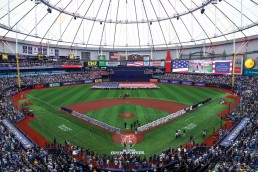
| digiLED has announced a new partnership with the Tampa Bay Rays for the 2026 season. The professional baseball team returned home to a restored Tropicana Field on April 6 following hurricane repairs. digiLED revamped the ballpark’s digital screen estate with bespoke, high-performance LED technology built specifically for the iconic dome.
The upgrade by digiLED delivers sharper visuals, stronger fan engagement, and fresh revenue opportunities across the ballpark. Tampa Bay Rays Return to Tropicana Field – A Fresh Start for 2026 After spending the 2025 season at George M. Steinbrenner Field in Tampa while Tropicana Field underwent major restoration (including a full roof replacement and new turf), the Rays are now back in St. Petersburg for the 2026 season. The home opener against the Chicago Cubs on April 6 drew a sellout crowd and marked an emotional homecoming. Just days into the return, the Rays welcomed the New York Yankees for a series that included a dramatic 5-4 walk-off win on April 12. The timing was ideal to showcase the enhanced digital experience. New Large Format Stadium LED Video Walls Transform the Main Bowl Static signage on either side of the main video board has been replaced with two striking digiLED displays. Each display measures 53.31 ft wide by 36.1 ft high. Together with the pre-existing central digiLED screen, they create one seamless visual canvas spanning 171.42 ft wide by 36.1 ft high. This continuous surface lets dynamic content and animations flow effortlessly across all three screens, giving fans a more immersive and energetic game day atmosphere. High Brightness Mid-Tier Ribbon Display Brings the MaintenX SkyDeck to Life A new marquee ribbon display now runs 302 ft wide by 6 ft high along the façade of the MaintenX SkyDeck, further enhancing the vibrant, high-impact digital experience. These video boards can display sponsor messages, game highlights, fan activations and live stats in real time. Premium Suite Fine-Pitch COB LED Screens Deliver Exclusive Fan Experiences In premium suite locations, digiLED has installed next-generation, fine-pitch COB LED technology. These high-resolution screens provide a crisp, close-up viewing environment that makes every play feel personal, even from the comfort of a luxury suite. Why Sports Stadiums Are Choosing Bespoke LED Video Walls for Fan Engagement digiLED’s approach at Tropicana Field focuses on custom engineering and full technical support throughout the season. From large-scale main bowl displays to fine-pitch solutions in premium areas, helping teams turn their digital real estate into a genuine competitive advantage. digiLED’s Ongoing Commitment to Tropicana Field and the Tampa Bay Rays “This partnership builds on digiLED’s previous work at the venue and reflects our long track record delivering LED solutions for major sports and entertainment arenas worldwide,” commented Michael Hopkins, SVP Commercial Integration USA, digiLED. “At digiLED, we’re proud to play a part in welcoming fans back to a refreshed Tropicana Field, and we look forward to seeing the new screens in action all season long.” Visit digiLED.com for more information on how bespoke stadium LED display solutions can deliver real impact for your next venue project. |

Comcast Business Powers Levi’s Stadium Tech
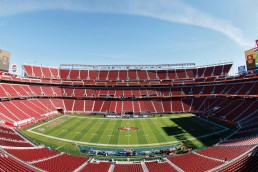
Comcast Business have detailed the advanced network infrastructure it has deployed at Levi’s® Stadium, home of the San Francisco 49ers – one of the most technologically-enabled venues in professional sports. The network underpins the high-performance connectivity required for immersive fan experiences, seamless operations, and large-scale live event production.
Through its ongoing collaboration with the 49ers, Comcast Business has helped enhance the stadium’s connectivity backbone. The infrastructure is engineered to handle the data demands of high-density WiFi usage, mobile engagement, and next-generation in-venue technology – simultaneously, at scale.
Comcast Business provides end-to-end connectivity across Levi’s® Stadium – high-capacity dedicated internet, redundant fiber architecture, advanced voice solutions, and stadium-wide WiFi presented by Xfinity – all engineered to work together like a single, unified system. This foundation enables critical operations throughout the venue, from mobile ticketing and frictionless concessions to real-time analytics in the stadium’s command center.
These capabilities support broader innovations across Levi’s® Stadium, including advanced 4K video production and one of the largest outdoor 4K video board deployments in professional sports – systems that require resilient, high-bandwidth connectivity to perform at broadcast-quality.
“Delivering a world-class experience for 70,000 fans starts with connectivity you can depend on,” said Costa Kladianos, San Francisco 49ers Executive Vice President and Head of Technology. “As we continue to transform Levi’s® Stadium into an Intelligent Stadium that exceeds our fans’ expectations, it is crucial to have bandwidth that is not only built for our current needs but for the future of the fan experience. Comcast Business gives us the reliability and scale to keep pushing what’s possible.”
For fans, that translates into fast, reliable connectivity for streaming, sharing, and engaging with digital experiences throughout the stadium. For operators, it enables more informed, real-time decision-making and reliable performance at scale across events of any size.
“Today’s stadiums operate as technology platforms as much as they do sports and entertainment venues,” said Christian Nascimento, SVP Connectivity and Digital Customer Solutions, Comcast Business. “Our work with the 49ers demonstrates how we partner with leading organisations to deliver scalable connectivity that performs under pressure and enhances every aspect of the experience for fans and operators.”
Comcast Business partners with many of the most recognized sports and entertainment organizations, delivering enterprise-grade connectivity solutions – from multi-gig fiber networks to advanced cybersecurity and managed services – for modern, high-performance venues. The 49ers partnership is among a growing portfolio of major venues where Comcast Business serves as the integrated technology partner for live events at scale.
Daktronics install new led screen at Davenport Field
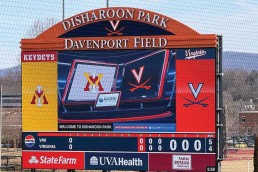
When Cavaliers baseball fans head to Davenport Field at Disharoon Park this season, they will be greeted by a new LED video display – top ten in size in college baseball – manufactured and installed by Daktronics in partnership with the University of Virginia (UVA). The installation was completed earlier this year, including a backstop display behind home plate, and is ready to make an impact on live events in Charlottesville, Virginia.
“The new Daktronics video board that was installed this spring has been such an asset to the experience with Disharoon Park,” said UVA Head Baseball Coach Chris Pollard. “It has accentuated the game-day experience for fans and supporters, while also providing important practice functionality day in and day out within our practice setting. Graphics and video really ‘pop’ within the confines of the stadium. This new board has only made one of the best atmospheres in college baseball even better.”
Video Display Details
The new outfield display is the sixth-largest in college baseball and measures 33 feet high by 58 feet wide with the ability to showcase all of the live action, statistics, replays, graphics and more that fans crave at every live sporting event, especially the statistics associated with baseball. It features a 10-millimeter pixel spacing for crisp, clear imagery delivered to fans throughout the stadium. The variable content zoning ability of the display ensures a mix of content needed to produce an informative and engaging experience.
“Davenport Field at Disharoon Park is an incredible ballpark to watch an elite-level college baseball game,” said Fran Kulas, Daktronics sales representative for Live Events in the mid-Atlantic region. “Seeing this display lit up in person and observing the reactions to it from the dedicated and loyal supporters of the program was a truly special experience. This display is a game-changer for UVA and we’re honored to have partnered with such a special university, athletics department and storied baseball program to create many more unique experiences for years to come.”
Backstop Display Details
Behind home plate, a backstop display brings additional engagement and sponsorship opportunities to UVA baseball. It measures roughly 3 feet high by 11.5 feet wide and features a 4.4-millimeter pixel spacing to ensure excellent image clarity and contrast to every logo, animation and graphics shown.
Daktronics is also including a complete Show Control solution. This industry-leading control system provides a combination of display control software, world-class video processing, data integration and playback hardware that forms a powerful yet user-friendly production solution. For more information on Show Control, visit www.daktronics.com/show.
Sacramento Republic showcase hospitality at new stadium
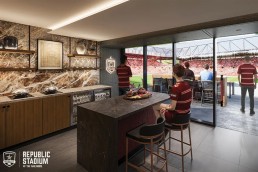
As construction crews advance important infrastructure work, Republic FC is launching a new, elevated matchday experience, marking a new era of premium offerings in Sacramento sports and entertainment hospitality. Republic FC’s new downtown home will feature two new suite types – 12 Field Suites and 15 Executive Suites – adding to the world-class venue set to open in 2028.
“Sacramento’s world-class venue is coming to life, and these suites represent our vision for what premium truly means in this market. We’ve designed a hospitality and benefits package that we believe will stand among the best in American soccer — but more importantly, it will feel distinctly Sacramento,” said Republic FC President & General Manager Tim Holt. “Whether you’re a business looking to entertain clients, a family wanting to create lasting memories, or a group looking for the ultimate matchday outing, we’ve built something special for each experience.”
Designed by celebrated premium experience designer Edith Ponciano of EP Atelier — whose portfolio includes BMO Stadium, Chase Center Arena, Q2 Stadium, and Snapdragon Stadium — the suites draw deep inspiration from Sacramento’s distinctive architectural character and the warmth of its finest neighborhoods. The interior design of the suites, clubs and additional social spaces will complement the overall venue architecture and fan first design elements crafted by MANICA – leading sports architecture firm that recently opened Inter Miami CF’s venue, NU Stadium.
“Sacramento has a unique elegance expressed through the region’s homes, restaurants, and architecture,” said Edith Ponciano of EP Atelier.
“Our goal has been to create spaces that honour Sacramento’s timeless character while offering an elevated sense of comfort, creating environments that feel warm, inviting, and residential in nature rather than traditionally sports-inspired. These suites are designed to feel equally suited for game day and everyday moments beyond the stadium.”
The suites are inspired by Sacramento itself. Each space is designed to feel warm, welcoming, and familiar, drawing from the homes and neighborhoods that define our region. Classic entryways, outdoor patios, shared spaces to gather and celebrate, and the best seats in the house with elegant touches to showcase the core spirit of Sacramento through elevated design.
The Field Suite at Republic FC’s new stadium is a first-of-its-kind premium group experience in Sacramento — an indoor/outdoor, climate-controlled suite for private group gatherings and celebrations, positioned on the West touchline. Completely covered and fully all-inclusive, it places guests at the heart of the action for sports and entertainment events. The twelve suites will offer all-inclusive food and beverage programming, seating for twelve guests and spacious 24-inch seating and coveted field-level access, ensuring an intimate and luxurious view of the action.
Perched above the action, the Executive Suites at Republic FC’s new stadium delivers a refined, home-inspired premium experience for guests, clients, friends, and families. Sightlines connect guests to every event, while refined interiors — featuring welcoming sitting spaces, shared dining areas, and seamless indoor/outdoor flow — evoke the elegance of Sacramento’s finest homes. The fifteen elevated suites will feature all-inclusive food and beverage service, room for twelve guests with the option for four additional tickets, and generous 24-inch-wide theater-style seats, creating a premium setting with exceptional sightlines and a more private, upscale experience.
Suite holders will enjoy an unparalleled matchday experience, beginning with dedicated concierge hospitality service and access to premium parking upon arrival. Inside, guests are treated to all-inclusive food and beverage programming and exclusive access to the premium club and social spaces in the West Tower. Beyond matchday, suite holders can take full advantage of their investment year-round. Suites are available for private use on non-match and non-event days, supported by concierge event service to seamlessly arrange access to the venue’s various club and social spaces for corporate gatherings or private celebrations. Packages are also available for additional stadium events, including concerts and other year-round events.
Cumberland Sports Village plans given Green light
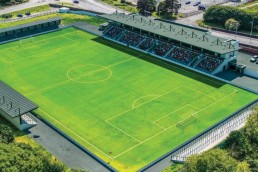
Plans for Cumberland Sports Village have been given the go-ahead.
The planning approval is another important milestone for the ambitious project. It follows the announcement that an additional £4.5 million funding has been secured from the recently formed Cumbria Combined Authority to enhance the development in Workington.
The additional CCA funding will result in the scheme being extended to include the replacement of all the terraces and increase the total capacity at the new stadium to 5,000.
Within the planning submission, it said that the development will “..create a high quality, inclusive and accessible venue for the football and rugby clubs and benefit the wider community with the addition of new sporting facilities for all to enjoy.”
The project is also supported by the UK Government Town Deal, Cumberland Council and Football Foundation.
Leader of Cumberland Council, Cllr Mark Fryer, said: “The Cumberland Sports Village (CSV) project presents a fantastic opportunity to create a modern, fit-for-purpose stadium facility for both Workington AFC and Workington Town RLFC.
“As well as sport, the stadium would also act as a focal point for both the community and businesses within the area. An improved hospitality offer means the stadium could also be used for meetings, conferences, functions, events and community activities.”
The revised scheme will be project managed and delivered by Cumberland Council.
A design team is in the process of enhancing the existing scheme and a new programme of works and updated timeframes is being produced. Plans for a new community pitch are also being drawn together.
The new stadium will be shared by Workington Town RLFC and Workington AFC, who are known as Workington Reds. They continue to be closely involved in the project.
The Community pitch will be undertaken by the Football Foundation.
Work Pro Audio: CVA Series
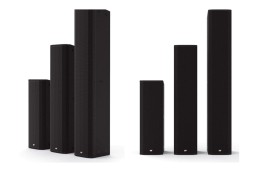
The CVA Series of column vertical array speakers from WORK PRO Audio, the installation and pro audio division of Equipson are suitable for a wide range of applications. The new speaker series has been designed to offer precision sound and flexibility in a highly durable cabinet.
The CVA Series is a range of line array column speakers consisting of three models: the CVA 4, CVA 6 and CVA 8. Featuring two, four or six 5-inch woofers depending on model, and dual 3/4-inch compression drivers paired with line horns, the CVA Series delivers from 500W program power rating to 1300W at 8Ω to produce clear and powerful audio.
In addition to its exceptional sound performance, the CVA Series has been engineered with extreme durability as a top priority, further extending its appeal.
Read the full article from ISSUE 47 below:
https://issuu.com/mondiale/docs/mdst47_digitallr/60
RAJ Sports Sign Lease Expansion at Kaiser Permanente Performance Center
Workspace Property Management, a leading suburban commercial office property management operator, have announced that RAJ Sports, the sports investment platform for the Bhathal Family and owners and operators of the NWSL’s Portland Thorns FC and the new Portland Fire WNBA franchise, signed a long-term lease expansion for its headquarters at 8760 NE Evergreen Parkway in Hillsboro, Oregon, a suburb of Portland.
The additional lease comes 14 months after a 15-year lease agreement was signed with RAJ Sports for two other office buildings and surrounding land to develop the first dual-sport professional women’s performance center and practice facility for the Thorns and Fire at 3220 and 3340 NE Aloclek Drive. This new office lease will run coterminous with the adjacent practice facility lease through February 2040.
“Workspace is proud to deepen our partnership with RAJ Sports, one of the most innovative and forward-thinking sports ownership groups in the country. We are excited to support the Portland Thorns and Portland Fire and transform our prime Hillsboro location into the undeniable home of women’s sports in the Pacific Northwest,” said Tom Rizk, CEO of Workspace Property Management.
Roger Thomas, President and COO of Workspace Property Management commented, “Being a strong partner to our tenants and creating the adaptive property solutions that meet their unique needs remains our top priority. Our leasing momentum remains strong throughout our premier suburban office portfolio and we are energized by what’s on our horizon.”
"When we originally envisioned the Kaiser Permanente Performance Center, we were looking at roughly 60,000 square feet. We're now at 100,000 square feet and that growth reflects exactly where this organization is headed. This is a $150 million investment in the future of women's sports, and making sure our business operations team is housed within that environment wasn't just a practical decision, it was an intentional one. We want everyone building this organization, on the field and off, working side by side in a facility that sets a new standard for what women's sports infrastructure can look like,” said Mike Whitehead, Managing Director of RAJ Sports.
RAJ Sports remains the anchor tenant at the 12-acre Evergreen Corporate Center, which includes the historic dual-sports performance complex featuring outdoor soccer pitches and indoor basketball courts, along with two remaining office buildings. The Thorns and Fire’s corporate headquarters will be positioned on the first floor of the two-story building, with the remaining 75,000 square-feet available to future tenants in need of space ranging from 9,100 to 43,000 square-feet.
An adjacent property within the center, 3310 NE Aloclek Drive offers larger blocks of space to accommodate tenants needing 45,000 to 91,000 square-feet. With Hillsboro’s strong market demand, the presence of the Thorns and Fire’s teams, and the property’s history as a former Nike office, the site remains a highly desirable destination for businesses seeking space in the area.
Aramark Named Catering Partner for Brno’s New T‑ARENA
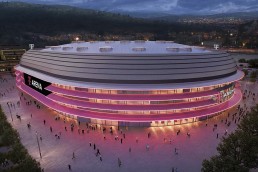
ARAMARK Czech Republic has been selected as the catering services provider for the new, multifunctional T-Mobile Arena in Brno, Czech Republic’s second largest city.
Currently under construction, the T-ARENA is scheduled to begin greeting sports fans, concert-goers, and other guests in Fall 2026. The arena will have the ability to host up to 13,000 spectators. Events will be held approximately 120 days a year.
“We consider the selection of a strong and experienced partner in the food service industry to be a key step in preparing the arena for full-scale operations,” said Petr Kratochvíl, Chairman of the Board of Directors for Arena Brno and Brno City Councilor for Transportation. “Food service is an integral part of the overall visitor experience, and our partnership with Aramark gives us confidence in long-term quality and a professional approach.”
Aramark Czech Republic’s culinary offerings will be available at one restaurant and 12 concessions outlets, along with premium catering services on the club level and in skyboxes and party boxes.
“We’re honored to be chosen as the catering partner for the new arena in Brno,” said Milan Pech, President and Managing Director, Aramark Czech Republic. “Delivering exceptional food experiences is at the heart of what we do, and we’re excited to bring that commitment to every visitor at T‑ARENA.”
One of the most trusted catering providers in Czech Republic, Aramark has delivered exceptional food and facility services to clients and their guests for more than three decades, serving large industrial companies, the armed forces, schools, healthcare facilities, and sports clubs, including a collaboration with the Slavia Prague football club.
Aramark Czech Republic’s new concessions agreement at T-ARENA is valid for 10 years with the option to extend for an additional five years.
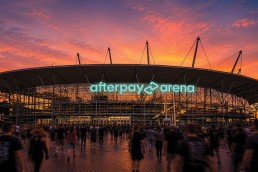
Qudos Bank Arena becomes Afterpay Arena
Afterpay, the leading buy-now-pay-later (BNPL) platform, have announced a naming rights partnership that will transform the venue currently known as Qudos Bank Arena into Afterpay Arena – recently awarded the number five arena in the world and Australia’s most iconic live entertainment destination.
The partnership, set to officially launch in the coming months with an initial five-year deal, will see the iconic Sydney Olympic Park venue become the first major entertainment destination in Australia to offer complete payment flexibility across the entire customer experience – from initial ticket purchase through to meal and merchandise transactions inside the venue.
New research commissioned by Afterpay reveals that access remains the defining challenge for Australia’s live entertainment industry: 94% of cost-affected event-goers have missed events due to upfront payment barriers. The opportunity is clear – 58% of consumers say they would be more likely to attend with flexible payment options available, and 74% would spend more at venues that offer payment choice.
The partnership leverages Block’s complete payment ecosystem, bringing together Afterpay’s flexible payment solution for ticket purchases and Square’s integrated payments and POS platform across in-venue transactions. Fans can split ticket purchases across four interest-free instalments, while Square powers faster food, beverage, and merchandise transactions throughout the venue – minimising time away from the live experience and keeping fans where they came to be.
“Live experiences are one of the more meaningful ways people choose to spend their time. We wanted to be the brand that makes sure nothing gets in the way of that,” said Nick Molnar, Co-founder and CEO of Afterpay.
“What we’ve built here is genuinely end-to-end – the flexibility starts when you buy your ticket and carries through to fans’ meal and a piece of merch on the night. Square’s technology makes every transaction as fast as possible, because every second you’re standing in line for merch is a second you’re not in the moment you came for,” said Molnar.
Since opening with Luciano Pavarotti in 1999, the Arena has become a landmark venue for live entertainment in Sydney, hosting the world’s leading artists from Billie Eilish to Rüfüs Du Sol to TWICE, major sporting events, comedy, family entertainment and cultural experiences. The Arena’s 15 millionth ticket was sold during Linkin Park’s Tour 2026 World Tour, adding to the recognition by Billboard magazine as a Top 5 Live Music Venue globally in 2025.
“We are obsessed with enhancing the guest experience at every interaction, and we know Afterpay’s popularity with Australian audiences means they now have another option to secure tickets,” said Harvey Lister AM, President & CEO, Asia Pacific & Middle East for Legends Global.
“More than 1.1 million people walk through this Arena’s doors every year, and this partnership represents a significant evolution in how Australians access live entertainment. Afterpay’s five-year commitment is a genuine investment in Australian culture and in every single one of those fans,” he added.
The physical transformation of the venue – including new external signage, interior refreshes, and fully integrated Afterpay and Square touchpoints throughout – is currently underway, with further milestones to be announced in the coming months. During this period, the venue will continue to be known as Qudos Bank Arena and will host its full calendar of world-class entertainment throughout the transition.
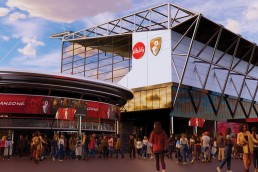
Planning Permission Approved for Vitality Redevelopment
AFC Bournemouth have welcomed BCP Council’s decision to approve the club’s redevelopment plans for Vitality Stadium.
The approval represents a major milestone in the club’s long-term commitment to Bournemouth, the local community and the future of top-flight football at Vitality Stadium.
The proposed redevelopment will support the club’s ambition to increase stadium capacity, improve the supporter experience and enhance facilities for fans, players, staff and partners.
The wider scheme also includes significant public realm and infrastructure improvements around the stadium campus, including enhanced pedestrian and cycle routes, landscaping and improved accessibility.
AFC Bournemouth remains committed to continued engagement with residents, supporters, local businesses and stakeholders as the project progresses through its next phases.
The club believes the redevelopment will further strengthen Bournemouth’s profile nationally and internationally, while supporting the local economy and creating long-term community benefit.
AFC Bournemouth chairman and owner, Bill Foley, shared his comments with afcb.co.uk: “The granting of planning permission is a major step forward in our vision for the future of this football club and the wider community.
"This project is about far more than a stadium. It is about strengthening our connection with supporters, investing in the local area, and ensuring AFC Bournemouth can continue to compete and grow at the highest level both on and off the pitch.
"I’d like to thank BCP Council and the planning committee for their efforts over the past year. We are proud of what has been achieved so far, and this approval represents the beginning of an exciting new chapter for everyone connected with the club.”
The redevelopment forms part of a phased long-term vision to modernise and future-proof Vitality Stadium while preserving AFC Bournemouth’s historic home in Kings Park.