

Lincoln City update on Stadium work progress
Work is continuing on the exciting Imps Territory project at the ProAmpac Stadium as Lincoln City prepare for their upcoming Championship campaign.
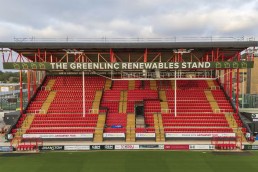
With the roof and external areas of the Greenlinc Renewables Stand completely repainted, solar panels have been installed on the roof.
A new battery storage area has been built outside the stadium which will store electricity generated by the panels.
The installation of new seats in the stand has also been completed, while the seats in the Stacey West Stand have been completely removed ahead of new ones being put in.
The new venue, on the back of the Rilmac Stand, is really taking shape. The roof and cladding have been in place for a couple of weeks, with the floor now in for the upper tier of the building.
The main hospitality area is in place, as are the spaces where the additional seats will be installed.

New York Yankees select Lumen to connect the organisation
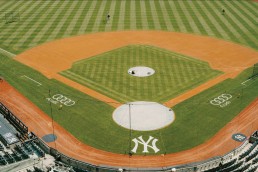
The New York Yankees have selected Lumen Technologies to run the network behind one of the most recognised brands in sports, connecting Yankee Stadium and the team's facilities in Tampa, Florida, and carrying everything from security and game video to fan internet traffic. As part of the move, the Yankees relocated their primary data center out of Yankee Stadium into a new, purpose-built Tampa facility engineered to withstand 200 mph sustained winds, stronger than any hurricane on record in the Atlantic Basin.
"Live sports are one of the clearest examples of how real-time demand is reshaping industries," said Ryan Asdourian, chief strategy and marketing officer of Lumen Technologies. "The Yankees understand that success today depends not just on what happens on the field, but on the systems behind every decision, every play, and every fan interaction. We're proud to give them a network that holds up under pressure and scales with their ambition."
Lumen connects the Tampa data center to Yankee Stadium over two separate 100-gigabit fiber paths, one routed through New York and one through New Jersey, both terminating in Tampa. One path carries live traffic; the second stays on standby and takes over automatically without data loss if the first is disrupted. Because the two paths are independent, the Yankees can always remain connected between New York and Tampa.
"With automatic failover, we can lose our entire central office and still maintain connectivity to the Tampa data center," said Erron Pettry, senior manager of data center facilities operations for the New York Yankees. “The Yankees cannot go offline, and having Lumen’s infrastructure safeguards our operations."
The network also flexes with demand. Rather than paying year-round for a peak data-rate the team hits only a few times a season, Lumen’s Network-as-a-Service enables the Yankees to add or shed capacity as needed by the event and pay only for what they use, freeing budget for other priorities.
The pressure peaks in the moments fans remember. On a sold-out night, roughly 50,000 fans and staff may join the stadium Wi-Fi at once, and a single play can spike traffic instantly.
"When the Yankees stars hit a home run, thousands of fans instantly capture it, text it, and share it.” Pettry said. "That creates a significant surge in bandwidth, and we trust Lumen to help keep that connectivity moving out of the stadium — which is why this partnership is so important.”
The same flexibility supports the press. An early regular season game might host 40 to 50 media members; a postseason game can bring hundreds, all pushing video and photos out at once. For the people who run the network, the goal is that no one notices it at all.
“If my team is doing their job and the network’s doing its job and everything’s working, nobody notices anything," said Scott Swist, senior director of IT for the New York Yankees. "The goal of my team is to be invisible."
"AI is a new and exciting frontier, and our new Tampa facility provides us with room to grow into emerging cloud and AI services," said Mike Lane, senior vice president of technology and broadcasting and chief information officer for the New York Yankees. “We partnered with Lumen to feel secure that our network can keep an immense volume of data moving whenever and wherever the organization needs it to go. The partnership between the Yankees and Lumen has been transformative for us."
Roig Arena select d&b audiotechnik as operational partner
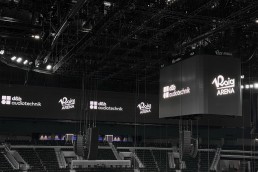
Valencia’s Roig Arena has selected d&b audiotechnik as its operational partner to equip the venue with a new permanent sound system. This system ensures the arena can reliably host an increasingly ambitious schedule of concerts, sporting events, and international shows.
The installation features systems from d&b audiotechnik’s SL, A, and CL-Series and its versatility has already been proven during two high-profile events: the celebration of Valencia Basket’s second league title and Rod Stewart’s concert on June 30 – the British artist’s only Spanish performance of 2026 and the first major international show held at the venue using the new system.
Adaptive technology to suit any venue configuration
With a capacity of up to 20,000 for concerts and over 15,000 for sporting events, Roig Arena is a highly versatile venue that changes its layout depending on the type of event.
To meet these needs, the Arena employs a combination of SL-Series systems (GSL, KSL, and XSL) alongside AL90 and CCL units – configured here as front-fill and delay systems, respectively – to reinforce coverage in areas both close to the stage and further away. The main PA system consists of SL-Series left and right arrays (each with 12 GSL8 modules and two GSL12s), complemented by two KSL arrays for out-fill (10 KSL8s per side) and two XSL arrays for wide out-fill (8 XSLs per side), ensuring uniform coverage throughout the venue.
Low-frequency reinforcement is handled by an SL-SUB system, comprising two arrays of six units per side and six additional ground-stacked subwoofers. The system is rounded out by ten delay arrays equipped with CCLi8s for the furthest zones and 16 AL90 systems configured as front-fill/down-fill units to optimize coverage for the areas closest to the stage.
"The Roig Arena was conceived from the start with a clear goal: to offer the best possible acoustic experience. To achieve this, work focused on both the sound quality inside the venue and acoustic isolation from the outside. Incorporating this d&b solution represents another step in that commitment, elevating acoustic performance and allowing us to guarantee a consistent, high-quality audio experience anywhere in the venue," explains Paül Mollà, Technology Director at Roig Arena.
A permanent system tailored to the needs of a multifunctional venue
The d&b audiotechnik installation is part of the venue’s permanent infrastructure and remains integrated into the ceiling structure when not in use. This significantly reduces setup times for each event, streamlines operations, and maximizes the space's flexibility.
Coverage is further optimized through d&b ArrayProcessing, which is used to adapt sound distribution to the venue's specific configuration for each event. A custom-developed rigging solution allowed for seamless system integration and rapid installation, minimizing work time within a technically complex venue.
A strategic partner for the arenas of the future
The installation also incorporates state-of-the-art d&b audiotechnik amplification, designed to deliver maximum performance with lower energy consumption.
"d&b’s commitment to efficiency and reliability, combined with the brand’s prestige among major international tours, were key factors in our decision to choose this system. We aim to establish the Roig Arena as a premier venue for music, sports, and entertainment. With our new d&b system, we are ready to regularly host top-tier international artists in Valencia," states Pablo Serra, Music Content Director at Roig Arena. Upcoming scheduled events include concerts by artists such as Pet Shop Boys, Chayanne, Judas Priest, and Bryan Adams, as well as top-tier sporting competitions like Project B – the new international touring basketball league.
“With this project, d&b audiotechnik reinforces its position as a technology partner for arenas and large multi-purpose venues. The combination of acoustic excellence, coverage control, energy efficiency, and a comprehensive ecosystem of hardware, software, and services offers Roig Arena a reliable platform for artists, operators, and the audience,” notes Alfonso Luria, Sales Manager at d&b audiotechnik Iberia.
16,000 Capacity Arena included in City Walk Abuja Plans
Link Developments has today announced the launch of City Walk Abuja, a privately funded, landmark mixed-use smart city development that will establish a new global gateway for investment, enterprise, culture, and innovation in Africa.
Strategically located on the principal corridor linking Abuja's Central Business District with Nnamdi Azikiwe International Airport, within a government-designated Free Trade Zone, City Walk Abuja has been conceived as a world-class destination where businesses, residents, and visitors can live, work, and connect within a sustainable, technology-enabled urban environment.
Its Free Trade Zone status is intended to create an attractive environment for international investment, offering businesses a globally competitive location from which to establish regional headquarters, expand operations and drive innovation across West Africa.
Spanning over 200 hectares, the master planned development will integrate commercial, residential, hospitality, leisure, cultural, and civic districts into a vibrant new city designed to support Nigeria's long-term economic growth and reinforce Abuja's position as one of Africa's leading capitals.
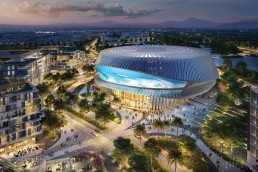
Among its defining features will be Africa's tallest tower, rising 450 metres, alongside an international arena with a capacity of over 16,000 seats, creating two landmarks that will anchor a new gateway district for the continent. Designed around a dramatic natural ravine that forms the project's ecological spine, City Walk Abuja will combine landscaped public spaces, biodiversity corridors, and sustainable water management systems with smart infrastructure and walkable neighbourhoods.
The masterplan has been created by internationally acclaimed design studio Benoy, whose portfolio includes some of the world's most recognised mixed-use urban destinations. Drawing on global expertise while responding to Abuja's climate, culture, and future growth, the design places sustainability, public realm, and human-centred planning at the heart of the development.
To support the delivery of this ambitious vision, Link Developments has appointed Broadgate Developments Group Ltd as Development and Construction Management Advisor. Broadgate will provide executive development leadership, technical governance, and integrated programme oversight throughout the delivery of City Walk Abuja.
With extensive experience delivering complex real estate developments, master planned communities, and infrastructure-led projects across Africa and international markets, the Broadgate management team has played a leading role in landmark developments including Jabi Lake Mall and Heritage Place in Nigeria, One Airport Square in Ghana, and the Douala Airport Business Park in Cameroon. The appointment reflects Link’s commitment to delivering City Walk Abuja to the highest international standards.
Peter Young, Chief Executive Officer of Broadgate Developments Group Ltd, said: "City Walk Abuja represents the type of transformational development where vision, technical excellence, and disciplined execution must work together seamlessly.
"We look forward to working alongside Link, Benoy, and the wider professional team to help deliver a destination that has the potential to establish a new benchmark for integrated urban development in Africa."
Alex Arkaah, Chief Development Officer and Group Technical Director of Broadgate Developments Group Ltd, added: "The future of every great city is shaped long before its skyline emerges. City Walk Abuja presents a rare opportunity to bring together visionary ambition, international expertise, and engineering excellence to create a destination designed for long-term value.
"The greatest developments are defined not only by their scale, but by the confidence they create, the opportunities they unlock, and the legacy they leave for future generations."
City Walk Abuja is designed to become a catalyst for inward investment, economic diversification, and sustainable urban development, creating a globally competitive destination that showcases the future potential of African cities.

Hawk-eye strike VAR partnership with Croatian Football Federation
Hawk-Eye Innovations, a Sony group company, and the Hrvatski nogometni savez (HNS), the Croatian Football Federation, have announced that they’ve officially entered into a multi-year agreement to deliver state-of-the-art Video Assistant Referee (VAR) services across Croatia’s top-tier football competitions. This partnership builds upon Hawk-Eye’s proven track record of delivering elite VAR services across major FIFA and UEFA competitions, alongside its ongoing, long-term partnerships with prominent domestic leagues including the Premier League, Serie A, Ligue 1, the Eredivisie, CBF, and the Saudi Arabian Football Federation (SAFF).
The finalised agreement secures a five-year term, running from the 2026/27 season through the 2030/31 season, ensuring long-term sporting integrity for Croatian football.
Hawk-Eye will deploy its industry-leading technology across Croatia's top tier of domestic football. This comprehensive rollout includes full-season coverage for all SuperSport Hrvatska nogometna liga (HNL) league matches, the annual Croatian Supercup curtain-raiser, and the crucial final stages of the Croatian Cup, beginning with the high-stakes quarter-finals. In total, Hawk-Eye will support up to 188 matches per season across 10 stadiums nationwide, ensuring elite technology integration at every major milestone of the domestic calendar. The season will kick off on Saturday 1st August, with the opening match day of the SuperSports HNL.
Max Wright, Managing Director, Football at Hawk-Eye highlighted: “Our VAR technology and service continues to be the gold-standard in video officiating in football, and we are extremely proud that the Croatian Football Federation has chosen us as its partner for the next five years. We look forward to supporting the federation in ensuring the Croatian Football League has the highest level of officiating for many years to come.”
"The implementation of the most advanced technological solutions is an important part of the continuous development of Croatian football. By entering into this five-year partnership with Hawk-Eye, we have secured the long-term stability of the VAR system and ensured the highest standards of its implementation across our competitions,” said Josip Tomaško, General Secretary of the Croatian Football Federation.
“We are confident that Hawk-Eye's technology, expertise and experience will further enhance the quality of refereeing, the integrity of our competitions and the trust of everyone involved in Croatian football. HNS remains committed to investing in infrastructure, education and modern solutions that keep pace with the ongoing development of world football. We are delighted to be working with a global leader in officiating technology over the coming years, ensuring that our competitions continue to be delivered to the highest standards of organisation and match operations.”
The collaboration extends beyond technology delivery. Ahead of the 2026/27 season kickoff, Hawk-Eye will deliver a comprehensive, hands-on VAR training program for select HNS match officials to ensure seamless operational readiness. Throughout the season, every match day will be backed by dedicated on-site technical support teams, guaranteeing elite-level system integration, reliability, and match-day integrity.
This inaugural deployment marks the beginning of a long-term strategic collaboration, with both organisations committed to exploring deeper technology and innovation integrations in the seasons to come.
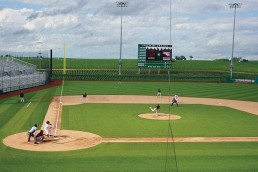
Daktronics install LED Video Board at Field of Dreams Ballpark
Daktronics of Brookings, South Dakota, has manufactured and installed an LED video board in the outfield of Field of Dreams Ballpark in Dyersville, Iowa. The new facility is adjacent to the famed corn field-framed ballpark from the iconic 1989 movie. Installation was completed this spring ahead of hosting a minor league all-star game and a professional baseball game later in the summer.
“The addition of the Daktronics LED display is another important step in bringing a first-class fan experience to the Field of Dreams Ballpark,” said Tyler Daugherty, ballpark general manager. “Whether we're hosting Northwoods, high school championships, collegiate competition, concerts or professional events, this technology allows us to create memorable moments for every guest while honoring the timeless tradition and magic that make the Field of Dreams so special.”
“Since 1989, the iconic movie site has drawn fans from around the world and a chance to play catch or run the bases,” said Matt Warnke, Daktronics sales representative. “Today, with the new permanent ballpark, it gives baseball fans another opportunity to enjoy the great American pastime. Daktronics is proud to play a small part in what will be an amazing facility.”
Video Display Details
The video display in the outfield measures nearly 30 feet high by 50 feet wide and features a 10-millimeter pixel spacing for excellent image clarity, contrast and viewing angles. The display can show one large image or be divided into zones of content much like a major league production.
The installation includes two pace-of-game clocks and a digital content package to be produced and delivered by Daktronics Creative Services. Altogether, it features everything needed to host contests from the little leagues to the major leagues.
Powering the equipment is the Daktronics Show Control system. This industry-leading control system provides a combination of display control software, world-class video processing, data integration and playback hardware that forms a powerful yet user-friendly production solution.
“This isn’t just another ballpark,” added Daugherty. “This is a place that belongs to all of us – a living testament to why we love this game in the first place. It is for every fan who ever played catch with their father, every child who dreamed of the big leagues, every person who understands that baseball is more than a game.”

AXS becomes ticketing partner of Texas Health Mansfield Stadium
AXS, a trusted leader in advanced ticketing and live event technology, has announced it has been selected as the Official Ticketing Partner of Texas Health Mansfield Stadium, the newest state-of-the-art venue in Mansfield, Texas, following the stadium’s grand opening on July 1.
Texas Health Mansfield Stadium is quickly emerging as one of the premier sports and entertainment destinations in Texas. In addition to serving as the home venue for North Texas SC, the stadium recently served as the training base and operational headquarters for the Czechia National Team during its FIFA World Cup run. The venue will also host USA Women’s Rugby vs. Italy as part of World Rugby’s WXV Global Series, as well as Concacaf W Championship quarter and semifinal matches featuring the U.S. Women's National Team, Mexico, and Canada, further elevating its profile as a destination for international sports.
AXS will power ticketing operations across Texas Health Mansfield Stadium, providing fans with a seamless and secure ticket-buying experience through its industry-leading platform, including AXS Mobile ID technology.
"As we open the doors to Texas Health Mansfield Stadium and enter an exciting new chapter, having the right ticketing partner is critical," said Scott Norton, General Manager of Texas Health Mansfield Stadium. "AXS understands both the operational needs of a modern venue and the importance of creating exceptional fan experiences. Their technology, service, and commitment to innovation made them the clear choice for our future."
AXS will provide Texas Health Mansfield Stadium with its full suite of ticketing and mobile ticketing solutions, including mobile ticket management, data and analytics tools, integrated marketing capabilities, premium seating support, and access to AXS's expanded distribution network and live event technology.
“Great venues create lasting memories, and every memorable experience starts with getting fans through the gate quickly and confidently,” said David McElwee, Vice President, AXS. “We’re incredibly proud to support Texas Health Mansfield Stadium from day one, helping deliver an easy, convenient and seamless ticketing experience for fans attending everything from soccer matches and international rugby to major live events.”
The partnership further strengthens AXS's growing footprint across sports and live entertainment. The company serves as the ticketing partner for some of the world's most iconic sporting events and organizations, as well as premier venues and events around the globe.
With more than 1,600 clients worldwide and over 70 million tickets delivered annually, AXS continues to invest in technology that helps venues, teams, and event organizers deepen fan engagement while maximizing business performance.
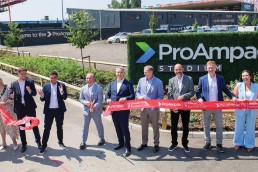
Lincoln City unveil the ProAmpac Stadium
Lincoln City and ProAmpac have officially unveiled the ProAmpac Stadium marking another milestone in the long-term partnership between the club and its stadium naming rights partner.
Representatives from ProAmpac joined Lincoln City staff and members of the local media for a special ribbon-cutting ceremony to celebrate the stadium's new identity.
Ahead of the unveiling, guests were welcomed for a behind-the-scenes tour of the ProAmpac Stadium, offering an insight into the home of the Imps.
The group then gathered outside the stadium for the official ribbon-cutting ceremony, formally marking the unveiling of the ProAmpac Stadium and celebrating the next chapter in the partnership between the club and ProAmpac.
Following the ceremony, guests made their way to the Branston Legends Lounge for a series of presentations, before enjoying the opportunity to pose for photographs alongside the Sky Bet League One trophy.
The landmark 10-year agreement sees the stadium renamed the ProAmpac Stadium as part of a long-term commitment to both Lincoln City and the wider Lincolnshire community.
The ceremony celebrated the beginning of a new chapter in the partnership, which will continue to support the club's ambitions while creating opportunities to engage with supporters, local organisations and the wider Lincolnshire community.

Olympiacos unveil new Stadium plans
Thursday, 2 July 2026, marked a historic day for Olympiacos, as Club President Evangelos Marinakis officially unveiled the new “Georgios Karaiskakis” Stadium.
The clubs's new home will be expanded and comprehensively modernised, becoming the club’s new shining asset. This unique project will welcome more than 53,000 supporters at every match, providing the stage for new unforgettable moments as Olympiacos continues to pursue glory in Greece and across Europe.
The Club’s leader, Evangelos Marinakis, presented the new Georgios Karaiskakis Stadium during an official event held at the iconic Municipal Theatre of Piraeus. The entire Olympiacos first-team squad was in attendance, alongside athletes representing the Club’s amateur sports departments, members of the women’s football team, and numerous distinguished guests
The project, which will cost more than €250 million, will be financed by Olympiacos and Marinakis personally.
Marinakis said: "The Club has its own new state-of-the-art new training centre in Renti, the finest in Greece and one of the best in Europe.
It continues to improve every year, just as the Club’s state-of-the-art privately owned headquarters continue to develop. The Club now possesses every resource necessary to sustain the largest budget in Greek football and a team capable of competing at UEFA Champions League level.
All of this has been achieved through substantial personal investment on my part, just as substantial were the investments made in Karaiskakis Stadium, which can no longer accommodate the team we dream of seeing achieve even greater success in Greece and throughout Europe.
That is why our new home will have a capacity of more than 53,000 seats. It will be the largest and most modern football stadium in the country a technological marvel of which Olympiacos, Piraeus, and all of Greece will be proud."

O2 & Boldyn Networks significantly enhance 5G at Silverstone
O2 has become the first operator to go live on Silverstone’s new high-capacity mobile network, putting its customers in pole position ahead of one of the biggest sporting events of the year.
Delivered in partnership with Boldyn Networks, the new distributed antenna system (DAS) spans across 570 acres, including the 3.66 mile Grand Prix circuit.
The deployment marks a significant upgrade for the circuit. Historically, operators have relied on temporary infrastructure to support major events at the track. Boldyn’s network is the first permanent mobile solution at Silverstone, helping O2 customers share photos and videos, follow live race updates, access event information and stay connected throughout the venue.
As demand for mobile data at major sporting events continues to grow, the network will help deliver a faster and more reliable experience for fans all year round.
Professor Robert Joyce, Director of Mobile Access Engineering at O2, said: “Whether it’s sharing a video of a dramatic overtake, finding your way around the venue or keeping in touch with friends and family, connectivity has become a huge part of the fan experience for racing fans. Going live on Silverstone’s new dedicated network infrastructure means O2 customers can enjoy a faster and more reliable connection at one of the biggest events in the British sporting calendar.”
Paul Osborne, Chief Commercial Officer at Boldyn Networks UK, said: “This weekend’s British Grand Prix will draw over half a million fans, driving record demand for connectivity. O2 is moving first, giving its customers priority access to the enhanced experience powered by our state-of-the-art Silverstone network. At Boldyn, we’re proud to be supporting Silverstone and advancing connectivity at the UK’s most iconic venues.”
The launch at Silverstone forms part of Virgin Media O2’s wider investment in connectivity at some of the UK’s busiest venues, transport hubs and destinations where demand is highest. Through its £700m Mobile Transformation Plan, the operator is continuing to improve coverage, capacity and reliability across the country.