

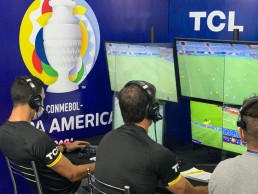
Copa América Uses Clear-Com Solutions for VAR Technology
The 2021 Copa América tournament was the 47th edition of the international men's football championship organized by South America's football ruling body, CONMEBOL. Clear-Com®’s B
A Video Assist Referee is an appointed match official who reviews decisions made by the head referee with the use of video footage in order to minimize human errors. This process requires efficient, reliable communications with very low latency between the VAR referee reviewing the footage, the head referee on the field, and the video replay operator, as it can greatly influence the outcome of a game.
“The communication is the most important part for the VAR team. It’s important that the audio is clear and intelligible because we are recording it for playback that can impact who wins the game,” said Sergio Miño, Technical Manager, Mediapro Paraguay.
Five major Brazilian stadiums—the Maracanã, Estádio Olímpico Nilton Santos (Engenhão), Mané Garrincha, Serra Dourada, and the Arena Pantanal—used a VAR system powered by Clear-Com systems for their Copa América matches.
Arena Pantanal in Cuiabá city used a VAR system based around FreeSpeak II, the Serra Dourada Stadium in Goiania city used a HelixNet digital partyline, and two stadiums in Rio de Janeiro, the Maracanã and Estádio Olímpico Nilton Santos, as well as the Mané Garrincha Stadium in Brasilia, used similar configurations with Encore analog partyline system integrated with an Eclipse HX frame via LQ, and V-Series panels connected over IP.
“We had Savana’s Clear-Com expertise and technical teams to help us with setup and operation during the matches in all the stadiums we served which was an ideal situation, and we had zero problems regarding Clear-Com,” said Sergio.
“The Clear-Com users reported that the systems were easy to use and met every demand required by the sport and by the technical teams operating the systems,” recalled Joao Pedro (JP) Homem, Engineering, Savana Comunicações.
VAR can be game-changing when the outcome depends on validating or reversing a call on the field, and it increases the overall certainty of a call by creating more points of call verification, which greatly reduces the possibility of human error.
“I believe that VAR brings equality to the sport and levels the playing field, so to speak, for all players,” said JP. “It’s great to know that Clear-Com is a part of it, bringing quality and credibility to the referee work. Clear-Com answered every demand without issue which makes us very confident going into the upcoming season,” he concludes.

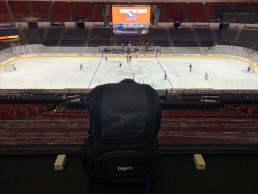
Dejero Expands Away Game Coverage for AHL’s San Diego Gulls
The San Diego Gulls, American Hockey League (AHL) affiliate of the National Hockey League’s (NHL) Anaheim Ducks, have expanded away game coverage across local television channels (KSWB-FOX 5 San Diego, KFMB-CW San Diego) and streaming platforms by using a Dejero EnGo mobile transmitter for live broadcasts made possible with resilient, high-bandwidth wireless internet connectivity.
The EnGo was initially implemented by the production team when the San Diego Gulls temporarily relocated to the Anaheim Ducks practice facility, FivePoint Arena at Great Park Ice in Irvine, California, for the 2020-2021 season as a precaution during the coronavirus pandemic.
“In Irvine, we didn’t always have access to the FOX 5 production truck for microwave transmission of our packaged game coverage. We relied on the cellular and satellite connectivity provided by EnGo to send our primary feed back to FOX 5 HQ, where a Dejero WayPoint received the video,” explains Aaron Cooney, director of communications and broadcasting at the San Diego Gulls Hockey Club.
At FOX 5 HQ, a Dejero WayPoint receiver reconstructed the video transported over IP from the Dejero EnGo, outputting to multiple distribution platforms, including FOX 5 San Diego TV and their online streaming platform.
”It worked incredibly well and was simple and cost-effective to set up, so we figured it would also work for away games,” added Cooney.
The San Diego Gulls have since broadcast away games from Bakersfield, CA., Tucson, AZ. and Las Vegas using the Dejero EnGo for primary transmission. They also added an extra five games to their 2021-2022 season broadcast schedule. Dejero WayPoint receivers are also located at other affiliate stations such as KFMB-CBS-8 San Diego, which covered the Gull’s 2020-2021 season.
“The Dejero EnGo has opened up a whole new window of opportunities for us in terms of storytelling, touchpoints with fans, and cost-effective remote broadcasting, allowing us to deliver more broadcasts than before,” says Cooney.
The EnGo features Dejero’s Smart Blending Technology which simultaneously combines cellular connections from multiple providers, as well as other wired or wireless IP connections if they are available, to form a virtual Dejero ‘network of networks’. The result is reliable, high-bandwidth internet connectivity for broadcast-quality live video transmission from anywhere.
“The importance of telling a compelling story for the Gulls and their fans is anchored in the live transmission provided by EnGo,” said Brian Nettles, television producer for the San Diego Gulls. “The EnGo gives us the confidence to roll up to stadiums that don’t have fiber, satellite links or pre-installed cables, knowing that we’ll still have the connectivity and bandwidth required to send high-quality broadcast video out to Gulls’ fans via bonded cellular.”
“Being able to broadcast more away games is a great way to further engage with our passionate Gulls fan base, expand our reach to local sports fans and continue to grow our brand in San Diego,” added Cooney.
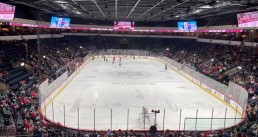
The Dejero EnGo is also used as a backup during every home game at the Gulls’ Pechanga Arena should the cable fail between the Gulls’ production truck and the onsite FOX 5 truck that transmits the packaged game coverage to FOX 5 HQ.
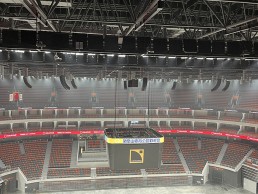
L-Acoustics Scores at Chengdu Phoenix Mountain Indoor Stadium
The 18,000-seat Chengdu Phoenix Mountain Indoor Stadium lies at the heart of the state-of-the-art Chengdu Phoenix Hill Sports Park. With an ideal design for global basketball, ice hockey, and other competitive games, the stadium will host the upcoming 31st World University Games and the 18th Asian Cup in 2023. In addition to hosting international and domestic sporting events, the venue is poised to stage live concerts, performance art shows, and high-profile product launches. The massive complex is a world-class events venue that will enrich the local Jinniu district community with a wide range of multi-cultural entertainment programs throughout the year.
Construction on the NBA-standard arena began in 2019, with audio and video technology design and installation awarded to China Radio, Film and Television Design and Research Institute (DRFT). Mr. Zhou Yaoping, Director of Engineering at DRFT, had worked with L-Acoustics and was confident in the brand’s reputation for delivering world-class audio solutions for high-profile sports and touring projects. Mr. Zhou worked with local L-Acoustics Certified Provider, Rightway Audio Consultants (RAC), for technical support throughout the project. “On top of the superior precision and power of the L-Acoustics solution, we knew that we would also receive impeccable service from both RAC and the L-Acoustics Application team,” he explains.
Challenges to the sound design included VIP box areas with reflective glass surfaces and a centrally located 360° LED display screen, which would change positions depending on standard heights for the sport or optimal placement for live events. Systems Designer at DRFT, Ms. Zhang Xinyu used L-Acoustics Soundvision software to map the venue and test different sound system configurations to attain optimal coverage and SPL for the entire audience, regardless of where the LED screen is placed. “Soundvision was an excellent tool to help me experiment various design ideas,” explains Ms. Zhang. “It allowed me to find the best speaker configuration for optimal performance, taking all screen placement options into account.” Settings for each event type are pre-calculated and can easily be recalled by venue operators in LA Network Manager.
The final system installation was led by Mr. Li Daojun, Senior Engineer at DRFT. The main system consists of eight arrays, each comprising six L-Acoustics A15i Focus and one A15i Wide, hanging from the roof in an oval shape above the LED display to deliver 360-degree coverage to the audience. A cluster of four hangs of three KS21 subwoofers each, flown in the middle, ensures low-end rumble. Under the display cube, four L-Acoustics X15 HiQ act as monitors for athletes on the court. The whole system is driven by 22 LA4X amplified controllers.
Senior Engineer Mr. Li praises the support DRFT received from RAC and L-Acoustics. “We were able to call upon experienced application engineers at any time during this three-year project, in turn ensuring that we provided the end user with a comprehensive run-through of the operating system” he says.
Mr. Li added: “The flexible A Series system was the right solution to a complex brief. Chengdu Phoenix Mountain Indoor Stadium and the technical team are now ready to serve quality sports and entertainment programming to the dynamic Jinniu community.”
Similar sentiments were echoed by Mr. Liu Heming, Deputy Technical Director of Chengdu Chengtou Vanguan Sports Culture Development Co. Ltd., the company in charge of technical operations of the arena: “On testing day, the overall sound in the arena amazed me. Not many sporting venues possess a sound system of this calibre. Now my team has the right tools and resources to perform at the high technical standards of world-class events.”
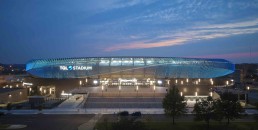
TQL Stadium
Officially opened in May 2021, FC Cincinnati’s TQL Stadium, with its capacity of 26,000, registers as one of the largest soccer-specific stadiums in the United States. The new, state-of-the-art venue boasts a striking presence, connecting two historic neighbourhoods - Over-the-Rhine and West End – and honouring the legacy of soccer in the Queen City through a progressive design and ambitious interpretation of a Cincinnati on the rise.
MONDO | STADIA spoke to FC Cincinnati’s Co-CEO, Jeff Berding about the long-term plan behind TQL Stadium: “When Carl H. Lindner III (CEO) and I founded FC Cincinnati as a USL club, the goal was always to be the city’s third professional sports team, so, getting to Major League Soccer was always our ambition. We visited the MLS office to confirm with the commissioner that we would have that opportunity if we were successful in the USL. So, from the beginning, we understood that building a soccer-specific stadium was going to be a requirement of promotion to the MLS.”
The design of TQL Stadium intentionally harnesses the energy of a dedicated fan base to bring a world-class soccer experience to Cincinnati, which is something that was mapped out very early on.
Read the full cover story in the latest issue of MONDO | STADIA:
https://issuu.com/mondiale/docs/mondostadia-23/24
RCF Delivers High-Power System to Legacy Arena
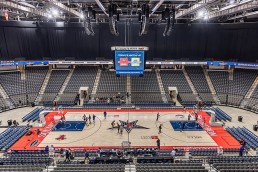
Originally built back in 1976, Legacy Arena may be the most impressive renovation of the $300 million expansion of the Birmingham/Jefferson Convention Complex, which began in 2018. Some of music’s biggest names performed at the arena — from Bob Dylan to Garth Brooks, Luciano Pavarotti to Prince, Led Zeppelin to Lynyrd Skynyrd, The Grateful Dead to Taylor Swift, JAY Z to ZZ Top, to name a few. It has hosted major sporting events as well, from basketball to hockey, to tennis matches, and attractions from tractor pulls to the Ringling Bros. and Barnum & Bailey Circus. And now, chosen venue for the Birmingham Squadron, DanceSport and Gymnastics events for the 2022 World Games.
When Populous, the project architects for the BJCC renovation, required audio design services they brought in top consultants Wrightson, Johnson, Haddon, Williams (WJHW) from Carrollton, Texas. Specialising in sound and video for many of the largest stadiums and arenas nationwide, WJHW Senior Consultant, Guillermo Wabi and his team were brought in to address the challenges and requirements for the arena and design a robust audio system for the installation.
“Imagine you have a venue with six unique areas — all having different sizes, elevations, and acoustic signature, while being open to each other, and having to be adaptable to multi-use scenarios.” explains Wabi. “To design a sound system for those areas, that sounds clear, intelligible, and balanced to everyone, along with providing performance and flexibility, and to be configurable for multiple scenarios by the venue staff, while also having limitations in maximum weight, size, and budget — it was quite a challenge.”
Wabi continues, “The primary sound system needed to be compact and lightweight with the acoustic performance and flexibility to cover not only the seating areas but also meet the various venue configurations for sports and live concerts. The support system [outside the arena] needed to match at the delay and fill positions, the tonal and acoustic qualities of the primary system, while maintaining an aesthetically pleasing formfactor. Since the arena concourse areas were redesigned to an open format, we wanted the back of house system to have a similar tonal quality as the primary and secondary systems. Often when you design a system for a project like this, there must be a minimum of three systems to choose from, especially when using government funds,” adds Wabi. “RCF became one of the three systems because of the variety of products and accessories in their portfolio that matched with the project needs and budget.”
While the physical and acoustic evaluations were reviewed and analyzed, the contractors hired ESB Group Inc. out of Springville Alabama, who’s main bowl sound system package was consisted of the RCF solution. “Arenas are always a very difficult environment to achieve intelligibility,” says Drew Breland, design engineer at ESB Group. “We’re always impressed with RCF performance, and it’s proven itself in this space,” adds Breland. The RCF solution is comprised with [112] HDL 28-A full-range line array modules and [24] flyable HDL 36-A subwoofers for the center of the arena, as well as a wide selection of speakers [RCF MR- and C-Series speakers] for 40 zones.
With many acoustical challenges sorted out, a few more practical challenges presented themselves. “When it came time to plan for the install of the arrays, we found we were limited with where we can put our motors to adjust the proper angle,” noted Breland. “We worked with outside fabricators to design custom brackets for this particular system. A “spine” system allowed each array to hang firmly in place from a horizontal top bar, while also allowing for each box to be in their corresponding angle. We could rotate the array vertically, as well as offset the position horizontally with pinpoint accuracy. Installation time for the first array took about an hour and half to figure out our center of gravity. From there the other 7 arrays took about 5 hours in total. All arrays were up within 8 hours.”
An integrated support system covered areas throughout the arena, under balcony, luxury suites, and corridors. “We installed various C-Series speakers, filling in all areas under balconies, supplemental to the main system. We also installed 25 MR-Series boxes for the back of house areas to provide additional coverage for the 12 suites. The arrays cover much of those areas, but it was important that every seat, in the back of the suites, had an equal listening experience,” add Breland.
Control of all zones was key to its success. “RDNET was deployed with this system to control the primary bowl system. “We spent a few days tuning with Oscar Mora [Senior System Engineer] from RCF. We tuned the arrays with RDNet and used Q-SYS for all the auxiliary zones. All things considered we felt the installation was very successful in space,” concluded Breland.
“We are more than satisfied with the deployment of this HDL system,” noted Jim Reed, System Designer at RCF USA. “The aesthetic blends into the structure and we’re happy to have surpassed all performance expectations.”
ATM Media, Pixellot to Revolutionise Automated Production & Broadcasting in Spanish Sports
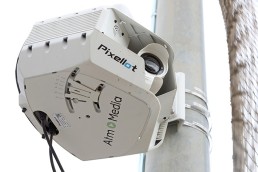
ATM Media, a Barcelona-based company that offers automated transmission services for sporting events, has signed an alliance with Pixellot, a world leader in artificial intelligence technologies for the automation, production and retransmission of sports content, and becomes its key partner in Spain; in an agreement that also includes several Latin American countries.
Through the development of its own algorithms, that allow Pixellot's technology to be adapted, ATM Media offers personalised automated transmission services for 16 different sporting disciplines. The improvement of the algorithm and its adaptation to water polo is the latest milestone in work that already makes it possible to produce and broadcast football, basketball, futsal, hockey or volleyball events and competitions, among others.
The services are based on the installation of automated cameras that capture and record what happens on different parts of the pitch, or sports facility, and through artificial intelligence, are merged to offer an integrated image and ambient sound. The audiovisual content is produced by adding to it the data, or specifics of the match or sports discipline, the graphics and even the voice of the announcers, where appropriate. In addition, an OTT platform is offered from which high-quality content can be accessed.
This automated production and retransmission represent a revolution in the possibilities of development, visibility, business generation and community creation for federated, grassroots, amateur and adapted Spanish sports, which represent 98% of the competitions and events held in Spain.
The alliance between ATM Media and Pixellot makes available to this large group of clubs, schools and entities, which are the true heart of Spanish sport, a technology that is already used by FC Barcelona, Real Madrid CF, Real Sociedad and Real Betis Balompié, in a personalized and competitive way; and adapted to each discipline with an algorithm that incorporates variables and characteristics of the sport in question.
Jordi Roquer, CEO of ATM Media, has pointed out that "it is essential for us to go hand in hand with Pixellot, a world leader in this technology". “We have a very clear vision of what we can contribute”, added Roquer, who highlighted that “the added value of our services allows progress towards the democratisation of audiovisual content in Spanish sport and, at the same time, contributes to the modernisation of it and the promotion of sports practice and the generation and feeling of community around it.
For his part, Alon Weber, CEO of Pixellot, has been "delighted" to grow and have a greater presence in Spain thanks to the alliance with ATM Media. Weber has also referred to the contribution of value to Spanish sport and has highlighted that the objective is to help it “grow, making high-quality content and technical and data analysis tools available to clubs and federations. In this way, they can help their formative and base teams to reach their potential”. In addition, he added that "ATM Media is a strategic partner, because it actively contributes to the development of the technology that we offer to sports around the world."
Daktronics Announced as Real Madrid Official Stadium Supplier
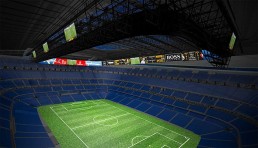
Continuing a long-standing association, Real Madrid and Daktronics have announced a global and multi-year partnership agreement. Daktronics will be responsible for designing, manufacturing and installing, together with Legaz Arquitectura e Ingenieria, its partner for installations and services, a new LED halo display system at Santiago Bernabéu Stadium in the heart of Madrid, Spain. The project totals more than 3,700 square meters of LED displays and installation is planned throughout the calendar year of 2022.
“Thanks to this agreement with Daktronics, the new Santiago Bernabéu Stadium will have iconic advertising devices with the highest quality and technology available that will allow us to offer a unique experience to our fans and visitors through the contents,” said Enrique Uriel, Real Madrid CF IT Director.
Plans for the renovation and technology upgrades began with discussions back in 2016 as the teams involved looked over concepts and possibilities. Trips to other world-renowned stadiums took place over the years to experience the live event atmosphere and the technology firsthand. The process led to the selection of the halo design and additional displays.
“In the process of deciding what design to implement, many iterations and ideas were considered and vetted, analyzing different existing projects, before moving forward with a 360 degrees Halo,” said Ivan del Rio, Daktronics regional manager. “With this LED displays configuration, the Santiago Bernabéu stadium will be at the forefront of technology and at the same level as the best stadiums in the world. These video screens will serve Real Madrid CF to offer unique experiences both in its football competitions and in the other multiple uses of the stadium in the future.”
The halo combines 18 total LED displays, both on the inside and backside, to form the centerpiece of game-day experience for Real Madrid as well as other events held at the multi-use facility. The two displays along the inner sideline of the halo each measure 6.58 meters high by 114.12 meters long while the two inner goal end displays each measure 6.58 meters high by 52.69 meters wide.
On the backside of the halo, 10 total displays will be installed, each measuring 5.49 meters high by 9.88 meters wide. Three of these displays will be installed along the sideline backside on each side of the field and two will be installed on the goal end backside on each end of the field.
The inside corners of the halo will each feature a freeform ProPixel stick display to curve the corner and deliver an uninterrupted continuous view of digital content. Each corner display will measure 6.60 meters high by 16.53 meters wide and curve around the inner corners of the halo.
The inside corner displays will feature 25-millimeter pixel spacing and all the other displays on the halo will feature 13HD pixel layouts to deliver excellent image clarity and contrast to audiences in every seat.
The 13HD displays are capable of variable content zoning which allows each to show one large image or to show multiple zones of content. This content can include live video, instant replays, up-to-the-minute statistics, graphics and animations, and sponsorship messages.
A ribbon display will also be mounted to the seating fascia of the stadium as part of this project. It will feature a 13HD pixel layout and measure 1.10 meters high by 491.47 meters long. This display can show supplemental information and graphics to the halo while also providing the opportunity to highlight sponsors throughout events.
Daktronics will also be including its powerful Show Control solution with this installation. This industry-leading system provides a combination of display control software, world-class video processing, data integration and playback hardware that forms a user-friendly production solution.
Toronto Blue Jays Improve Home Field Advantage with New Daktronics LED Displays
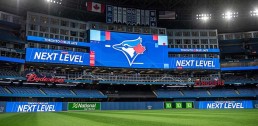
As the Toronto Blue Jays move into the 2022 season, they have improved the home field advantage and game-day experience by continuing a partnership with Daktronics for 10 new LED displays at the Rogers Centre in Ontario. The total of 14,000+ square feet of displays combining for more than 11 million LEDs were installed this offseason, including an HDR-capable main video display.
The new main video display is curved, HDR-capable and measures approximately 49 feet high by 110.5 feet wide. It is installed in center field to bring an excellent viewing experience to Blue Jays fans throughout the stadium. This display features variable content zoning allowing it to show one large image or multiple zones of content including any combination of live video, instant replays, up-to-the-minute statistics and game information, graphics and animations, and sponsorship messages.
Flanking the main display are four additional LED displays and content can be coordinated across all five displays for one main center field viewing experience. Two displays mounted even with the bottom of the main display measure 15.5 feet high by 75.5 feet wide and two ribbon-style displays appear to extend out from the middle of the main display measure nearly 5 feet high by 75.5 feet wide. All center field displays feature 10-millimeter pixel spacing.
“The new HDR-capable main video display and center field display configuration at the Rogers Centre will deliver an amazing viewing experience for the Toronto Blue Jays, their players and fans,” said Daktronics President and CEO Reece Kurtenbach. “We’re thrilled to continue our long-standing partnership with the team and to introduce this cutting-edge technology at their ballpark.”
Additional displays include a main ribbon display installed along the seating fascia measures 3.5 feet high by 1,324 feet wide and features 16-millimeter pixel spacing. Two displays near the foul poles each measure 6 feet high by 32.5 feet wide and, along the outfield wall, two field-level fence displays each measure 9.5 feet high by 65 feet wide. These four displays feature 10-millimeter pixel spacing.
Coordinated together, all of these displays provide additional statistics, graphics and sponsorship opportunities to entertain and engage Blue Jays fans during every game.
Daktronics Delivers Audiovisual Experience at Credit Union of Texas Event Center
To improve the visual experience for event goers, Credit Union of Texas Event Center in Allen, Texas, has turned to Daktronics of Brookings, South Dakota, to design, manufacture and install seven new LED displays and an audio system. Six video displays and a new ribbon display are installed and operational to engage and inform audiences.
“The new displays and audio systems have made a huge impact at Credit Union of Texas Event Center,” said Assistant General Manager at Credit Union of Texas Event Center Ross Girouard. “Obviously, they look and sound great, but there have also been major ease-of-use upgrades and new functionality that are allowing us to bring a more dynamic experience to everything we do.”
The six new LED video displays each measure approximately 11.5 feet high by 31 feet wide and are located throughout the seating bowl to capture fans’ attention. Each display features 5.9-millimeter pixel spacing to share excellent image clarity and contrast to further immerse viewers in the action.
Surrounding attendees, a ribbon display was installed along the seating fascia. It measures approximately 2 feet high by 880 feet long and features a 15-millimeter pixel spacing. This display offers the opportunity to supplement the main displays with information and statistics while also highlighting sponsors throughout events
“The technology enhancements to Credit Union of Texas Event Center elevate the live event experience for audiences and bring many more opportunities to the venue,” said Brandon DeSmet, Daktronics sales representative. “It’s extremely exciting to see these improvements and I’m looking forward to experiencing them in person in the future.”
The six video displays are capable of variable content zoning which allows each to show one large image or to show multiple zones of content. This can include live video, instant replays, up-to-the-minute statistics and event information, graphics and animations, and sponsorship messages.
The new audio system is integrated into the video and scoring system to provide a booming audio experience with intelligible speech so fans can clearly understand all announcements while being surrounded in sound during events.
“The new loudspeakers, amplifiers and control equipment provides more energy for sporting events and large crowds at the arena,” said John Olsen, Daktronics Audio sales representative. “Larger, more powerful loudspeakers and extended low-frequency array provides additional bass ‘thump’ to meet the demands of modern music. The richness and clarity of the system is a step up in performance that the fans and teams appreciate. We are proud of our relationship with Credit Union of Texas Event Center and look forward to supporting them for years to come.”
Daktronics will also be including its powerful Show Control solution with this installation. This industry-leading system provides a combination of display control software, world-class video processing, data integration and playback hardware that forms a user-friendly production solution.
ASM Global's AO Arena Unveils $63 Million Plans
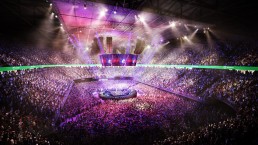
ASM Global, the world’s leading producer of entertainment experiences, venue management and event strategy, has announced a $63 million plan beginning this summer to transform the AO Arena in Manchester. This plan is set to dramatically enhance the venue’s premier position for live entertainment experiences through state-of-the-art infrastructure expansion and innovative guest features as the iconic arena looks to the future.
AO Arena in Manchester, located in the heart of the city, is one of the busiest indoor arenas in the world. Through its near 30-year history, the venue has firmly established itself as a beloved and iconic Manchester landmark, a must-play for artists, and a fan-favourite destination for world-class live entertainment. Officials from the AO Arena will be releasing more detailed plans in coming months.
Chris Bray, EVP Europe at ASM Global, said, “AO Arena is one of the world’s iconic venues and a much-loved part of Manchester’s rich culture and history. It has been delivering world-class entertainment experiences for over two decades. As we approach our 30th anniversary, this ambitious endeavor will not only reinforce its position as a leading destination for live entertainment but will extend its market leadership for ‘live’ and fan experiences for the next 30 years. We’re proud to be further investing into the heart of Manchester.
“The first phase will enhance and increase our standing floor capacity to share this historic arena with even more of our guests, and we will also be adding new hospitality lounges and investing in delivering an upgraded concourse experience. Our performers will be immersed in an all-new, back-of-house artists’ campus, unparalleled anywhere.”
Additional major developments include new arena entrances welcoming guests to the venue and new premium seating, which will transform the venue to an elevated experience.
AO Arena’s back-of-house campus dramatic upgrade will include a complete overhaul of the backstage experience for artists, production and crew. This includes new artist dressing rooms and production areas, a world-class green room with meet-and-greet facilities, an overhaul of crew catering, and first-class connectivity and technology.
Plans have already been jump started by the venue’s rapid scheduling of major sell-out 2022 events, including Billie Eilish, Dua Lipa, Diana Ross, Alicia Keys, Swedish House Mafia, Snoop Dogg, George Ezra and more.
Jen Mitchell, General Manager at the AO Arena, said, “This is a really exciting time for AO Arena. Not only are we able to welcome guests back after a challenging two years with a program packed full of world-class acts and entertainment, now we can reveal the first phase of ASM Global’s plans for the arena’s redevelopment. This will enhance the experience for everyone who sets foot in the venue, including artists, production, crew and our staff who work so hard to make the magic happen right here in Manchester.”
Unveiled in 1995, the arena was the first indoor venue in the U.K. to be built with a layout of 360-degree seating. Attracting over 1 million visitors yearly, the 21,000-capacity arena is a winner of the Stadium Business Awards’ prestigious ‘Venue of the Year’ award. The venue has hosted everything from the 2002 Commonwealth Games, 2008 FINA World Swimming Championships and international boxing bouts by Mike Tyson, Anthony Joshua, Tyson Fury, David Haye, Joe Calzaghe and local champions Ricky Hatton, Amir Khan and Anthony Crolla.