

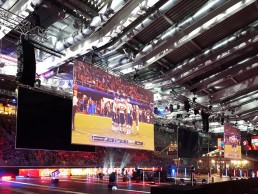
Alcons Sounds the Super Bowl Party
The Austrian private broadcaster PULS 4 celebrated Super Bowl LII as ‘Europe’s biggest Super Bowl Party’ in the Vienna Albert Schultz ice rink in Austria, with more than 4000 sports fans followed the call during the night of 4-5 February.
The Viennese company Pro Performance was responsible for the entire sound concept of the Super Bowl Party. The long-standing Alcons distribution partner was supported by ils medientechnik from Leipzig, who under the management of Thomas Ils and Matthias Heilmann took over the detailed audio planning, supervised the network technology and managed the labour coordination. Also material disposition and logistics lay in the hands of the Leipziger. Uwe Biesgen from Creative Sound was on site for ils as system engineer.
The Super Bowl Party was amplified from both sides of the ice arena. A total of 54 Alcons pro-ribbon LR18 line array modules were split into 6 clusters (2x L / C / R), each complemented with 2 Alcons BC543 triple 18inch cardioid subwoofers per cluster. In addition, Pro Performance relied on 4 Alcons BQ211 compact 21inch subwoofers and 2 Alcons VR12 for DJ monitoring. For stage monitoring / cheerleading monitoring, 8 Alcons VR12s were used, and 2 Alcons VR8s were used for FoH monitoring. The sound system was powered by 24 Alcons Sentinel10 amplified loudspeaker controllers.
Celebrating a huge party in an acoustically demanding ice rink posed challenges for the audio team. Wolfgang Sauter, owner of Pro Performance, explained: “The seating ranking is not even on both sides in the Albert Schultz ice rink. While the rank on the right is continuous, it is divided on the left side by a walkable level in upper and lower rank. On the right side above the rows of seats are the VIP areas with acoustically critical glass fronts. In addition, we had to deal with a very wide area of over 60 meters, but we were able to cover excellently with the 90° dispersion to 20 kHz of the LR18.”
Despite the adverse circumstances, the Alcons LR18 pro-ribbon line array system helped to achieve an even level distribution, sometimes at a very high level. “When 4,000 people scream with enthusiasm in an ice rink, it’s really loud in there,” added Sauter. “The extraordinarily high level of speech intelligibility inherent in all Alcons systems could again convince on this occasion.”
Thomas Ils, Managing Director of ils medientechnik, added: “The sound system fully met expectations. We have achieved a very good speech intelligibility. The system has ‘let go’. The result was an analytically unobtrusive, homogeneous sound without any listening fatigue – even at high ambient sound levels. ”
“We would like to thank PULS 4 TV and the project managers for the fantastic event, the extremely professional and team-oriented environment, and last but not least for the great trust that has been placed in Pro Performance and the power of Alcons Audio’s LR18 systems,” Wolfgang concluded.

HHB & Studio Technologies Scoops Gold with NEP
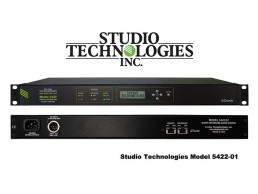
Pro audio supplier, HHB Communications have supplied a Studio Technologies 5422-01 Dante Audio Engine to NEP Visions to assist in streamlining and mixing on a Dante network at numerous events, including the 2018 Winter Olympics.
The Olympic Winter Games in PyeongChang, South Korea took place between the 9th – 25th February 2018. NEP Visions Head of Sound, Paul Fournier consulted with HHB Manager of Broadcast and SI Sales, Nikki Pascoe to find a solution that would allow him to streamline and mix return audio. When asked why the 5422 appealed so much to NEP and their projects he stated ’It’s the ability to mix sources in the same domain, all within a 1U unit. We can now do things that we simply could not achieve before.’
The AES67 supported 1U Studio Technologies 5422 is available with 32 or 64 channel options and allows users to create party-line (PL) intercom circuits that function with other Dante compatible products whilst also allowing users to mix sources within an IP audio network. Like all other Studio Technologies products, the Dante range delivers high-performance, cost-effective, and flexible solutions for fixed and mobile broadcast, post, theatres and more.
With the uptake of AoIP related technology in the pro audio realm increasing, Paul commented ‘No doubt we will find other uses for the units including many communications scenarios going forward in an IP world. Over the next few years in the OB world, audio will migrate more into the IP domain.’
All valid Studio Technologies AoIP products are now fully compatible with Dante Domain Manager.
www.hhb.co.uk
Symetrix a Superior Solution for Texas Stadium
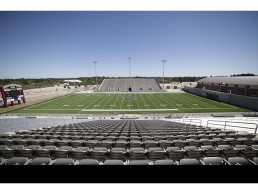
Conroe Independent School District (CISD), 40 miles north of Houston, needed a new sound system for Woodforest National Bank Stadium, its leaders called on TASC A/V.
Based in Conroe, the TASC team knew exactly what was required: very loud, yet clean and clear audio to serve a big, noisy, enthusiastic crowd plus straightforward and simple system control. To manage the system, the TASC A/V team chose a Symetrix Prism 12x12 DSP.
"This was the second large stadium we've done for the Conroe Independent School District," recounted TASC's Steven Spruell. "A couple of years ago we put a similar system in Moorhead Stadium, which is in Conroe and seats 8,400. We used a pair of Symetrix Radius DSPs for that install."
Woodforest National Bank Stadium is about eight years old, hosts five teams, and is even larger than Moorhead Stadium. "Woodforest's previous sound system was always underwhelming," Steven continued. "The system was underpowered, and its frequency range was poor. We're high school football fans, like everyone else around here, so we experienced it first hand. The new system needed not only power to be heard above the crowd but clarity. One reason we chose a Symetrix DSP was its sound quality."
Symetrix Prism DSPs offer 128 (64x64) Dante channels for ultra-reliable multi-channel audio networking over IP. The Prism's analog I/O is scalable; the Prism 12x12 chosen for Woodforest Bank Stadium provides 12 switchable balanced mic or line-level inputs and 12 line-level outputs. Prism's embedded web server displays I/O levels, diagnostics data, and hosts Symetrix' ARC-WEB browser-based interface for smartphones, tablets, and computers.
"We went with an all-Dante system, which is another reason the Prism was the right choice," Steven reported. "The Prism has an excellent Dante implementation."
To deliver the requisite decibel power, the TASC A/V team mounted two Community R6-51 high-output, horn-loaded loudspeaker systems on custom-built towers in the south end zone, opposite the Daktronics scoreboard. The speakers are driven by 14,000 watt Lab Gruppen power amplifiers. "At the far end of the field, the speakers can still hit 96 to 97 dB, with plenty of headroom," asserted Steven. "Between the speaker's power and the overall system's sound quality, fans have no problem hearing everything."
In addition to its Dante support, sound quality, and compatibility with third-party controllers, Spruell appreciates the Symetrix processor's ease of programming. "Symetrix' Composer software made it easy to program the Prism," he detailed. "With Composer, we can design a complete end-to-end DSP signal path, including routing the Dante streams and programming the user interface. That makes a big difference in projects such as this one."
Having installed two systems in CISD stadiums, both based on Symetrix DSPs, TASC can claim two of the most important sound system projects in the area. "Both stadium systems have been a big success," confirmed Steven. "We use a lot of Symetrix DSPs, and the new Woodforest National Bank Stadium system is a good example of why. It works great, sounds great, was easy to program, and is easy to control-everything we and the school district hoped for."
Moots Counts on Lectrosonics for Winter Games
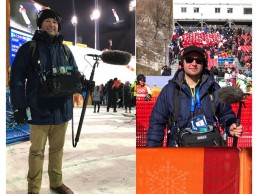
Freelance field audio mixer Callahan Moots’ Lectrosonics Digital Hybrid Wireless equipment, including LT, SMVQ transmitters and SRc receivers, covers major breaking news and events including, most recently, the Pyeongchang 2018 Winter Olympics, in South Korea.
Callahan carries a selection of Lectrosonics wideband equipment in his bag, including four LT Digital Hybrid Wireless belt-pack transmitters paired with Sanken COS-11D lavalier microphones. “The new transmitters and receivers from Lectrosonics have a wide range of frequencies that you can transmit on,” said Moots. “That is especially helpful in a place like Pyeongchang, where we were very limited as far as which frequencies we could use.”
He continued: “The wideband range of my Digital Hybrid Wireless transmitters made it easy for me to select a couple of the frequencies that they allowed me to use. I was easily able to program those into my equipment. The entirety of the time I was there, I didn’t have any issues with the gear. It was bulletproof. I slept very well at night knowing that I had that equipment.”
In South Korea, Callahan was tasked with putting wireless body microphones on some of the athletes, correspondents and anchors for a variety of news programming. “My job was to conduct sound recording and mixing for interviews, cover some live events, such as downhill skiing, and talk to athletes there in the mixed zone,” he says.
Callahan typically carries a Sound Devices 633 mixer/recorder in his bag together with a pair of Lectrosonics SMQV transmitters that enable the wireless hop to the camera, which is outfitted with an SRC dual-channel receiver. “I’m not only transmitting wirelessly from whomever I’m miking up — that would be wireless transmitted to my mixer — but I also use a wireless camera hop, so I’m transmitting from my mixer to the camera,” said Callahan. “Especially in the field, wireless makes the most sense, and I’ve taken full advantage of the Digital Hybrid Wireless that Lectrosonics has offered for many years.”
The experienced audio mixer inherited his appreciation of the audio quality and robust performance of Lectrosonics gear from his father, who has been a fan of the company’s wireless equipment ever since it was founded over four decades ago. It also doesn’t hurt that he is now a resident of Rio Rancho, NM, where Lectrosonics has its headquarters. “I’d be a fool not to drive over there and bug them and hang out with Karl Winkler, their vice president of sales,” he laughed.
Agrena Utilises Bose Professional
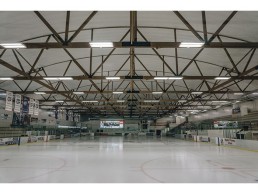
Alberta-based multi-facility Agrena, which houses Grant Fuhr Arena and the Stu Barnes Arena, used for both ice sports in the winter and dry-land sports in the summer, recently received an upgrade in sound via RoomMatch Utility loudspeakers by Bose Professional.
“We had really antiquated systems in the arena,” said Craig Goebel, Supervisor of Recreational Facilities for the city. “It was definitely time for new sound systems, not only because the old ones were really worn out, but because people have come to expect better sound in their sports arenas.” Edmonton-based AV systems integrator Production World brought a Bose Professional system design to the table. The brand was immediately recognisable. “We rely on professionals like Production World when it comes to technology,” added Craig, “but we certainly knew the Bose name and associated it with quality sound.”
Over six days, the integrator removed the old components and installed the new Bose systems. In the Grant Fuhr Arena, the larger of the two venues, the sound system consists of four Bose Professional RoomMatch Utility RMU208 loudspeakers for coverage of the rink area and eight Bose RMU206 speakers for coverage of the main seating areas, with eight Bose FreeSpace DS100F pendant loudspeakers to cover the south end of the seating area. The RoomMatch Utility loudspeakers are amplified through a Bose PowerMatch PM8500N networked amplifier; and a Bose FreeSpace ZA 2120-HZ zone amplifier is used for the Bose DS100F pendant loudspeakers. A Bose Professional ControlSpace ESP-00 Series II modular processor, with 12 input channels and eight output channels, manages the system.
In the Stu Barnes Arena, the system consists of eight Bose RoomMatch Utility RMU206 loudspeakers powered by a Bose PowerMatch PM4500N networked amplifier. “We went with Bose as our first choice for this project,” explained Matt Poles, Production World A/V Technician, Programmer and On-site Foreman for the project. “That’s usually the case for us these days. The RoomMatch Utility components and other Bose speakers and systems just give us everything most projects require: clear, intelligible sound, and excellent, predictable coverage.”
Ken Greene, Commercial Operation Manager for Production World, who supervised the bid and the sale, commented: “The arena has a fairly low ceiling, so we couldn’t use a big box loudspeaker or an array, but the Bose speakers fit the spaces perfectly. And they’re very compact so you don’t see them at all.”
“We took out six amplifiers and were able to replace all of them with a single Bose PowerMatch PM8500N networked amp in the Grant Fuhr arena,” Matt continued. “The PM8500N gives us eight channels, so they’re able to control the volume individually over the east and west bleachers and over the south side seating, as well as the front entrance area, the lounge areas, and directly over the ice, with the ControlSpace ESP-00 processor zoning all areas so each can be controlled separately. It’s a very versatile sound system but didn’t require a lot of pieces.”
“The Bose sound system met and exceeded our expectations,” concluded Craig. “It sounds great, looks great, and it’s much simpler to operate than what we’ve had before. It’s the ideal sound system for us.”
APG Partners Sonowest
APG Audio has announced its partnership with Sonowest Group.
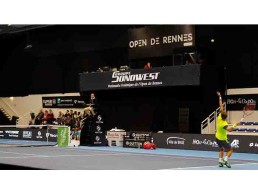
Located in the West of France (Rennes), Sonowest has acquired a Uniline Compact inventory for the rental market; utilising the small size “line source” system for an indoor sport event.
In January 2018, Sonowest chose the Uniline Compact for the Open de Tennis de Rennes, an international Tennis competition for the West of France, with 2,000 attendees.
The sport’s complex is very reverberating, and this type of event requires a high discretion and intelligibility, that’s why Sonowest decided to trust in the Uniline Compact for the 2nd year, a system well known for its precision in every situation.
Sound Image & WJHW Outfit Arizona State Stadium with EAW
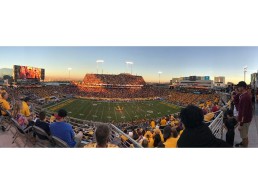
The Sun Devil Stadium 365 Reinvention seeks to blend athletics, student life and the community into a multi-use facility that will be used 365 days of the year. To help accomplish this goal, the school called upon Wrightson, Johnson, Haddon & Williams (WJHW) to design a new sound reinforcement system that would provide the flexibility the multi-use concept requires.
Mark Graham, audio consultant, associate principal, WJHW designed an Eastern Acoustic Works (EAW) Adaptive end-zone system that covers the 57,000-plus-seat facility with even SPL and extremely consistent intelligibility. Tempe, Arizona-based Sound Image provided system integration and installation for the project.
“We were familiar with Anya and were confident this would not only provide the coverage the University required but also the flexibility to use the stadium for events that expand well beyond football games,” added Ben Davis, Sales Engineer, Sound Image. “They wanted a system that could put sound only where it was needed. Not only would that help avoid unnecessary reflections, but it would be a far more efficient use of the system. Anya can do that very easily. It was a perfect match.”
Graham specified two Anya arrays, each hung to the left and right of the video scoreboard. Each array is made up of one main column of 16 Anya and an auxiliary column of eight additional modules – bringing the total to 46 Anya. Adaptive Performance manages coverage and directivity via Resolution 2 software. The combination allows the system to throw 650 feet from one end of the stadium to the other or scale it back for events that will not utilize the entire space.
Scoreboard underfill is covered by two more clusters – this time each are made up of two QX544i and one QX564i loudspeakers – hung under the main PA columns to ensure those directly under the end zone scoreboard have the same audio experience as everyone else in the stadium.
“There are a few seating areas with limited coverage due to structures that block sound,” added Ben. “In those cases, we are utilising EAW MK8126i loudspeakers placed under the overhangs and directed to the far seating under the balcony to ensure not a bad seat in the house. We also installed EAW CIS ceiling loudspeakers in the suites, restrooms, hallways and common areas, keeping the audio quality seamless throughout the space.”
Ben concluded: “The client continues to be quite happy with the result. As a matter of fact, we are working on some other projects for them where we are also using EAW Adaptive systems. This has been a highly successful project for us.”
VUE Takes to the Ring with HBO
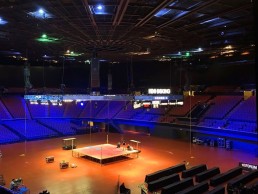
Audio Visual Live, Inc. (“AVL”) recently deployed a VUE audiotechnik al-8 line array system for the HBO Boxing After Dark live broadcast event on 27 January 2018.
Looking to strike the ideal balance of intelligibility, directionality and SPL, AVL identified the VUE line array as the best option for the challenging, low-headroom indoor arena, The Forum, in Los Angeles.
AVL has handled production for many televised boxing events for promoters across multiple networks. This venue has always presented a challenging tradeoff between ideal system performance and size.
As is typical with live-broadcasts, AVL needed a system that could handle a range of material — from high-SPL DJ performances to the ring announcer’s spoken word — all without disruption to the live TV broadcast. Directionality and precision of coverage were also key to avoid covering areas that require lower SPL. Adding to the challenge was a relatively low 30-foot clearance from the top of the lighting truss to the venue ceiling.
“Based on our experience doing in-arena sound for boxing, I can hands-down say that this VUE system is the ideal fit for HBO Boxing,” lauded AVL owner, Dennis Layton. “The al-8’s clarity in the vocal range allows us to put the ring announcers’ voice out into the audience without disturbing the TV broadcast, yet they have enough punch to get the live audience off their seats during DJ sets.”
AVL deployed an all-VUE system consisting of 32 medium-format al-8 elements in four hangs of eight, with eight (2 perched atop each of the 4 arrays) al-8SB flyable subwoofers for low-frequency support. The al-8’s high output-to-size ratio proved the ideal solution to AVL’s long-standing challenge. Each array is just shy of 15-feet in length (including motors, subs and rigging), and easily hidden above the lighting truss. Ten V6 VUEDrive System Engines provided all power and processing, while SystemVUE for iOS enabled real-time monitoring and control.
“There’s a simple reason why AVL continues to invest in the VUE line – particularly the al-Class. Regardless of the complexity or constraints of a project, the versatile VUE al-class system can be easily configured to exceed even the toughest requirements and client expectations — and they just sound spectacular,” concluded Dennis.
With the addition of the al-8 system to their existing al-12 inventory, AVL now boasts a 100+ piece VUE inventory — one of the largest VUE arsenals in North America.
EAW Takes Gold at PyeongChang
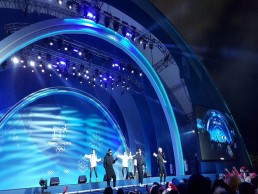
During 2018's Winter Olympics, the Medals Plaza stage within the PyeongChang Olympic Plaza was home to cultural performances and video displays of the competition during the day and Olympic medal ceremonies in the evening. The experience was reinforced by an Eastern Acoustic Works (EAW) Adaptive System provided by Seoul-based Dasan SR.
The Medal Plaza – 1,267 sq metres in size – featured a wide, domed stage and an audience area wider than it is deep. The challenge was to blanket the outdoor area with clean, high-quality sound while providing the flexibility the different forms of entertainment require.
To accomplish this, Dasan SR specified left-right columns of 4 Anna modules hung above the stage video screens (covered by scrim to match the dome). Scaffolding towers were erected further left and right of the stage for the main PA, which was made up of 20 Anya modules. 2 columns of 5 Anya modules hung in each scaffold.
A combination of 12 Otto subwoofers – ground stacked 2 x 3 – located under each Anya array along with 4 SB1002 subs placed under the stage provide the low end the program demands. There were 6 KF730 enclosures placed along the lip of the stage for front fill while 16 MicroWedge stage monitors were on hand for the artists.
“It is an incredible honour to have our products in such a prestigious location in the Olympic Plaza,” said T.J. Smith, President and General Manager of EAW. “When Dasan told us that Adaptive would reinforce the Medals Plaza stage, we were delighted. The flexibility of the system made it an easy choice for a venue that hosts everything from live performance and video to Olympic Medal presentations. We are very, very pleased that EAW could play a role in the 2018 winter games.”
GLP Scores the Super Bowl Halftime Show
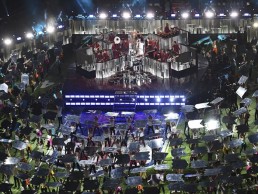
Around 250 German Light Products flagship LED products were deployed at the Pepsi Super Bowl LII Halftime Show at the US Bank Stadium in Minneapolis.
For Lighting Designer Bob Barnhart, of 22 Degrees, for whom this was his 20th involvement in the event (and 9th as principle LD) the sub-zero temperatures were just one of the many challenges he faced. Collaborating with set designer Bruce Rodgers of Tribe Inc, Nick Whitehouse, Justin Timberlake’s designer; and Josh Zangen of Fireplay, he drew heavily on GLP’s inventory to help light Justin Timberlake’s show, which took place in 8 different performance positions.
Bob explained: “JT was turning in so many different directions throughout the show, one of the biggest challenges was just keeping him lit properly. We had many different ‘key’ light looks, but it was quite the process coming up with all the proper angles, especially when you consider that we had to pick our final spot positions way back in September.”
The show opened in a basement ‘Laser Lounge’, doubling as the underpinning of the 360° stage, before JT emerged down the catwalk ramp and used the full expanse of stage and then field (all of which were immersed in production lighting). With Tony Ward from PRG’s Los Angeles office again providing inventory (and acting as lead Gaffer), supported by Travis Snyder, GLP’s impression X1 was the first fixture to make its mark, with 67 of the tiny heads used in the initial club sequence. Then, as he emerged from the 'club' and onto the field of play, 30 impression X4 lined the bridge. Barnhart also made extensive use of GLP’s hybrid GT-1, deploying 74 in total on the main stage, with a further 20 X4 Bar 20 battens also mounted into the stage. Finally, 80 GLP JDC1 hybrid strobes were mounted behind the stage and set into the front of some of the stage panels.
Bob first got together with head of GLP, Mark Ravenhill, at the LDI Show in November to discuss fixture choice. “I told him I needed a small format light for the beginning of the show. So we looked at the X1 and I felt it would be a perfect fit,” he said. “Using a large amount of small fixtures I think helped to keep the room a little more mysterious and club like. The X4’s were used on the ramp because we were transitioning from the club and we felt that we should maintain the fixture style to help tie things together.
"Thanks to their colours, matrixes and the ability to tilt, these are much better then the traditional xenon strobe,” he explained. This time they were deployed on the face of the band stage, mainly for the dance breakdown midway through the show, as well as on the upstage field carts which also saw the majority of the GT-1. “JDC1 has a lot more to offer than we had time to show off in 12 minutes,” Bob added.
The GLP GT-1s were also used on lighting carts upstage of the band stage as well as on all the speaker carts that went around the field. Barnhart said they were chosen because of their weight advantage and lack of a ‘brain box’ attached to the yoke. “I like the GT-1, it is versatile and smaller and lighter than its cousins from other families. As for the X4 Bars these were mounted to the front of the band stage. There was a row at the bottom exclusively for the dance break. There was also a top row for the dance break that could flip over and become footlights on the band stage.”
The LD paid tribute to his co-designers and the creative collaboration. “Bruce [Rodgers] did a great job of taking Timberlake’s idea of being all over the stadium, while Nick [Whitehouse] was good at keeping us in JT’s ‘world’ and helping everyone understand what he and the band needed and liked. I should also mention Pete Radice, David Grill, and Jason Rudolph, our 3 lighting directors.”
Finally, Bob reflected on his relationship with GLP, and the various roles played by the company’s fixtures. “GLP has been a true partner in our continuing efforts to bring something new and evocative to our shows,” he concluded. ”They have become a very solid manufacturer in the lighting industry, and as for support I cannot say enough about Mark Ravenhill and his team.”