

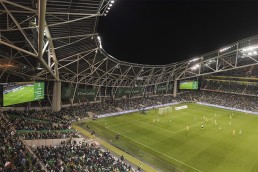
Aviva Stadium
Dublin’s Aviva Stadium, home of the Irish Rugby Union team and Republic of Ireland Football team, was built in 2010 to replace the historic Lansdowne Road Stadium, which had been serving avid sports fans since the 1800s. With a 51,700 capacity, Aviva Stadium is Dublin’s second largest sporting venue, and has played host to many major tournaments, including the Rugby Union and the FAI Cup Final.
https://issuu.com/mondiale/docs/mondostadia11/54

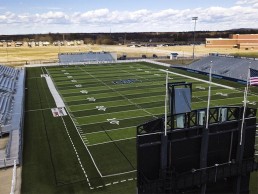
Springdale School District Installs Danley J1-94 Jericho Horns at Both of its High School Football Fields
Springdale School District is the largest school district in Arkansas and is responsible for over 23,000 students. It operates two high schools – Springdale High School and Har-Ber High School – each with over 2,000 students. Football is a big deal in Springdale, and both high schools have well-appointed stadiums that are capable of entertaining over 6,000 fans each. Not content with the anemic sound reinforcement that is typical at the high school level, the district worked with local Springdale AV integration firm, All AV Services, to design a big-impact, high-intelligibility, sound reinforcement system using a single Danley J1-94 Jericho Horn in each stadium. The deal was sealed after an impressive demo arranged by regional Danley rep Anderson Sales & Marketing won over all the stakeholders.
“The decision-makers at Springdale School District were well-acquainted with the world of speaker-on-a-pole sound systems, and they were tired of it,” explained Scott Fusselman, owner of All AV Services. “Sure, you can build a speaker-on-a-pole system that’s reasonably intelligible, but they wanted a real game day experience. They wanted something with guts. They wanted to feel the music. They wanted atmosphere. Stephen Lightfoot, Springdale School District director of performing arts centers and AV systems, did his own research before reaching out to us and discovered that Danley Sound Labs might have the kind of impactful, out-of-the-ordinary solutions that they were looking for.”
Stephen went so far as to find the nearest high school with a Danley Jericho Horn and contacted Scott with the idea that they drive eight hours round trip to hear it. Scott was game, but before they actually went, he contacted Kim Comeaux at Anderson Sales & Marketing. “Kim was incredibly helpful,” Scott said. “He first made sure that Springdale School District was aware that, by itself, a Danley Jericho Horn looks pricey. I had already hashed that out with Stephen, and the only alternative would have been a much larger system with vastly more components that, while cheaper individually, would sum to rival the Danley system’s cost; and for performance he already knew they weren’t interested in. Kim suggested that instead of driving all that distance for a demo that only Stephen would hear, it would be better to arrange a demo right there at Springdale High School so that Stephen, the athletic director, the principal, the dance team instructor (really everyone) could hear it. Then no one would have had to trust someone else’s opinion… they would have heard it for themselves!”
Comeaux brought a Danley J1-94 Jericho Horn to Springdale High School and approximated its would-be installed position near the scoreboard. Everybody involved walked the field and traveled both the visitor and home stands while Comeaux played a representative mix of spoken word and game-day music. “Everyone had a huge smile on their face,” Scott said. “The athletic director is a University of Nebraska alum, and he made the joke, ‘I’d really know how good this system was if I heard Nebraska’s fight song, Hail Varsity.’ Without saying anything, Stephen pulled it up on his phone and as the athletic director was walking off the field, Kim got it up through the Jericho. That guy’s fists went up into the air, he was thrilled!”
With everyone solidly on board, plans moved forward to get a Danley J1-94 Jericho Horn installed at Springdale High School before the first game of the season. But as that day approached, the approximately fifteen-year-old system at the other high school, Har-Ber, went out completely. Worse, Har-Ber’s first home game was earlier than Springdale’s. Finding itself in a tough spot, Springdale School District asked All AV Services to install the Jericho Horn it had on hand at Har-Ber and to order a second for Springdale. “One job became two,” Scott said. Both Jerichos went in with a four-channel, 20,000-watt Danley DNA 20k4 Pro amplifier with integrated DSP and optional Dante connectivity for simple connection to existing systems at the press box. To save money, Springdale’s capable engineering staff fabricated the necessary accessories and installed the systems themselves.
“The completed systems are everything they had hoped for,” Scott said. “When you’re walking toward the stadium before a game and you hear the Danley Jericho booming out, you know you’re in for an event. This is no budget PA. This is exactly the kind of experience Lightfoot and everyone at Springdale was hoping for when the project began. Having heard how Danley transformed their football fields, they’re believers.”
Stephen shared his thoughts: “The Jericho has the ability to transform the atmosphere at high school football games. No longer are we crippled by mediocre SPL and low intelligibility, but now have the exact opposite. It has the presence of a professional stadium. I think it is phenomenal that from 140 yards away (which is where our band bleachers are) there is still low-end presence. This is something you typically don't see in a high school football stadium, let alone out of one single cabinet. Danley’s motto “Hearing is Believing” holds true to their product. We will be utilizing Danley systems in many more facilities.”
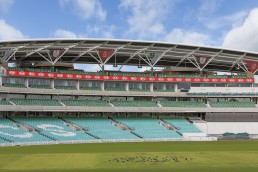
KIA Oval
Surrey Cricket Club is one of England’s oldest and most prestigious cricket clubs, taking residence at the iconic Oval ground in South London since its establishment in 1845. Having held first-class status since conception, it is one of the 18 clubs in the domestic cricket structure of England and Wales. Cricket has been played on the site of The Oval since the early 18th Century, prior to this the land having been given to Henry Prince of Wales by his father, King James 1st, in 1611, hence the prince’s feathers feature on the club’s badge. The ground’s rich heritage has continued throughout history, famous for its location next to the iconic Victorian gasholder and for hosting the first game of international Test cricket.
https://issuu.com/mondiale/docs/mondostadia11/72
Photos: Pioneer Group
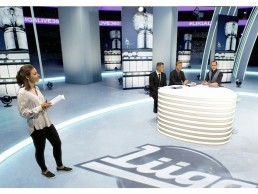
Telemetrics Offers Compatibility with Zero Density for Advanced AR Graphics Production
Telemetrics has established a close working relationship with Zero Density, makers of virtual set and augmented reality systems. When used together, the combined power of Telemetrics robotic camera systems and Zero Density’s advanced compositing and rendering technology will provide broadcasters with captivating new real-time visual effects.
“Telemetrics’ robotic control systems and Zero Density’s virtual studio technology have been successfully used to create powerful AR and in-studio graphics that viewers have enthusiastically embraced,” said Michael Cuomo, Vice President of Telemetrics. “Our combined technologies also provide a good foundation for At-Home productions and studios operating remotely. This is a partnership that will result in many benefits for our respective customers.”
As one example of this on-going partnership Streamteam Nordic Oy, one of the largest technical TV production companies in the Nordic countries, is now making previously unavailable player interviews and multi-layered graphical elements “come alive in virtual reality” on set in real-time for viewers at home.
Working within a state-of-the-art, green screen studio owned by public broadcaster YLE in Pasila, Helsinki, Finland, Streamteam has developed an innovative technique using a Reality Virtual Studio system from Zero Density to allow live on-air presenters to regularly interview stars “in-person” without those stars physically appearing in the studio. Instead, they are using special VS software from Zero Density to enable that player to be interviewed at the sports venue against a green screen located miles away and have their image appear in the studio for the live interview.
“Streamteam utilizes Reality’s latest virtual studio and AR tools and strives to work with the best broadcast technology in YLE studios. We’re proud to be involved in their immersive projects alongside Telemetrics,” said Ulas Kacmaz, Co-founder and VP of Sales and Marketing at Zero Density. “This application – “teleportation” – is not new to the industry, but we raised the standards to another level with photo-realism and dynamism.”
The innovative production system includes remotely controlled camera robotics consisting of the Telemetrics RCCP series controller, LP-S5 PT head, and EP-1000 ceiling-mounted pedestal systems, which first went live for the start of 2019/2020 hockey season. This robotic system is critical to tracking the on-air presenter in relation to the computer-generated player being interviewed in real-time. The Telemetrics pan/tilt heads provide a UDP-stream of positioning data to the Zero Density Reality Engine, which in turn renders the look of the player.
In total, a single Telemetrics RCCP-1A robotic camera control panel and two Telemetrics PT-LP-S5 Pan/Tilt heads were installed, one with a longer EP7-1000 Televator®
elevating pedestal and the other with an EP7-600 and a 9-meter TeleGlide® track mounted on the floor of the 8x6 meter YLE studio.
At each hockey arena of The National Finnish league, a player stands in front of a small green screen and wears a headset to enable them to talk with the presenter. Their virtual image is then generated in the studio for viewers at home to see. The VS effect is very realistic looking (with a mere a 1 millisecond of delay) and allows the real presenter to interact with the virtual star as if they were together in the same room.
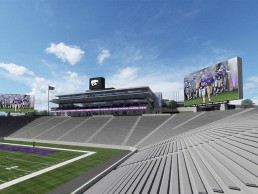
Kansas State University Upgrades Audio and Video Displays with Daktronics
Daktronics of Brookings, South Dakota, has continued a long-standing partnership with Kansas State University to provide new Custom Audio and LED video displays at Bill Snyder Stadium for football and Tointon Family Stadium for baseball. The baseball installation took place over the winter and the football installation is planned for this summer.
“We are proud to partner with Daktronics as we continue to find ways to significantly enhance our fans’ experience at our games,” K-State Athletics Director Gene Taylor said. “The new display at Tointon Family Stadium is a complete game-changer for our fans, and when they return to Bill Snyder Family Stadium next fall, the two new boards and sound improvements in the south end of the stadium will provide them a complete experience. They will now have four mirrored video display options for all angles and sides of the stadium which will also include an improved sound system in the south end. And our fans have probably already experienced the upgraded marquee along Kimball Avenue which will provide us more visibility to our residents.”
Bill Snyder Stadium is set to receive two end zone displays and a ribbon display in the south end zone, a marquee display outside the stadium, two wall-mounted displays in club spaces, and a custom audio system. The two main video displays will each measure 38.5 feet high by 68.5 feet wide and the ribbon display will measure 2.5 feet high by 220 feet long. These three displays will feature 13HD pixel layouts to bring excellent image clarity and contrast to every seat in the stadium.
The two club displays will each measure 13 feet high by 33 feet wide and will feature 3.9-millimeter line spacing for up-close viewing. The marquee display will feature 16-millimeter line spacing and measure 10.5 feet high by 14.5 feet wide.
“We’re extremely honoured to be a part of these exciting new audio and LED video improvements taking place at K-State Athletics,” said Ryan Kuzman, Daktronics sales representative. “We are excited to see these awesome new solutions very soon when sports begin coming back to all of us and look forward to this cutting- edge technology having a positive impact on their athletics programs for years to come.”
The custom audio system at Bill Snyder Stadium will be integrated with the video and scoring system to provide full-range sound reproduction while delivering clear, intelligible speech. This will provide a powerful audio experience for fans in every seat of the stadium.
"Thousands come for the entire game-day experience at K-State and approaching ‘Go Time’ in the stadium means ramping up the excitement in the entire venue,” said John Olsen, Daktronics audio sales representative. “The new audio system will provide the energy needed at key moments, grabbing attention and creating emotion – with an audiovisual experience that extends beyond the bowl – and reason to come back for more. It is our goal at Daktronics Audio to make every second, minute and moment matter for fans, sponsors and players each and every game day. Does it sound like fun? Well, it is!”
Tointon Family Stadium welcomed a new video display in left field featuring a 15HD pixel layout and measuring 20.5 feet high by 36 feet wide. It brings image clarity and contrast to live video, instant replays, up-to-the-minute statistics and game information, graphics and animations, and sponsorship messages.
The main video displays at both facilities are capable of variable content zoning allowing them to each show one large image or to share any combination of live video and pre-created content.
Daktronics will also be including its powerful Show Control solution with this installation. This industry-leading system provides a combination of display control software, world-class video processing, data integration and playback hardware that forms a user-friendly production solution. For more information on Show Control, visit www.daktronics.com/show.
In addition to the equipment installations, Kansas State will also receive a content package that will be produced and delivered by Daktronics Creative Services.
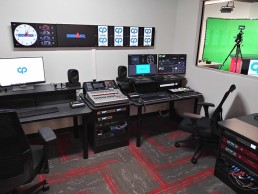
CP Communications Integrates Multipurpose Studio and Control Room for IRONMAN
CP Communications has completed the systems integration of a custom-designed streaming media studio and control room that enables The IRONMAN Group—a Tampa-based sports event management company—to deliver live coverage of its branded multisport and marathon events over-the-top (OTT) via its website and Facebook Watch.
Owned by the Chinese Wanda Sports Group, The IRONMAN Group produces more than 235 race events across 55 countries worldwide. These include the iconic IRONMAN Triathlon, which combines swimming, biking, and running into a single long-distance contest; the Rock ‘n’ Roll Marathon Series, and more.
“With this new multipurpose facility, IRONMAN can now produce live video coverage of events remotely over IP, saving travel and crew costs for a faster ROI,” said Kurt Heitmann, CEO, CP Communications. “Bonded cellular—one of our specialties—facilitates video signal backhaul and distribution, bringing IRONMAN over the finish line as a provider of premium sports content.”
Besides bonded cellular for IP-based transmission, the design leverages Dante to configure, manage, and route broadcast-quality audio over IP; and NDI, an IP-based video networking platform that extends the HD-SDI workflow. These technologies form a powerful yet-cost-effective studio and control room to manage remote productions via IP, and simultaneously produce live studio segments for event commentary, news, and Skype call-ins. A digital media room supports production of live stream video podcasts and on-demand training videos for IRONMAN athletes.
IRONMAN had already purchased some equipment before engaging CP Communications, including a 4-input NewTek TriCaster Mini video switcher and an analog Mackie audio board. They required a more sophisticated technical infrastructure to accomplish their production goals and CP expanded IRONMAN’s capabilities to maximize those capital investments. Within two months and on a tight budget, CPharnessed the combined experience and technical expertise of their designers, engineers and systems integrators, who built-out the studio and control room in two adjoining offices at IRONMAN’s Tampa headquarters.
The control room now includes the following gear to enhance the production workflow:
- An external 20x20 expansion router to expand the switcher’s video inputs from 4 to 20
- A Dante license was added to the TriCaster Mini to accommodate Dante-compliant audio
- A Yamaha TF-1 digital audio mixer with Dante sound card
- A Dante-enabled Unity intercom system, wireless mics, and in-ear monitors
- A Wowza Clearcaster for streaming to online portals like Facebook
- Mobile Viewpoint 2K4 playout servers and Terralink bonded cellular encoders
The 20-square foot studio design added the following capabilities:
- A News Desk Production set
- A greenscreen stage for immersive virtual sets and backdrops
- A NewTek TalkShow for bringing Skype callers into the live program
- Two Sony PXW-100 (1080i) cameras with added zoom and focus control, fluid head
- tripods, Dante communications, and NDI-based teleprompters
- A DMX lighting control system to control color temperatures and lighting set-ups
“We designed this studio/control room to enable IRONMAN to record training videos with virtual sets and to acquire, produce and stream its own high-value sports content,” Heitmann said. “We also paid special attention to the quality and consistency of the lighting for virtual sets, and keeping video and audio in sync with NTP clocking. The complete solution now ensure a flawless, broadcast-quality presentation for every IRONMAN event.”
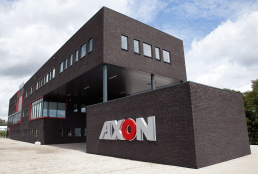
EVS Acquires Broadcast Network Infrastructure Specialist Axon
EVS has announced the acquisition of leading broadcast and media network infrastructure specialist Axon.
With development centres in the Netherlands and the UK, and more than 80 team members, Axon has a rich 30-year history of technology innovation. The company has an international presence in the live broadcast infrastructure market, including mobile trucks and data centeres, and a product portfolio that complements EVS’ existing live production offering.
As an industry leader in live production, EVS offers high-performance solutions that enable the creation of the most compelling live stories delivered by broadcast and media producers around the world.
In early 2020, EVS’ leadership team revealed the PLAYForward program, a global company growth strategy that identified the importance of developing a broader offering of modular and flexible IP infrastructure. Integrating Axon’s product portfolio will allow EVS to offer customers the most extensive live production infrastructure on the market, enabling optimized resource management, greater scalability and faster deployment across multiple sites for remote live operations.
It will also enable EVS customers to implement turnkey solutions to smoothly migrate their infrastructure towards IP and remote production-based workflows.
This acquisition, the largest in EVS’ history, will position EVS as the only technology company able to provide a comprehensive modern media infrastructure solution that includes advanced IP processing, SDI/IP conversion, SDN-based control and monitoring, as well as UHD-4K and IP multiviewer. The unrivalled combination of EVS’ Score Master SDN IP orchestrator, with Axon’s Cerebrum control and monitoring system, Neuron IP stream processing platform and the extensive Synapse modular infrastructure platform, will provide a scalable and redundant end-to-end solution to empower customers everywhere.
This mutually beneficial deal also allows EVS to further expand its global footprint and leverage its international presence to accelerate the reach of Axon’s expertise and technology. Additionally, EVS will benefit from Axon’s extensive relationships with channel partners, while also broadening the reach of its industry-leading product portfolio to different distribution channels.
“We’re extremely excited about the opportunities this acquisition will provide us and our customers over the coming months and years,” said EVS CEO Serge Van Herck. “Axon’s strong broadcast reputation and expertise, combined with our shared customer service-focused philosophy, make this marriage a perfect fit. It will enable us to deliver the most comprehensive media infrastructure solutions on the market.”
Axon CEO Michiel Van Duijvendijk commented: “This deal offers a major growth opportunity for both businesses, bringing together two innovative and proven product portfolios to form a unique end-to-end offering. We’re looking forward to joining the EVS team and working together to provide our customers with all the tools they need to power their journey towards IP-based media production.”
Benoit Quirynen, EVS’ SVP Strategy added: “In Axon, we’ve found an ideal partner. Its products match our vision of a centralized control model with distributed scalable resources. The company’s in-house expertise in FPGA and broadcast infrastructure, as well as other operational models, perfectly complement our research and development processes.”
Axon CTO Peter Schut concluded: “Our merger with EVS is a unique combination in the industry. With no overlapping products we will achieve maximum synergies. Our established Synapse modular infrastructure range has a proven track record in the most demanding applications, and the recently introduced Neuron Platform, the world’s first true Network Attached Processor designed for real time IP workflows, are perfect additions to EVS’ product range. Combined with Cerebrum, our popular, powerful and flexible control system, this adds the overarching control layer over both companies’ products. I can see a fantastic shared future for both companies.”
The Axon brand will be absorbed into EVS over the coming weeks and its product portfolio will be integrated into EVS’ global solution offering. The objective is to integrate Axon team members and to further invest in their technology and market expertise.
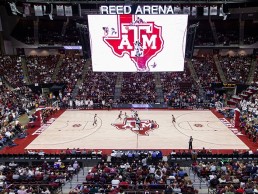
Texas A&M Goes IP with Imagine Communications for Integrated Sports Production
12th Man Productions, the sports broadcast and post facility for Texas A&M University, has moved to IP connectivity to provide a common production platform for all its sports venues. A cornerstone of the new installation is the Selenio Network Processor (SNP) from Imagine Communications.
The A&M campus in College Station, Texas, incorporates seven sports venues, spread across the site, which host as many as 110 events a year. As well as offering broadcast outputs from any event at any location, 12th Man Productions also provides in-stadium big screen entertainment and information. The football stadium, Kyle Field, was rebuilt in 2014, and as part of that project, a central studio was planned.
Today, fiber circuits connect every field back to the Kyle Field stadium, allowing resources to be allocated to any venue dynamically. Four control rooms allow two venues to broadcast live, while also producing big screen shows at two more venues. This calls for a large number of feeds in each direction, supporting monitors, multiple digital signage networks and big screen replays, as well as feeds for home and visiting teams. There is also a need to provide for official replay facilities in many sports. All signals are handled as uncompressed HD, minimizing latency by eliminating the delays of compression math, and allowing for live remote production even when venues are 10 kilometers from the control room.
“When we originally installed fiber, we used it as point-to-point connectivity,” said Zack Bacon, chief broadcast engineer for 12th Man Productions. “Not only did that limit our capacity, it meant that every device became a critical point of failure. “What this project has done is to network every device at every location,” Bacon said. “It means that instead of a fiber carrying just a single SDI feed, it carries multiple bidirectional signals – as many as 32 uncompressed HD feeds. Capacity between venues is no longer an issue, giving us much better utilization of the fiber capacity and allowing us to do much, much more. And because it is IP, should there be an equipment failure, then the network will simply work around it."
The new installation provides for seamless IP connectivity between every field, the studios, the central technical facilities and the control rooms. Central to its success is Imagine Communications’ SNP, widely recognized as the most flexible and efficient standards-based IP media processing platform. SNP enables companies like 12th Man Productions to simplify operations and reduce costs by supporting both SDI and IP networks. A single SNP can support up to eight channels of Ultra HD, 32 channels of HD, or a combination of the two, configured as SDI to IP, IP to SDI or IP to IP. Each FPGA-based SNP has four independent processing paths in a single compact 1RU frame, which can be reprogrammed for different functionality at the click of a mouse. The result is a very dense, extremely flexible broadcast installation that is IP native and sits transparently on the network.
This project was carried out in association with Cisco, which provided the QSFP fiber optic interfaces for bandwidth optimization, along with Nexus high-performance switches.
“This installation is a huge endorsement of the SMPTE ST 2110 standard for live, uncompressed production, along with the SNP as the ideal gateway and processor,” said Cassidy Phillips, VP Networking Solutions at Imagine Communications. “No other device on the market offers the same benefits as the SNP: huge flexibility in processing and gateway capabilities, fantastic signal density with four independent chains in a 1RU box, and full support for fiber optimization. It means that operators at 12th Man Productions can build and develop their workflows without worrying about the physical layer –allowing them to respond horizontally and vertically to the demands of their consumers.'
The new SMPTE ST 2110 installation at Texas A&M was completed for use from the start of the spring semester. The network continues to develop to reflect growing demands and capabilities, with the desire to move to a fully virtualized environment in the future.
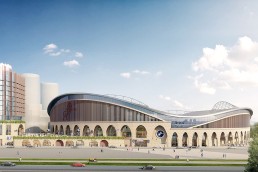
The Den - London, England | AFL Architects
New proposals for Millwall FC’s historic stadium, The Den, have been drawn up by AFL architects. The design of the new proposals has been inspired by the history of Millwall FC and its surroundings. The use of brickwork arches references the railway viaducts and industrial past that surround the current site, and also those at Millwall Park, which was home to the club on the Isle of Dogs over one hundred years ago, where the brick railway viaduct can be seen in the background of historic match photographs. Internally, as much of the original stadium infrastructure as possible will be kept, to ensure the unique atmosphere of the Den is retained.
The stadium is set to receive phased expansion of its existing venue, up to a total maximum capacity of 34,000 seats. This will provide additional media and player accommodation, meet premier league requirements and also, in time, provide enhanced facilities for fans to transform their match day experience.
Part of the proposal is the creation of a vibrant new public plaza at the heart of New Bermondsey railway station providing a valuable amenity for the surrounding community, as well as engaging space for fans on match days with retail, commercial and community areas. The Millwall Community Trust will also gain facility upgrades including a new sports centre with a sports hall, gym and community café.
The development strategy is also set to retain as much of the existing stadium structure as possible, while providing for a flexible phased uplift to both facilities and capacity over time. This not only maintains the stadium in use for fans, but minimises demolition and construction waste.
https://issuu.com/mondiale/docs/mondostadia11/12
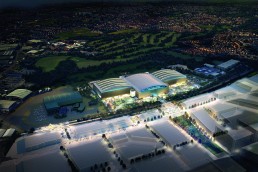
YTL Arena - Bristol, England | Grimshaw Architects / MANICA Architects
The planning application for Bristol’s multi-purpose YTL Arena was approved in early March this year. The new stadium aims to put the city firmly on the world stage for live music, sport and entertainment, repurposing the historic Brabazon Hangars, with a capacity of 17,080.
Behind the project, Grimshaw architects, alongside MANICA architects, aim to redesign the central, east and west hangars to create separate hubs for entertainment, food, drink, work and play across a 365-day-a-year calendar. The performance space will offer a variety of different stage configurations and capacities with the ability to support a range of events.
With sustainability high on the agenda of many sports venues at the moment, the stadium will use battery storage systems on site, as well as recycling rainwater and developing a green transport policy for staff and visitors.
In order to ensure the best sound quality within the stadium, internal walls and ceilings will be equipped with sound absorbing materials, and seats will be designed to further reduce reverberation and minimise acoustical changes.
https://issuu.com/mondiale/docs/mondostadia11/10