


AVIXA Expands Collaboration With the Association of Luxury Suite Directors
AVIXA, the Audiovisual and Integrated Experience Association, is teaming up with the Association of Luxury Suite Directors (ALSD) and representatives from professional sports teams and venues to explore the innovative ways integrated audiovisual technologies are creating a modern, immersive fan experience while generating better business outcomes for everyone involved in the production of modern sporting and entertainment events.
AVIXA will host four panel discussions and two industry roundtables at the 29th Annual ALSD Conference & Trade Show and Sports Venue Design & Build Forum, June 30-July 3 in Chicago. The four-day event brings together over 1,500 industry team, league, and stadium executives to hear from more than 100 speakers while participating in league meetings, sales training, and networking receptions.
“Anyone who has attended a sporting event in the last 10 years has witnessed firsthand the transformative role played by AV technology in creating fan experiences that are revolutionizing the businesses of sports and entertainment,” said Grimes. “Through our expanding collaboration with ALSD, AVIXA, together with forward-looking teams and stadium owners, is showcasing for the industry the cutting-edge AV technologies that are redefining spectator sport as an experience and as a business."
According to AVIXA’s Industry Outlook and Trends Analysis (IOTA), sports venues, in order to compete with fans’ ever-advancing home entertainment systems, are investing in audiovisual solutions to bring a “wow” factor to the fan experience that can’t be found at home. Venues are embracing AV technologies such as 4K videowalls, immersive and interactive displays, high-resolution audio, and more. “It’s a strategy that’s working,” Grimes said. “Venues and events generated $27.7 billion in pro-AV revenue worldwide in 2018, and AVIXA expects revenue to continue growing at a healthy rate over the next five years.”
The four AVIXA-hosted panel discussions, moderated by Grimes, will feature industry executives such as Gregg Allen, Chief Sales Officer, Sporting Kansas City; Jeff Berding, President, FC Cincinnati; Ralph Esquibel, Vice President of IT, Los Angeles Dodgers; Joe Januszewski, Chief Revenue Officer, Texas Rangers; Brian Keyes, Vice President of Technology, Cincinnati Reds; Joe LaBue, Vice President of Ticket Sales and Service, Carolina Panthers; and Leslie Lee, Director of Event Strategy and Service, San Francisco Giants.
The roundtables, also moderated by Grimes, will feature Jessica Fickenscher, Senior Vice President of Special Projects, Speedway Motorsports; Tom Moreland, Associate Athletics Director, Purdue University; Mel Raines, Senior Vice President of Facility Operations, Pacers Sports and Entertainment; Raj Saha, General Manager, Arena, Milwaukee Bucks; and Lee Zeidman, President, Staples Center & L.A. Live.
The AVIXA sessions, which will be included within the conference’s first-ever “AV Fan Experience” track, will explore important topics such as AV’s role in emerging industry trends such as eSports and sports betting; strategies for utilising an entire venue as an entertainment district through the integration of immersive AV experiences; ways to make the “behind the glass” suite and club experience as exciting as the on-field/on-court fan experience; and ways AV technologies allow merchandise outlets to optimise their operational efficiency to drive new and increased sources of revenue.
Learn more about applications of audiovisual technology in stadiums at avixa.org/sportsAV.
For a complete calendar of the industry events that AVIXA takes part in, visit avixa.org/markets/vertical-market-events

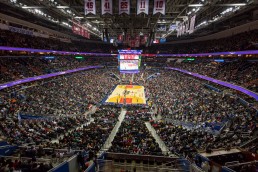
Capital One Arena Scores with EAW Adaptive Systems
Home to the 2018 Arena Football League Champion Washington Valor, NBA Washington Wizards, NHL 2018 Stanley Cup Champion Washington Capitals, and Georgetown University Hoyas men’s basketball team, the Capital One Arena hosts about 220 events per year, including major concerts. The arena opened in December 1997 and recently received a major renovation, including a new sound system in the main bowl based on Eastern Acoustic Works (EAW) loudspeakers.
“With changes in technology and the age of the system, we knew it was time to update the sound system,” comments Capital One Arena/JLL sound engineer Mark McCabe. “We had areas in the arena that did not have good sound coverage and equipment that was failing that could not be repaired.” “The old system didn’t provide the capabilities that are expected at modern NBA and NHL events,” adds Stu Schatz, a consultant at Wrightson, Johnson, Haddon & Williams (WJHW; http://www.wjhw.com), the design and consulting firm hired by arena management company Monumental Sports & Entertainment to manage the sound system renovation. “We wanted to modernize, and we looked at several options.”
Schatz, WJHW Associate Principal Kevin Day, and other members of the WJHW team worked closely with McCabe and the arena team to find a solution that would work for the many different types of events held at Capital One Arena. “We were the designers, and Clare Solutions did the install,” Schatz details. “Clair has a great team, and their lead on the project, Jim Devenney, did a terrific job.”
For the main loudspeaker system, the WJHW team chose 54 EAW Anna 3-way full-range array modules, configured as 6 arrays of 9 Annas. The Anna is part of EAW’s Adaptive Systems loudspeaker line, which can assess and perfectly match the three-dimensional performance requirements of any venue. Adaptive Systems loudspeakers utilize a high-resolution array of discretely powered and processed acoustical devices, in concert with software, to create optimized results without physical reconfiguration. This ability to electronically configure is a major reason the WJHW team chose the EAW solution.
“The arena has basketball, hockey, and arena football,” Schatz notes. “They also have a lot of concerts. We liked the EAW system’s ability to quickly reconfigure because there are plenty of times, especially in the fall, where they have hockey one night and basketball the next.”
A basketball court is considerably smaller than a hockey rink, which presents a challenge when aiming the sound. “Ideally you want to adjust loudspeaker coverage to match the seating,” Schatz explains. “When reconfiguring from basketball to hockey, there’s at least 50 feet more playing surface and less seating on each end. In more traditional systems, you aim to hit the seats at the end of the court for basketball and know that for hockey you’re putting sound on the ice for that extra 50 feet at each end. Of course that’s never good because ice doesn’t absorb sound; it reflects it. But with the EAW system we simply recall a preset to reconfigure the system electronically to fit the seating, rather than having to re-aim mechanically, as with most systems. For concerts, you want to pull the house system up and out of the way, and we can do that easily as well.”
To handle the powerful low end required in a major arena, WJHW specified four arrays of five EAW Otto Adaptive Subwoofers, with an Otto array placed behind each of the four corner Anna arrays. Utilizing two high-powered 18-inch woofers paired with independent onboard amplification, processing, and networking, Otto subwoofers extend Adaptive Performance to the lowest octaves of the audible spectrum. Combined in arrays, as at Capital One Arena, Otto provides a wide variety of possibilities in low-frequency pattern control.
Supplementing the main system, 24 EAW QX364 2-way trapezoidal loudspeakers form a delay ring to cover the upper back seats at the rear of the arena. The QX364 delivers the high output level needed for medium-throw arena fills, with broadband pattern control that is especially useful in a highly reverberant environment. That said, notes Schatz, “considering its vintage, the Capital One Arena is pretty well behaved acoustically. It has been acoustically treated reasonably well.”
The arena’s Dante-enabled Yamaha QL5 digital console was purchased only a year before the renovation. “We kept the QL5, as there was no reason to replace it,” recounts Schatz. “The Dante network is managed with several BSS processors. One processor at front-of-house, on the upper concourse level, takes everything Dante in and sends over fiber up to the network switch on the catwalk. From the catwalk, it’s CAT6 to the loudspeakers.” Also at the catwalk is a rack of Crown DCi 4|1250N amplifiers that drive the QX364s for the delay ring, under-scoreboard boxes, and other fills.
The existing sound system for areas of the venue outside of the main bowl was left in place, connecting to the main system at the front-of-house processor. The existing access points for the broadcast team and announcers also were left in place.
From WJWH’s viewpoint, the project is a team success. “WJHW has a longstanding relationship with EAW, and we appreciated the support of the EAW people, both at the sales end and commissioning the system,” praises Schatz. “Mark McCabe did a terrific job of driving this for the venue, and Clair Solutions did an excellent install.”
Most important, the Capital One Arena team is happy. “The new EAW sound system has corrected the issues, and due to sound mapping done prior to the new system being installed, we now have very good sound coverage in the arena,” confirms McCabe. “With the updated sound system, it is very easy to address different sound needs in the venue and to deliver a better sound experience for the fans. Overall, we ar e very pleased.
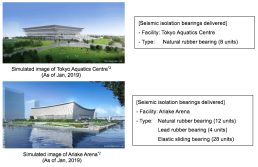
Bridgestone Technology Ensure Tokyo 2020 Venues are Earthquake-Ready
Bridgestone Corporation (Bridgestone), the only Worldwide Olympic and Paralympic Partner with global headquarters in Tokyo, has announced that it has supplied its cutting-edge seismic isolation bearings for two newly-constructed permanent venues that will host competition during the Olympic and Paralympic Games Tokyo 2020. As a global leader with founding roots in Japan that date back 90 years, Bridgestone is proud to provide its advanced earthquake protection technology to the Tokyo Aquatics Centre, where swimming, diving and artistic swimming competitions will be held, and Ariake Arena, where volleyball and wheelchair basketball will be contested for Tokyo 2020.
Seismic isolation bearings are flexible structural supports that isolate a structure from the ground to help reduce the spread of seismic shock and decrease the chance of damage in the event of an earthquake. These bearings range in size between 600mm and 1800mm diameters. The two new venues, which are set to be completed in 2019, feature a roof seismic isolation structure. Installing the bearings beneath the roof instead of under the foundation of the venue helps lower the burden placed on the roof’s structural support elements. This type of installation is often used in hall- or dome-shaped facilities with large, open spaces such as sporting arenas.
“Bridgestone has been at the forefront of seismic isolation technology for decades,” said Tomohiro Kusano, Vice President and Senior Officer, Responsible for Diversified Products Solutions Business, Bridgestone Corporation. “As we prepare to welcome the world to the Olympic and Paralympic Games in our hometown, we are exploring all opportunities in which our innovative products and solutions can enhance and support the way that athletes, visitors and guests in Tokyo move, live, work and play. Our seismic isolation bearings will help ensure a safe and enjoyable experience for all visitors to these two much-anticipated venues during Tokyo 2020 and for many years to come.
Bridgestone has been developing and manufacturing its seismic isolation technology in Japan since 1984. Today, the company’s seismic isolation bearings are used in various facilities in Japan and around the world, including historic landmarks such as Tokyo Station and Los Angeles City Hall, as well as disaster preparedness facilities, government buildings, hospitals, commercial facilities, residential apartment complexes, and more.
After the Olympic and Paralympic Games Tokyo 2020, the Bridgestone seismic isolation bearings installed at the Tokyo Aquatics Centre and Ariake Arena will continue to contribute to the safety of both venues as they host domestic and international events and serve as public recreation areas and cultural centers for years to come. Additional information on the advanced technology and mobility solutions that Bridgestone will deliver to support Tokyo 2020 and its legacy in Japan will be announced in the coming weeks.
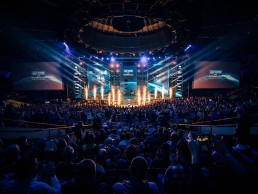
Robycam in Action at the ESL One Katowice 2019 eSports Event
With eSports being the current driving force in the entertainment and sports sector there is an ever-increasing demand for bigger spectacle and better viewer experience at eSports events, live on site, on TV or via streaming.
From 22 February to 3 March the ESL One Dota 2 eSports tournament and Intel Extreme Masters stopped in Katowice, Poland. Around 18,000 visitors followed the battles live in the Spodek Arena and several million via Internet stream. The perfect stage for Robycam Germany’s cable camera system.
On the impressive main stage, 12 teams fought for the title of Dota two champion in Katowice. With elaborate pyrotechnics and massive light shows, the Katowice event does not lag any other international live concert or show. Team Secret was the winner of the final.
Robycam Germany used the biggest Robycam system during the event in the Spodek Arena. Rigging points for the winches were placed to the right and left of the stage, and on the tiers, therefore the Robycam could fly over the entire stage and auditorium. The Robycam Germany team used a Grass Valley LDX 86 N Compact camera because of the primary exploitation of the event via internet streaming. All video signals were produced
throughout the entire production chain in 59.94p and also played out on the screens in the arena.
The gyro-stabilised camera head makes 3D camera movements possible. Together with a powerful control system, movements in all three axes are possible: pan, tilt, roll. All three axes are stabilised, i.e. there is also an 'Auto-Horizon' function, stabilising the image during wind or swinging movements.
The Robycam system uses four real-time controlled automatic winches and a sophisticated motion control system that allows for millimetre accurate and fast camera movements - up to eight m/s in all axes are possible. The largest system has an operating radius of more than 250 m x 250 m and the system works fully redundant (UPS units on each computer). All systems comply with the German safety standard DGUV 17/18
(formerly BGV-C1) and meet all other important national safety requirements. Defining areas in which the system can fly and those that are blocked is a particular feature of the system that enables use in environments with 'blocked' spaces. Even in the event of operating errors, absolute safety is guaranteed for
fixed installed obstructions or persons.
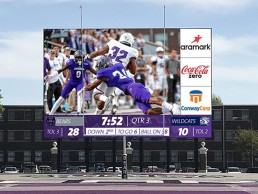
Daktronics To Install New LED Video Display at University of Central Arkansas
Daktronics of Brookings, South Dakota, has been asked by University of Central Arkansas to design, manufacture and install a new LED video display at Estes Stadium in Conway, Arkansas. The 1,944 sq ft video scoreboard will inform and entertain Bears fans at football games in 2019.
“We are excited to partner with the leader in video production applications,” said Brad Teague, University of Central Arkansas Director of Athletics. “The latest video technology, coupled with the large size of the video screen, will provide a great game-day experience for our supporters. We couldn't be more pleased with our new addition for the 2019 season.”
The new LED technology will measure 36 feet high by 54 feet wide and will feature a 15HD pixel layout to show crisp, clear imagery to every seat in the stadium. The display will feature industry-leading environmental protection from the outdoor elements and superior brightness to cut through direct sunlight on game days.
“The new video board will elevate the game-day atmosphere for University of Central Arkansas and entice more fans to make their way to the stadium for every game,” said Andrew Rice, Daktronics Sales Representative. “The new technology is the same as professional football teams are using in their venues to create an experience that simply can’t be replicated on television. We’re looking forward to seeing it come to life at Estes Stadium this fall.”
The display features all of today’s technological expectations including variable content zoning which allows it to show one large image or to be divided into multiple zones of content. It can show live video, instant replays, up-to-the-minute statistics, graphics and animations, sponsorship messages, and any combination thereof. Delay of game clocks and a four-input switcher were also included with the installation.
Daktronics will also be including its powerful Show Control System with this installation. This industry-leading system provides a combination of display control software, world-class video processing, data integration and playback hardware that forms a user-friendly production solution.
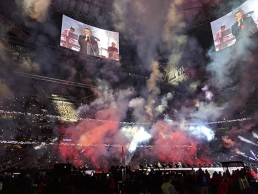
Professional Wireless Tackles Super Bowl LIII
Orlando-based Professional Wireless Systems recently handled all wireless microphone and IEM systems management for pre-game, half-time entertainment and post-game – along with the wireless microphone utilised by the referee – during Super Bowl LIII held in the Mercedes-Benz stadium in Atlanta. This is the 22nd year that ATK Audiotek has tapped PWS to provide wireless support for the Super Bowl.
“It is pretty amazing to think about all of the changes that have occurred in wireless technology over the course of 22 years,” explained Jim Van Winkle, General Manager, PWS. “This year was no different in that we implemented a number of new systems that helped us handle the exceedingly crowded RF environment in Atlanta – where the TV repack hasn’t even happened yet.”
As in previous years, PWS started planning back in October, with a site visit to Mercedes-Benz stadium. Jim and Gary Trenda, lead RF technician for PWS, made the trip along with ATK Audiotek team members Paul Liszewski, Brett Valasek, Kirk Powell, and George Schwartz. The site survey provides critical information about the physical site and local RF environment that Van and Gary need to design the game day wireless system.
This year, the main RF equipment location was on the NFC champions side of the field near the southwest 20-yard line. From there, the PWS team deployed the antennas necessary for the wireless microphones and in-ear monitors to provide state-of-the-art audio for one of the most-viewed television events of the year.
“With the available frequency spectrum shrinking, we’re starting to look for alternate areas to operate in.” explained Gary. “This year, we deployed a specialised antenna system in the 940-960 MHz STL band. The STL band is only available to licensed users, but this 20 MHz of spectrum can be similar to having three unused TV channels to operate in, depending on location. We decided to deploy a system of PWS 950 MHz Helical Antennas and utilise wireless microphones operating in that range.”
Ultimately Gary and team deployed four PWS 950 MHz Helical Antennas to support a Shure STL band Axient digital microphone system operating in Quadversity mode. There were also four PWS UHF Helical antennas to support a UHF band Axient digital system. RF signal distribution from the antennas was handled by a pair of PWS 4X4 Quad Multicouplers. The master antenna system also connected to racks of Axient analogue and Sennheiser digital microphones. A rack of Shure PSM-1000 in-ear monitor transmitters, managed by PWS technician Kasey Gchachu, rounded out the RF package, feeding more than 40 in-ear packs on the field.
A Wisycom MFL RF over fibre (RFoF) system allowed for much longer runs than traditional coaxial cable and with minimal signal loss. The Wisycom units were used for both receive and transmit applications. This allowed for a second pair of receive antennas, along with additional IEM transmit locations. Wisycom provides a wideband optical link for up to four RF channels multiplexed on a single strand of fibre optic cable.
“We used the Wisycom system last year and were very pleased with it,” added Jim. “Not only is it incredibly reliable, but it allowed us quite a bit of flexibility, which is necessary during an event of this magnitude. When connected to the Axient Digital microphone system, it offers clarity and reliability in crowded RF environments like Atlanta.”
Gary added: “The Axient Quadversity feature allows placement of two pairs of antennas in different zones or doubling of antennas in one zone, improving RF signal-to-noise in challenging environments. In this case, we deployed antenna pairs on both the AFC and NFC sides, ensuring reliable operation anywhere on the field.”
The Axient Digital system’s frequency diversity capability also ensures that a secondary frequency is immediately available as a back-up if the primary frequency degrades. Both the Axient and PSM-1000 systems are compatible with Shure’s Wireless Workbench control software. PWS technician Cameron Stuckey operated the Wireless Workbench setup. It was used for live monitoring, including RF and audio level timeline plotting, on game day.
PWS’s Helical Antennas provided longer range and greater reliability than standard antennas. Unlike traditional whip and similar antennas, which transmit and receive signals in a single polarisation, the circular polarisation of the helical antenna can better match the complementary signal, greatly reducing the risk of drop-outs.
The RF energy rotates through 360 degrees of polarisation, providing crystal clear reception in the artist’s ears and in the wireless mics receiver no matter how they may move about or where they go on the stage. This makes the PWS Helical Antenna particularly useful in large scale events, like the Super Bowl, where it may be virtually impossible to control the orientation of both the sending and receiving ends of the wireless communication.
“To conserve spectrum, we also moved some of the wireless intercom systems out of the UHF TV range.” said Gary. “The Reidel Bolero system operates in the 1.9 GHz DECT band – which is above the UHF TV band.” PWS worked with Matt Campisi and the ATK Versacom team to manage the wireless intercom frequency allocations. ATK Versacom technician Jeff Watson deployed over 40 wireless intercom packs to keep the production team in constant communication.
After Jim and Gary finalized their plans, Trenda reached out to NFL Frequency Coordinator Karl Voss and his team of Game Day Frequency Coordinators (GDCs) to request the frequencies necessary to lock down their production responsibilities.
“This is a perfect example of how things have changed over the years,” added Jim. “20 plus years ago, we didn’t have as much competition for bandwidth so there was less concern about potential problems. We have always coordinated closely with the GDCs. The airwaves are so crowded now that proper coordination is more important than ever. Even once we have our channel assignments, you never know what might happen, so being prepared is key.”
Part of being prepared takes place the Thursday before the Super Bowl – they call it RF War Games.
“The main unknown is the other wireless operators on site,” said Gary. “Everyone is required to coordinate with Voss and the GDCs. The goal is reliable operation for all wireless users. On the Thursday prior to game day, all the main wireless users will come into the stadium and try to simulate the gameday RF environment. The GDCs have everyone turn on their wireless systems and we see what happens – we fondly refer to this process as RF War Games.”
This is an opportunity for the PWS team to go through and make adjustments, modify gear placement and rework anything else that needs to be corrected prior to the game.
“We see how it all works together and then make any necessary adjustments,” Gary concluded. “This is usually the most congested wireless environment we work in and there’s always the possibility someone could accidentally start transmitting on the wrong frequency, which can create unwanted interference. The key is to make sure all your equipment works well with the other systems, and to plan for the unexpected – it’s all about preparation. The entire PWS team did an amazing job this year. It feels good to have a successful show with zero technical issues in an environment like this.”
Jim concluded: “It’s a group effort that has been taking place for 22 years, which is a testament to everyone involved. Deploying new technology, working with show-stopping half-time entertainment, and addressing any challenges that arise….it’s always a terrific event and something we are quite proud to be a part of.”
Daktronics Provides New Visual Experience at Red Bull Arena
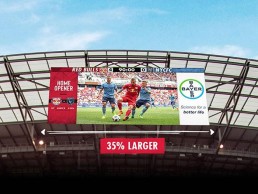
Red Bull Arena, home to professional soccer’s New York Red Bulls, received a new LED video display system from Daktronics (NASDAQ-DAKT) of Brookings, South Dakota. Two new 1,325 sq ft displays were recently installed at the venue in Harrison, New Jersey, to inform and entertain audiences at every event.
A new LED video board is positioned at each end of the venue. Each measure 24 feet high by 55 feet wide and features 10-millimetre line spacing to bring an improved visual experience, including wide-angle visibility, to fans in every seat.
Live video, instant replays, statistics, graphics and sponsorship messages will be brought to light with these new video boards. Each is capable of variable content zoning which allows each to show one large image or to be divided into multiple zones to show any combination of content at any moment during the event.
“The new technology at Red Bull Arena will elevate an already fantastic fan experience for the New York Red Bulls and other special events held at the venue,” said Peter Dunkle, Daktronics sales representative. “We’re grateful to partner with such a great team to bring this video board project to life. We’re looking forward to seeing them have a positive impact for many years to come.”
Integrated into the video system, Daktronics included its powerful Show Control System. This system provides an easy-to-use interface for event production while combining video processing, data integration and playback hardware in one robust control solution.
Clair Solutions Provides for New Penn State Stadium
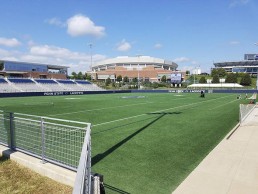
Penn State’s Nittany Lion athletics programme is fiercely competitive and well-supported by the school and its alumni. In that tradition, the Penn State men and women’s lacrosse teams now practice and compete in Panzer Stadium, a new multimillion-dollar, state-of-the-art facility. Its 1,300 seats are close to the action, and the entire facility is wired for modern broadcasting, which will allow Penn State to host high-profile NCAA and Big Ten championship games. Pennsylvania-based audiovisual design and integration firm Clair Solutions handled the broadcast infrastructure and sound reinforcement at Panzer Stadium, earning the job based in part on the sensible proposal of Jim Devenney, Clair Solutions’ senior systems designer and in part on the successful completion of numerous other projects at Penn State.
“We originally got involved because we’ve done a lot of other work at Penn State, including 100,000-plus-seat Beaver Stadium” Jim explained. “The school benefited because we’re a one-stop-shop with deep in-house knowledge about the design and installation of audio and broadcast systems. In Clair’s long history, we’ve seen it all. The decision-makers at Penn State who were responsible for Panzer Stadium’s audio and video systems had a clear vision for what they wanted, which gave us a solid, fixed target to shoot for.” Clair Solutions’ design/build worked in synergy with the larger project, which was designed by Moody Nolan, of Columbus, Ohio and APArchitects of Lemont, Pennsylvania, and built by general contractor PJ Dick of Pittsburgh, Pennsylvania.
Jim continued, “Penn State wanted the broadcast cabling infrastructure in Panzer Stadium to meet the high expectations of first-rate media outlets like ESPN. When an ESPN crew rolls in, they expect tie-ins for camera positions all around the field. They have high production values, and they’re every bit as high for lacrosse as they would be for, say, football or basketball.” The anticipation of high-profile media attention is not just wishful thinking on the part of Penn State, and lacrosse is now a Big Ten sport, and the Nittany Lions men’s and women’s lacrosse teams are among the best in the nation.
Jim’s design gives Panzer Stadium comprehensive connectivity via a lot of single-mode fibre, CAT6 data, video, and audio. “The cabling itself wasn’t cheap,” Jim observed. “When you’re buying a lot of wire, well, it is what it is.” Wires run from all possible camera positions and then sensibly split or go to the press box and/or the broadcast truck pedestal. Since there’s no better time to get the cabling right than during original construction – both for near-term needs and long-term growth, the Clair Solutions installation team endeavoured to provide Penn State with cabling infrastructure that will serve Panzer Stadium season after season after season without so much as a hiccup.
Per the school’s request, the sound reinforcement system is modest but capable of future growth if needed. A Soundcraft Si Expression 1 console serves as the user interface for Penn State’s audio techs and brings together a bevvy of Shure wired and wireless microphones and various playback devices. A BSS Blu160 DSP system handles input conditioning, routing logic, and loudspeaker conditioning and also provides simple, on-field input and volume control so that the teams can control their own music for practices and warm-ups. Lab.gruppen C-series multi-channel amplifiers power Community R2-series outdoor loudspeakers and JBL Control-series indoor loudspeakers.
Gearhouse Broadcast Chooses Freespeak II Wireless Intercom
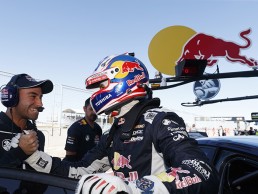
In Australia, Gravity Media’s Gearhouse Broadcast Pty Limited (Gearhouse) and Triple Eight Race Engineering Australia Pty Ltd (Triple Eight) have entered into a four-year service partnership for communications systems, with Clear-Com’s FreeSpeak II digital wireless intercom system providing communications between car controllers and their support staff. Both Gearhouse and Clear-Com are the Official Communications Partner to Triple Eight Race Engineering, competing as the Red Bull Holden Racing Team in their pursuit of Supercars Championship success.
“It was very clear to us that using FreeSpeak II is the best possible solution for the Supercars Championship,” said Triple Eight Team Manager Mark Dutton. “The tuneability of the system to suit and support our needs is truly next level, no other system in the past has come close to the functions, features, and clarity of the system. FreeSpeak II is a high-performance system which has allowed to communicate in high pressure situations in a way we only dreamed of in the past.”
As part of the agreement, Gearhouse will supply, service and install Clear-Com solutions for Triple Eight. This includes an Eclipse-HX based system with nine 12 key panels and with 15 FreeSpeak II belt packs roaming between four FreeSpeak II transceivers. Gearhouse will also supply other communications equipment, including custom designed high noise headsets (modified for FreeSpeak II), equipment racks and solid-state recorders.
“The Australian Supercars Championship requires that teams have superb communications regardless of the track, its conditions or anything else that would impede communications,” said Mitchell Lockyer-Lane, Business Development Manager for Gearhouse Australia. “The communications systems that we’ve put together for Triple Eight, based on FreeSpeak II and the Eclipse HX Delta assures the teams that their intercom system is something they won’t have to worry about.”
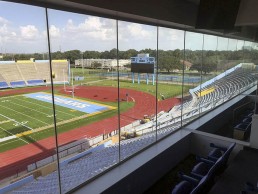
Mumford Stadium Upgrades to Danley
Although the 6,500-plus students at Southern University are big supporters of their SWAC NCAA Division I Jaguars football team, the much larger 28,500-seat capacity of A.W. Mumford Stadium reveals the team’s huge fan base of alumni and residents in Baton Rouge, Louisiana. Indeed, since it was first constructed in 1928, the stadium’s capacity has grown steadily and has always outpaced growth in enrolment. A.W. Mumford Stadium also hosts home games for the Southern University women’s soccer team and the Laboratory School Kittens football teams. After water and lightning damage crippled its relatively new sound system, area representatives Anderson Sales and Marketing conducted a Danley demonstration at a home game. After that, Southern was committed to getting a Danley sound system. Recently, Pensacola, Florida-based All Pro Integrated Systems designed and installed a permanent Danley sound reinforcement system at A.W. Mumford Stadium.
“We decided to go with a Danley system after a visit to LSU to check out the Danley system installed in Tiger Stadium,” explained Henry Thurman, Assistant Director of facility services at Southern University. “We were totally impressed with the performance of the Danley boxes, from the clarity of spoken word to its deep bass response to popular hip-hop music. The most important aspect actually came from the construction of each cabinet. Although it was only a few years old, our previous system was totally destroyed by moisture coming in contact with the cabinets and severely reducing performance. The Danley cabinets are solidly constructed and will definitely withstand the test of time in this southern Louisiana climate.”
Kim Comeaux of Anderson Sales and Marketing brought a pair of Danley Jericho Horns for home games after the premature demise of the previously-installed sound system. “The system we designed and installed is really just a larger version of the system Kim was bringing in on a temporary basis,” said Michael Walden, systems designer with All Pro Integrated Systems. “Henry and everyone else at the school was pleased with the Danley system, and we’ve always had great outcomes with Danley installs at All Pro. The fact that we can design a system to cover a nearly 30,000-seat stadium with just seven boxes makes the installation more efficient and cost effective.”
The new system is end-fired and consists of one Danley J6-42 Jericho Horn to cover the opposite end zone seating, two Danley J3-64 Jericho Horns to cover either side of the stadium, two Danley OS80 loudspeakers to fill in the areas close to the array that get missed by the Jerichos, and a pair of Danley BC218 subwoofers to round out the system’s deep, deep low end. Linea Research amplifiers power the system, with modest loudspeaker conditioning from onboard DSP. A new QSC Q-Sys DSP system provides input conditioning, routing, and all other signal processing functions. “When we were commissioning the system leading up to game day, we got favourable comments from across campus,” Michael said. “Faculty and staff noted the clarity of what they were hearing. They could hear and understand everything that was said.”
“All Pro Integrated Systems completed installation of the Danley system mid-season, and it debuted at one of our most-attended games of the year,” said Henry. “With almost 30,000 fans in attendance, we found that there was not a single dead zone in the stadium; we had excellent coverage. Because of this, we definitely saw an increase in fan participation, which made the game a more enjoyable experience for everyone. We will definitely be using Danley in the future for our other sports venue needs.”