

Danley Deliver Audio Upgrade for Eddie Robinson Stadium
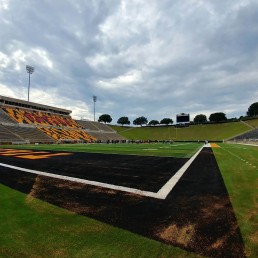
College Football Hall of Famer Eddie Robinson holds the record for the second-most victories of any college football coach while leading the Grambling State University Tigers in over fifty seasons of play, from the 1940s to 1997. Robinson coached over two-hundred players who went on to the professional AFL, CFL, and NFL leagues, and in any discussion about who was the best football coach of all time, Robinson is always in the running. Indeed, many pundits put him at the top. Thus, the small, historically-black Grambling State University is indebted to Robinson for elevating the school’s exposure and reputation. When the school constructed a new 20,000-seat stadium in 1983, it named the stadium in his honor. Recently, Eddie Robinson Stadium underwent scoreboard and sound system renovations, and a new, powerful, simple Danley Sound Labs Jericho Horn and BC-subwoofer system now puts the emphasis on experience in the game-day experience for Tigers fans.“The old sound system was antiquated, and – besides that – it had to come out with the old scoreboard that Nevco, of Greenville, Illinois, was replacing,” explained Larry Habetz, owner of A/V integration firm Gulf Coast Production Systems (GCPS) of Rayne, Louisiana. In collaboration with Danley rep Kim Comeaux, GCPS designed and installed the new Danley system for Eddie Robinson Stadium. Based on past successes, Nevco brought GCPS in on the project to handle the sound system integration.“We’re pretty new to Danley,” Habetz continued, “but we’re also based in Louisiana, home to LSU’s 102,000-seat Tiger Stadium. The Danley system at Tiger Stadium has been a huge success and offers proof of concept for anyone who wonders about Danley’s point-source technology for large stadium applications. For Eddie Robinson Stadium, it was clear that a Danley system would deliver the significant SPLs that Grambling wanted with fidelity and impact. Although the line item numbers for Danley boxes make them look pricy, the fact that you need so few boxes and so few amp channels make an entire Danley system extremely competitive. We’re typically hanging just one Danley box for every five to ten boxes of a comparable line array system.”The timeline for the installation was tight. From the moment GCPS had the purchase order to the first game of the 2017 season spanned just five weeks. “That’s a little shorter than the usual delivery time on an aqua-tight Jericho Horn, but Danley rocked it out and got the boxes to us ahead of schedule,” Habetz said. “We got the infrastructure in place ahead of delivery and then hung the boxes on Wednesday and Thursday, tuned the system on Friday, and showed up for the first game on Saturday! The fact that a Danley system is so simple and has so few ‘moving parts’ made it possible.”Indeed, a 20,000-capacity crowd gets ample coverage and volume from just two Danley J3-94 Jericho Horns, one on either side of the new scoreboard. Each Jericho Horn is powered by a four-channel Danley DNA 20k4 Pro amplifier. The only other components in the entire system are two Danley BC-218 subwoofers mounted together at the top center of the scoreboard and powered, together, by a single DNA 20k4 Pro amplifier. GCPS used the Danley amplifiers’ on-board DSP and custom-made presets for J3-94s and BC-218s to get the system close to dialed in, then long-time collaborator James Young of Current Designs in Acoustics stepped in for the final commissioning. “Jim [James Young] put maybe two or three parametrics on the output to boost or cut a few frequencies that were specific to the acoustics of Eddie Robinson Stadium, but it was very modest,” Habetz said. “We also worked with Josh Millward at Danley to get the Danley amp’s multiple layers of loudspeaker and circuit protections in place because Grambling is really going to put this system through its paces!”Now several weeks in, the technical staff at Grambling has gone out of its way to let GCPS know how happy they are with the new system. “It sounds excellent and can go as loud as they care to go,” Habetz said. “It was a really great project, and we’re looking forward to working with Danley technology at the very next opportunity.”

UEFA choose Madrid, Baku, Istanbul and Budapest for 2019 finals
After meeting in Nyom, UEFA officials have announced the final selection of stadiums that will host club competition finals in 2019.
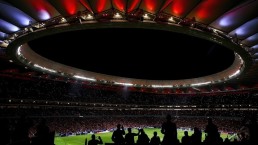
For Europe's premier competition, the UEFA Champions League, Atletico Madrid's new Wanda Metropolitano stadium has been awarded the final, which is scheduled for June 1st.
The Europa League final has been awarded to Baku's Olympic Stadium, with the game set to be played three days before the Champions League final on May 29th.
Another of the bidders, Vodafone Park in Istanbul, has been given the Super Cup final on August 14th.
Finally, the Women's Champions League final will be played at Budapest's Groupama Arena.
Zumtobel lights up WWK Arena
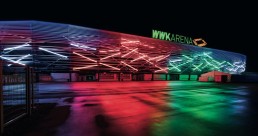
The new, modern and climate-neutral stadium, which was opened in September 2009, is the home ground of FC Augsburg and is also used as a venue for matches of the men and women’s national football teams. With the start of the 2015/16 season, the WWK Insurance Group became the main sponsor of FC Augsburg and since then, has lent its name to the 30,600-seat WWK Arena. With its commitment to Augsburg, the insurance group decided to finance the previously uncompleted façade, thereby turning the stadium into a special highlight. The aluminium structure is wrapped around the stadium like a nest in three levels. In an irregular, Mikado stick-like arrangement, the LED fluorescent tubes are woven into the aluminium tube construction. Zumtobel took up the idea and vision of architects Bernhard & Kögl of a homogeneously luminous, oversized tube of light throughout the project and turned it into reality with the construction of the 'light tubes'.
Zumtobel developed the entire design concept for the light façade based on state-of-the-art LED technology in close cooperation with the architects.
“It was only because of the expertise of the ‘Atelier of Light’ in various areas of special construction, lighting design and visualisation, combined with a unique network of competent, external specialists and partners that we were able to implement the development and production of this unique and impressive lighting solution in line with the architect's vision,” said Oliver Mosselman, Project Manager in the Complex Project Management Team of the Atelier of Light at Zumtobel.
The complex façade structure is made up of a combination of aluminium and fluorescent tubes, which are interwoven with each other and thus symbolise “enveloping the opponent”. Both elements are wrapped around three levels of the stadium like Mikado sticks. Depending on the distance between the tubes, a depth is created that seem more or less dense at places, depending on where they are.
The lighting concept is enhanced by 36 Contrast 2 LED L RGB spotlights from another Zumtobel Group brand, Thorn, which are mounted on existing lighting poles around the stadium. The compact and powerful LED spotlights support the light tubes in illuminating the impressive stadium façade and serve as basic lighting for the façade structure. The spotlights also cover the entire RGB colour spectrum, meaning they not only reinforce the adjusted colour scenes but also enhance the façade structure. This accentuates the three-dimensional character of the entire construction even more clearly. The light tubes and mast lights are controlled by livebau Solutions GmbH via a DMX server so each tube and each spotlight can be controlled separately. The result is an effective interaction between façade and column luminaires, which allows the colour and intensity of the individual luminaires to be adjusted.
Prior to implementation, the “Atelier of Light” team integrated the façade lighting concept into a three-dimensional stadium model with the aid of Zumtobel's own "HILITE" tool. The concept visualisation created with HILITE facilitates a very realistic view and evaluation of the expected lighting effect.
“Upon the final completion of the new façade, the WWK Arena gains a huge upgrade and yet another architectural highlight. The WWK Arena in Augsburg is designed as a FIFA stadium for international (country) matches and is one of the few stadiums in Germany that attracts attention with its impressive façade and creates a special atmosphere for fans,” summed up Jürgen Schrameier, Chairman of the Board of WWK.
SAAP 2017 Provides Perfect Forum for Business
The Stadia & Arena Asia Pacific 2017 conference and exhibition held last week in Chiba City, Japan, brought sports venue professionals together to discuss the latest trends in stadia and arena design, build and operation.
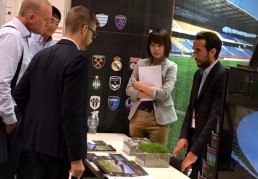
Hundreds of delegates flocked to the Makuhari Messe exhibition and conference centre to hear presentations and roundtables on subjects ranging from security and fan engagement to games legacy and pitch preparation and maintenance. More than 50 exhibitors, displaying seating, lighting, roofing and turf products among many others, welcomed visitors to their stands. The sports venue business is a growth industry in Japan, which is set to host the Rugby World Cup in 2019, the Olympic and Paralympic Games in 2020 and the Asian Games in 2026. The country plans to build 20 new stadia and arenas by 2025.
It was not only Japan in focus, however, as representatives from Jakabaring Sports City in Indonesia were on hand to highlight their facilities ahead of next year’s Asian Games in the country.
The governor of South Sumatra, Alex Noerdin, described how the sports city has been designed with a main 35,000 seat stadium, world class rowing and shooting facilities. The venue also boasts a retractable roof arena which can host tennis and basketball. A prestigious Moto GP circuit is also set to be built at the sports city.
Giving the closing keynote speech, Ben Fletcher, Director of Communication, Marketing and Strategy for the London Legacy Development Corporation, told delegates how important it is to build legacy into venues from the outset. The self-confessed ‘Olympics addict’ said,
"We want to build legacy in, not build it on afterwards. The important thing is to build the legacy part first and then create the venues needed for the Olympics. We brought the 2012 Games to a part of London that really needed development." He encouraged Tokyo 2012 to follow suit.
Earlier in the week at the opening ceremony for the event, Daichi Suzuki, former Olympic gold medallist swimming champion and now Commissioner of the Japan Sports Agency, said the sports industry was developing in Japan. He stated, "We came to realise that sport is an industry that can generate revenue and we aim to achieve 15 trillion yen ($1.3 billion) by 2025. We want to create 20 additional stadia and arenas by 2025. The size and scope of each of them is different and so we can’t look at them as one category. Stadia are large in size and expensive, while multipurpose arenas can be used for things other than sport."
He said that stadia and arenas could take on the role of shelters following natural disasters and national emergencies.
Hiroshi Hase, Member of the House of Representatives, said the new Olympic Stadium should become a focal point for sports and activities following the 2020 Games. Informing that, "The area around the new Olympic Stadium has been designated as a special district with commercial facilities, hotels and other related facilities. People gather there for sports but we can also introduce other activities." He said revenue generated from the facilities around the Olympic Park should be re-invested back into the community.
Meanwhile, Saburou Kawabuchi, President of the Alliance of Japan Top Leagues, gave an impassioned speech in which he said the country needed more and improved sports venues to be built and that Japan should learn lessons from the US and Europe, "Rather than just maintaining the status quo we should be more ambitious, otherwise we can’t achieve higher goals."
http://www.psam.uk.com/saap-2017-provides-perfect-forum-for-business
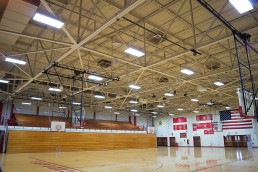
JD Sound and Video Provides Community Quality Sound for Two New Jersey High Schools
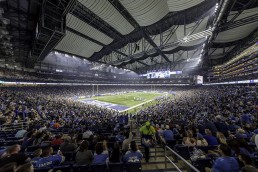
Detroit Lions Roar at Ford Field with Meyer Sound's LEO Family
A 178-loudspeaker Meyer Sound LEO Family linear reinforcement system is the keystone audio component of a $100-million off-season renovation of Ford Field, the 65,000-seat enclosed stadium that hosts home games for the National Football League's Detroit Lions. The new audio system designed and built in Berkeley, California will provide exceptionally high speech intelligibility with uniform coverage throughout the seating bowl while also delivering the broadband power and dynamic range required to energise fans in the stands and players on the field. The Lions' renovation project marks the first permanent installation of a LEO Family system in any NFL stadium.
"I think our fans will be blown away by the sound this season," predicts Todd Argust, Vice President of operations for the Detroit Lions. "There is no place in the venue where you won't be able to clearly hear all the play announcements and calls by the officials which unfortunately was not the case with our old system. It also will be a valuable tool for getting our fans pumped up at critical points in the game, so ultimately it will help the Lions perform at their best here at Ford Field."
Using the same loudspeaker components as touring concert bands such as Metallica, the LEO Family system possesses the wide dynamic range required to deliver clean, uncompressed and undistorted sound even during bursts of peak ambient crowd noise. Because the voice characteristics remain clear and natural, intelligibility remains high without sounding annoyingly loud. Extended dynamic range also enables greater flexibility in programming music and effects for climactic moments as sound doesn't have to be heavily compressed to prevent system overload. Detroit Lions President Rod Wood sums up the sonic overhaul. "We really needed to get the sound quality up to where the fans could clearly hear the calls from the field and enjoy the music during breaks. In that respect, I think we've gone from near the bottom of the NFL right to the top."
Todd Argust is pleased that the optimum audio solution for Ford Field came from a company that is American-owned and still manufactures all products in the USA. "Having a system made in America was important symbolically," he says, "but it was even more important logistically. Because of our accelerated construction schedule, we needed a vendor that could respond quickly and have the system ready on time with zero performance compromises. We found that with Meyer Sound."
The main bowl system is anchored by a distributed ring of eight LEO Family line arrays, with a total of exactly 100 LEO-M and LYON-M self-powered, full-range loudspeakers covering the majority of seating areas. Augmenting the main arrays are scoreboard delay arrays and corner fill arrays with an additional total of 36 LEOPARD compact linear loudspeakers. Bass power is propelled through 24 1100-LFC low-frequency control units, here deployed as cardioid arrays to provide directional control and maintain tight response for convincing impact both in the bowl and — when a special preset is selected — also on the playing field. A separately addressable system of 18 LEOPARD loudspeakers blankets the playing field with high-level sound. The entire system is controlled by eleven Galileo GALAXY networked processors and monitored via Meyer Sound's RMS networked monitoring system.
Outside the main seating bowl of the stadium, in the acoustically problematic atriums at gates A and G, audio is delivered by Meyer Sound CAL column array loudspeakers with advanced beam steering technology. Bass is supplied by two 500-HP subwoofers. The CAL systems provide exceptional intelligibility in these challenging areas.
Another key member of the Ford Field AV renovation team was Josh Beaudoin, a principal at the Dallas-based consulting firm of Wrightson, Johnson, Haddon & Williams (WJHW), a worldwide leader in AV design for sports facilities. "I basically served as the owner's representative," says Josh, "helping with product decisions, monitoring construction, keeping everything on schedule, and ensuring overall value. In regard to audio systems, I helped the Lions evaluate quality, USA sourcing, ability to meet the accelerated schedule, and the relationship they were looking for over the life of the system. Meyer Sound checked more of these boxes than any other supplier."
Also sharing credit for the new audio system, alongside WJHW and Meyer Sound's Design Services Department, is system integrator Parsons Electric of Minneapolis. "Over the years Parsons has proven to be a very good partner for many other professional sports teams, and we are always pleased to work with them," states WJHW's Josh. "We can be confident the job will be done right the first time."
Parsons also installed most other components of the complete AV renovation, including new USA-made LED video boards by Daktronics. Construction of Ford Field was completed in 2002, and in addition to NFL games the venue also hosts concerts, motor sports, collegiate sports and community events such as graduations.
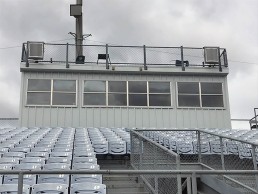
Danley Weatherproof OS-80 Speakers and Multi-Channel Amps Return Crisp County High School Football to Grandeur
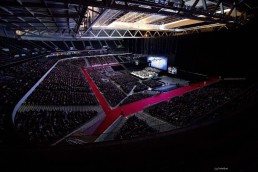
L-ISA System Immerses Spectators in Natural Sound for Verdi’s Requiem
On July 12th at Lille’s Stade Pierre-Mauroy, L-Acoustics deployed an L-ISA Live hyperrealistic sound system for the singular performance of Verdi’s Requiem by the Orchestre National de Lille (ONL) and the Choeur Régional Hauts-de-France. The 30,000-capacity stadium, normally home to Lille’s football club was a spectacular yet fitting venue for a performance intended to bring classical music to the widest possible audience.
Founded by Jean-Claude Casadesus and the Nord-Pas de Calais region (now the Hauts-de-France region) in 1976, the ONL has resolutely focused on ‘bringing music wherever it will be heard’ ever since, performing both in Lille as well as in over 30 countries around the world. After spending 40 years at the head of the ONL, conductor Jean-Claude Casadesus continues to lead three series each season while also forging a stellar international career.
For this special stadium performance of Verdi’s masterpiece, François Bou, managing director of the ONL consulted L-Acoustics founder Christian Heil. The L-Acoustics team custom-designed an L-ISA immersive sound system to face the hurdle of delivering the power of a world-renowned orchestra to the entire audience, all while preserving the emotional and artistic intensity of the performance. Central to the system’s design is the desire to deliver ‘what you see is what you hear’ to each spectator at the Stade Pierre-Mauroy, effectively putting the audience into the sweet spot occupied traditionally by Jean-Claude Casadesus himself.
“Our challenge was to put on a classical music performance for 13,000 people in a football stadium but make it sound like an acoustical performance in an intimate venue”, explains ONL Front of House engineer François Gabert, who worked with Frédéric Blanc-Garin, sound engineer for the project. “When L-Acoustics told us that they had a product that could dramatically improve the experience for the audience, Fred and I were intrigued.”
L-ISA, which stands for Immersive Sound Art, is a breakthrough in immersive audio technology combining L-Acoustics’ industry-leading sound design and world-class loudspeaker systems with sophisticated processing tools to create a hyperrealistic soundscape at live shows.
Sherif El Barbari, L-ISA Head of Applications, studied the Stade Pierre Mauroy closely, modelling it in L-Acoustics’ Soundvision software before proposing an L-ISA system comprising seven hangs of nine Kara stretched across the stage, to deliver hyper-localised sound. A mirror system of seven ground stacks of two Kiva II each across the stage lip provided front fill. Two hangs of eight K2 served as out fill and two central hangs of four KS28 subwoofers provided low end. The entire system was driven by LA8 and LA12X amplified controllers. An L-ISA Controller provided an advanced object-based multichannel environment for the event. “We found the L-ISA controller very simple to use,” François says. “The interface is intuitive and very functional. Once the sources are placed in their space, the mixing is fairly conventional and any adjustments within the software during the concert were quick and easy.”
It was, however, the clarity and natural feel of the sound which most impressed François, “The greatest compliment that I could receive would be for someone to ask me after a concert if there was any sound reinforcement,” François continues. “Given the results we obtained at the Stade, I’m convinced that in a more traditional environment, the audience wouldn’t know that there was any sound reinforcement at all.”
“We are proud to be working with Jean-Claude Casadesus and the Orchestre National de Lille again,” enthuses Christian Heil, founder and president of L-Acoustics. “We are excited to have deployed our newest creation to help them offer an authentic and immersive concert experience.” Francois says that, having experienced L-ISA, going back to using any other system would be “heartbreaking”. “It is an indispensable tool for classical music, opera and large ensembles,” he says. “I look forward to working with L-ISA again and deepening this experience. L-ISA has a bright future ahead.”
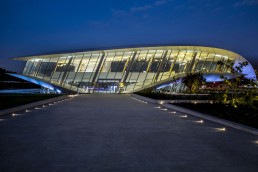
Etihad Museum: When Light Becomes Iconic
Dubai’s Etihad Museum, inaugurated in March 2017, is totally dedicated to the promotion of history, culture and artistic heritage of the United Arab Emirates. Each detail of the structure, a magnificent pavilion of 25.000 sq-metres was studied in order to transmit values which, in 1971, led to the union of seven Emirates (Abu Dhabi, Ajman, Dubai, Fujaira, Ras al-Khaima, Sharja e Umm al-Qaywayn) in one nation. The intention of the building’s futuristic design, through the symbology of the elements used, is to offer a visual representation of UAE’s history.
The technical-lighting project was realised by Umaya Lighting Studio based in Dubai, one of the most innovative emerging lighting studios in the Middle East market. Umaya used B Light’s know-how for the outdoor lighting of this majestic project. The aim of the project is to make the Museum’s stunning architecture stand out and to emphasise the uniqueness of its structure. The wavy shape of the building is designed to remind us of the shape of the unification Treaty of the UAE whilst the seven tapering columns symbolise the pens used by the Founding Fathers of UAE, the seven sheiks who signed the Union Agreement in 1971. Each element in the planning of the Museum represents fundamental symbols and meanings for the UAE, highlighted by a skilful use of light.
Minimal design, refined finishes and high performance of B Light’s luminaires perfectly embrace Umaya’s wish to create lighting schemes which not only complete the architecture of the Etihad Museum from the functional point of view, but above all, enhances it aesthetically.
Agena is a compact in ground, walkover luminaire and was chosen to illuminate the wide entrance avenue of the Museum and its pedestrian paths. The electronic control of operating temperature through a thermal sensor makes it particularly suitable for challenging outdoor environments, which can reach high temperatures and have a high temperature excursion. This grazing step light blends perfectly in the architecture, illuminating walkways with elegant light effects. Agena is a luminaire with IP67 protection grade, has reduced dimensions (only 99 mm diameter) and is available in mono or bi-emission LED sources and 2700K, 3000K and 4000K colour temperatures.
In the outdoor visitors’ transit area, Button DO was chosen to emphasise the structure’s soft lines and to give an almost futuristic atmosphere to the great pavilion. Ideal for creating luminous paths in modern contexts, Button DO is a LED recessed in ground luminaire and belongs to B Light’s Drive Over family. The RGB version was chosen for the Etihad Museum, to create greater effects through the use of different light colours which generate new and scenic atmospheres.
Button DO family satisfies the different needs of the architects and is perfect for outdoors, is available in three sizes, with diameters of 55mm, 95mm or 193mm. Button DO has a drive over load of 2.5 tonnes and a totally glare-free surface which makes it particularly suitable for pedestrian crossings, parks and vehicle suitable areas such as squares and public spaces.
B Light’s innovative spirit and professionalism together with its high quality luminaires have made lighting an iconic element, a symbol of modernity and change. The Etihad Museum lighting project has succeeded in creating a new and fascinating scenario, highlighting the architectural elements’ beauty.
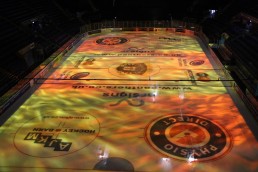
OneBigStar Adds Sparkle to National Ice Centre with CHAUVET Professional
Nottingham’s Olympic Ice Centre is one of the UK’s largest ice rinks. Home to the Nottingham Panthers Ice Hockey team and the GB Short Track Speed Skating Squad, the arena plays an important role on both the local and national stage. In 2015, OneBigStar completed a lighting overhaul in the facility’s main arena using CHAUVET Professional Rogue R2 Spots and COLORdash Par-Hex 12 units. Recently, OneBigStar was brought back to lend more sparkle to the venue’s lighting rig by adding eight Maverick MK2 Spot fixtures also from CHAUVET Professional.
With ever increasing numbers attending Nottingham Panthers games, the venue desired a selection of powerful and intensive spots to add to the already inspiring colour palette of the Rogue and COLORdash fixtures. The solution was to position eight Maverick MK2 Spots from trussing suspended above the rink itself, thus complementing the existing and well-utilised CHAUVET Professional setup.
OneBigStar’s Operations Director Steve Yeardsley said, “Our long-term relationship with Chauvet is based on sharing the same values when it comes to production quality and value-for-money. We suggested the Maverick MK2 Spots because they’ve performed so well in our hire inventory and we knew they would integrate perfectly with the existing lighting in the main arena and have enough power to cut through the high lux levels required for this sport.”
The resident ice hockey team Nottingham Panthers was so impressed with the latest lighting additions that they ordered custom gobos to project their logo onto the ice. With their two 6-position rotating slot and lock gobo wheels, a 7-position + white color wheel, variable frost, 3-facet prism and wide zoom range, the Maverick Spot fixtures are able to create a versatile selection of looks to keep the crowd entertained.
Thanks to the Maverick’s LED engine, the fixtures also correspond with the venue’s green ethos and ensure that running and maintenance costs are kept down to a minimum. As a result, the fixtures provide the perfect addition to the all CHAUVET Professional rig.